Good morning, and welcome to Vittles! Today’s essay is a long read by Joe Zadeh about the persistent fears in the West surrounding the reheating of rice. It’s the first piece that we’re publishing online from our second print issue, on the theme of ‘Bad Food’. The magazine contains lots of other deeply researched and engaging pieces about contemporary food culture – specifically the messy, unglamorous and chaotic aspects of it. You should buy a copy.
Speaking of things to buy, we have added five extra tickets for our sold-out event this Wednesday at Oxford House with Ixta Belfrage, Melek Erdal and Rukmini Iyer. These are sure to sell out so act quickly!
‘What are you talking about?’ Dad asked me, a look of incredulity on his face. ‘I’ve been reheating rice all my life.’ It was a warm Saturday evening. We were sitting at the dining table in his home in Gateshead, drinking beer and eating from a plastic tub of M&S bell peppers stuffed with ricotta. I had just told him that I was researching a story about the dangers of reheated rice – more specifically, the illness that has come to be dubbed ‘fried rice syndrome’ or ‘reheated rice syndrome’ across the Western world. Search those terms on most platforms, and you’ll find hugely popular posts issuing dire warnings about the condition. ‘Hospital workers say it’s some of the worst cases of food poisoning they’ve ever seen. And it can lead to death,’ reported food52, in a TikTok post with more than 431,000 likes at the time of writing.
Dad didn’t take this news well. He got up from the table, marched to the fridge, took out a glass container and started pointing at it animatedly. ‘What is this?’ he asked, before taking a second identical container from the fridge and waving it around. ‘And this, what is this?’
‘Rice,’ I said.
‘Exactly,’ he said defiantly. ‘And I will reheat some tomorrow, and the next day and the next day.’
Like many Iranians, my dad takes rice very seriously. When we cook polow together, he says things like ‘Careful!’, ‘Be gentle!’ and ‘You need to keep an eye on your rice, Mister!’ as if we were bathing a newborn baby. Despite having been divorced for twenty-nine years, his ex-wife – who is British and, incidentally, my mother – still cooks perfect Iranian-style rice due to how ardently she was drilled on his methods. When asked if he owns a rice cooker, he takes great pleasure in saying: ‘You’re looking at it.’
According to the food52 video, you should eat rice within a day of cooking it. After that window has passed, they advised viewers to ‘just throw it away. Just throw away your leftover rice, friends, it’s really not worth it.’ They’re not the only ones making this claim. On LADBible, a headline read: ‘“Fried rice syndrome” is real and can kill you, doctor says’. A post on the ‘r/TrueOffMyChest’ subreddit titled ‘I almost died from fried rice syndrome’ tallied over 500 replies. If you look at the comments on these posts, you’ll find lots of astonished people – frequently of Middle Eastern, Asian, African or South American descent – saying something to the same effect as Dad: I’ve reheated rice all my life, and I’ve never got ill. How can this be true?
This stark division in rice-reheating attitudes is almost comically widespread. While appearing on The Graham Norton Show in 2023, the British and Malaysian-Chinese stand-up Phil Wang joked that the main difference between white people and Chinese people is that the former are ‘absolutely terrified of reheating rice. For white people, rice has one chance to be food. And if there’s any left over after the meal, it just becomes poisonous straight away.’ Out of curiosity, I texted seven white friends to ask if they were brought up to believe that reheating rice was dangerous. All seven said yes.
Like my dear father, and Phil Wang, I have also been reheating rice all my life. As I write this, there is one container of rice in my fridge, and three in my freezer. Cooked white grains linger in my kitchen like coins in trouser pockets: forgotten for long periods, then rediscovered with joy. And I have never, to my knowledge, got sick from them.
As I plied Dad with more and more internet evidence of rice-related anxiety, he fell silent. We looked out the window into the back garden. The closing notes of the day’s sun played out on the grass. ‘China, India, Pakistan, Iran,’ he said, quietly. ‘Russia, Greece, Turkey, Japan,’ he continued, becoming louder and bolder. ‘Malaysia!’ I realised he was listing countries that ate rice. ‘There would be a lot less people in Iran if reheated rice was deadly. There are communities in Iran that are so poor, they eat rice for breakfast, lunch and dinner. They don’t have a fridge or a chiller. How can you explain that, Joseph? How?’
‘Like many Iranians, my dad takes rice very seriously. When we cook polow together, he says things like “Careful!”, “Be gentle!” and “You need to keep an eye on your rice, Mister!” as if we were bathing a newborn baby.’ … When asked if he owns a rice cooker, he takes great pleasure in saying: “You’re looking at it.”’
Of course, this wasn’t the first conversation I’d had about the dreaded syndrome. But I’d always thought that it was only a risk if you didn’t cook your rice properly in the first place, and so I’d dismissed it, with an air of superiority, as something not worth worrying about. But as the odd cultural divide became more apparent, my curiosity was piqued. How can so many people be terrified of reheated rice, while others live their lives in fluffy ignorance? Are the warnings overblown or have I – and most of the non-Western world – been dancing with death all these years? Is there something in the way that different cultures cook or store rice that protects against these toxic side-effects? And where did the very specific – and rather problematic – name fried rice syndrome come from? I felt compelled to find some answers.
Reheated rice fears have circulated for decades, but many of the recent posts on TikTok and other platforms seemed to have been triggered by the recirculation of a story about a young man in Belgium supposedly dying from fried rice syndrome. Despite regularly inspiring breaking-news-style posts – ‘Man, 20, found dead in his bed by devastated parents after he reheated common pasta dish’ reads a headline in the Sun from 2023 – the incident actually took place in 2008. As that headline reveals, the man hadn’t actually eaten rice, but leftover spaghetti (resulting in some online publications running confusing headlines like ‘20 Year Old Dies of “Fried Rice Syndrome” After Eating Leftover Pasta’). I texted the same seven friends from earlier to ask if they’d ever received warnings about reheating pasta as they had for rice. All seven said no.
According to a 2011 report about the case in the Journal of Clinical Microbiology, the man became sick after eating spaghetti leftovers that had been cooked five days earlier and then left in the kitchen at room temperature. Within 30 minutes of eating, he experienced a headache, abdominal pains and vomiting. He was found dead the following morning. The autopsy revealed the presence of the bacterium Bacillus cereus (B cereus), which was also detected in samples of the pasta dish that were analysed. The paper also references four other fatal cases attributed to B cereus food poisoning: two more associated with pasta, one with fried rice and one with noodles.
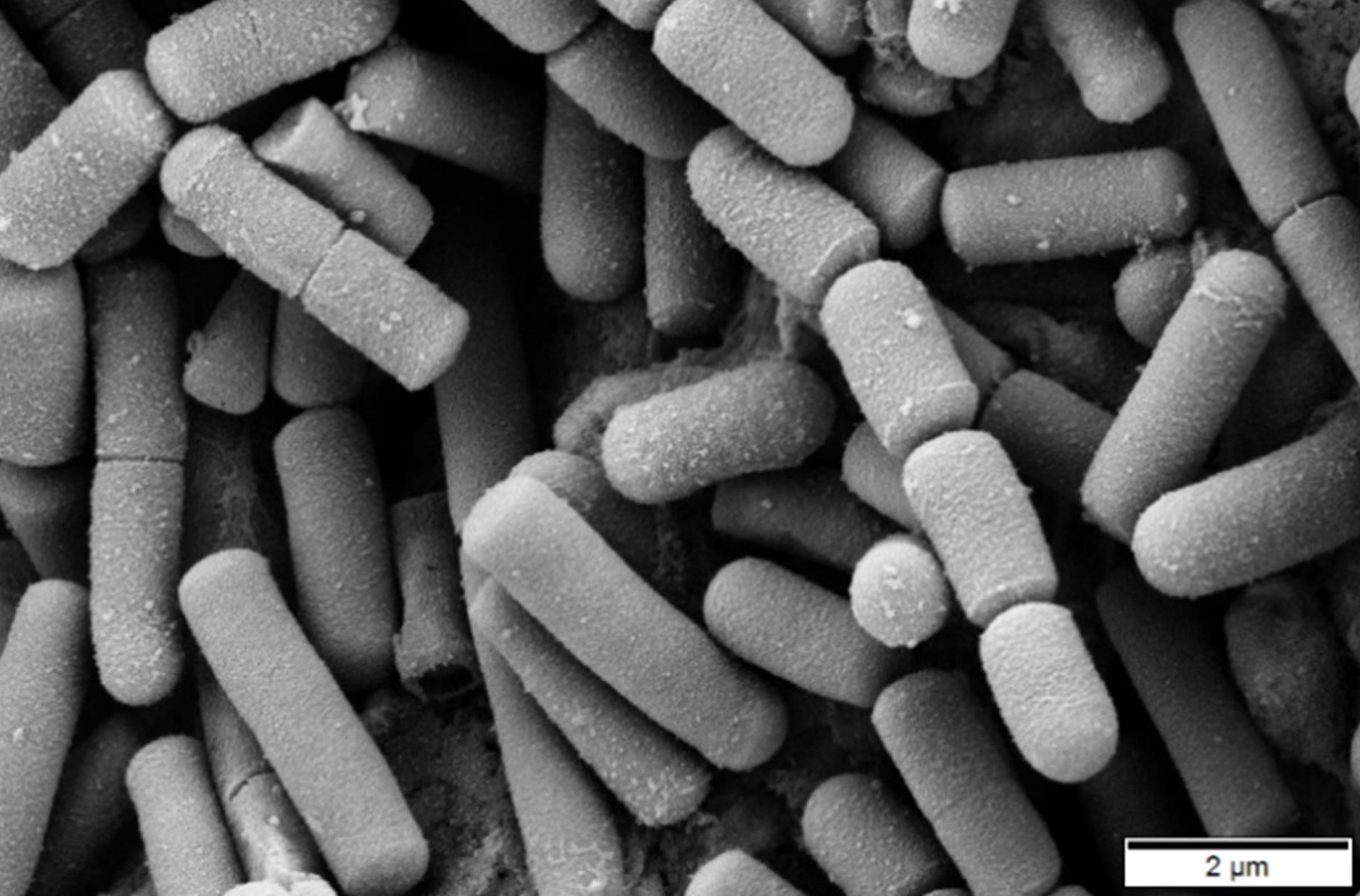
‘B cereus is the microorganism culprit behind the so-called fried rice syndrome,’ confirmed Enzo Palombo, a microbiologist at Swinburne University of Technology in Melbourne, whom I spoke to over Zoom. The name comes from Latin: ‘Bacillus’ means ‘little staff’ or ‘little wand’, while ‘cereus’ means ‘wax-like’. In your mind, picture a microscopic sausage that glistens and wiggles and can multiply into endless sausage links, and you’re not far off. B cereus is a close relative of the notorious Bacillus anthracis, responsible for anthrax. ‘Most of the time, it’s a benign presence,’ said Palombo. ‘But when the conditions are right, it has a few tricks up its sleeve that allow it to act as a food pathogen.’
An electron microscope image of B cereus. Credit: Mogana Das Murtey and Patchamuthu Ramasamy
Most food-borne bacteria are destroyed by heat during cooking, Palombo informed me. But B cereus is one of a few species capable of forming spores. ‘These spores are incredibly resilient: they can last for hundreds of years, and can resist acid, heat and other environmental conditions. They think they might even be able to survive in outer space.’ No matter how hot your stove, the spores of B cereus can survive in your food in a dormant state, waiting for an opportune moment to return, like a cryogenically frozen billionaire.
How do dormant spores turn into a nasty bout of food poisoning? According to Palombo, the ‘danger zone’ in microbiology is between 5°C (the temperature of the fridge) and 65°C (the temperature that food should rise above when cooked). ‘So, imagine you’ve cooked your rice or pasta and there is B cereus in there. You’ve killed the bacteria through cooking but the spores have survived. If you chill it right away, then you’re fine, if you reheat it properly then you’re fine,’ he told me. But if you leave it at room temperature for too long and there’s sufficient moisture, then the spores spring back to life and begin feeding on the starch while secreting toxins. ‘Bingo,’ Palombo continued, ‘these toxins are what will muck up your guts and cause you to have diarrhoea, vomiting or even more severe consequences.’
It’s worth emphasising that the Belgian case was rare and extreme – B cereus infection is usually mild, and hospitalisations are infrequent. The global mortality rate for cases associated with food poisoning is just 0.05%, and deaths generally occur in those predisposed to developing more severe illness (young people, old people, pregnant people and people with compromised immune systems).
Much of what Palombo and I talked about – danger zones and safe storage – felt intuitive. I don’t leave food out for hours. I divide big batches of cooked rice into smaller boxes so that it cools quicker. I always keep everything in either the fridge or freezer, and always thoroughly reheat. But I still felt deeply puzzled about some things. If B cereus is a risk with any starchy food, then why aren’t we as fearful of reheated pasta as rice? And if reheating rice does carry this potential to cause illness, why is the perception of risk so inconsistent across cultures?
‘It’s something I’ve always known about, but that just comes from a catering background,’ said Farokh Talati – Head Chef at St John Bread and Wine in London and author of the cookbook Parsi: From Persia to Bombay – when I asked him about rice anxiety. ‘Rice is the cornerstone of my cooking,’ he told me. ‘In my own home life, I’m loose. I’ll cook my rice, and put the leftovers in the fridge once it’s cooled down. When I heat it back up, I’m not there probing it, I just put a bit of coconut oil in a pan, fry the living crap out of it, and then eat it.’ But when it comes to his professional life, Talati has to be much more cautious, because of strict health and safety regulations. ‘But it’s not so much around just rice itself – it’s around everything we touch from raw foods to raw vegetables.’
I asked Talati if he had any theories about why rice might have acquired such a unique fear factor? He responded, ‘I can’t help but think: Is there something deeper going on? Is it something about how the West perceives the East? Is there something really ingrained in us here that sees rice as a scary thing, an unknown thing? What is this food that’s coming over? It’s not part of our cuisine – is it making us sick?’
Throughout history, rice has certainly been known to trigger animosity among Europeans. Friedrich Nietzsche wrote that eating rice caused one to become addicted to opium. The notable French gastronomist Jean Anthelme Brillat-Savarin – famous for his aphorism, ‘Tell me what you eat, and I will tell you what you are’ – thought eating rice made you soft and cowardly. Meanwhile, in his 1883 pamphlet, How, When and What to Eat: A Guide to Colonial Diet, the Australian doctor and novelist Stephen Mannington Caffyn cautioned that ‘We might expect to find rice-eaters everywhere a wretched, impotent, and effeminate race, and such is the case.’
It is certainly odd that food poisoning caused by B cereus has become so widely known as fried rice syndrome – a term used not just on social media and in news coverage, but even in peer-reviewed academic publications. I found it difficult to trace the exact historical origin of the name. The first complete scientific proof of B cereus as a microorganism capable of causing food-borne disease came in 1955, in Norway, and had nothing to do with rice – it was traced to a vanilla sauce prepared from corn starch that had been linked to a wave of illnesses in care homes and hospitals in Oslo.
‘Throughout history, rice has certainly been known to trigger animosity among Europeans. Friedrich Nietzsche wrote that eating rice caused one to become addicted to opium. The notable French gastronomist Jean Anthelme Brillat-Savarin … thought eating rice made you soft and cowardly.’
One of the earliest associations between B cereus and fried rice that I could track down was a 1973 article in the British Medical Journal that reported on eighteen outbreaks of food poisoning in the UK dating back to 1971, many of which had been traced to Chinese restaurants and takeaways where boiled rice was being stored at room temperature for long periods of time before being fried. But the phrase ‘fried rice syndrome’ was nowhere to be seen.
Around the time that this article was published, a completely separate food scandal associated with Chinese food had erupted, with misplaced fears about MSG stoked in the US by anti-Chinese racism and dodgy science. In a 1968 letter to the New England Journal of Medicine, Dr Ho Man Kwok wrote: ‘For several years since I have been in this country, I have experienced a strange syndrome whenever I have eaten out in a Chinese restaurant,’ before going on to describe symptoms that included numbness at the back of the neck, general weakness and palpitations. While Kwok posited MSG as only one possible cause among many, it was latched onto by scientists and the media. In 1969, experiments – now found to have been crucially flawed – appeared to confirm ‘Chinese Restaurant syndrome’ as a legitimate medical condition caused by MSG, one that could make you sterile and cause brain damage in babies. The subsequent public health scare lasted for decades.
It doesn’t feel like a stretch to posit that fried rice syndrome may have been coined during this racially charged moment in culinary history, in which food safety fears were being rampantly fuelled by a dislike and distrust of immigrant culture. ‘I think there is a bit of a stigma in how it has come to be named fried rice syndrome,’ said Palombo. ‘It seems to suggest that Asian food is the problem, but it’s not. Any starchy food should be considered a contamination risk.’
I was starting to understand how reheated rice, specifically, had become such a uniquely panic-inducing food for white people. But if beneath the noise there was still a very legitimate danger of food poisoning, why was this risk being so little discussed, underplayed or even ignored in other cultures? In essence: Why was my dad angry about this?
‘I had no idea this was a massive thing until I read your email,’ said Mandy Yin, founder of the Malaysian restaurant Sambal Shiok in North London, after I sent her links to the TikTok rice panic. At the same time, it didn’t surprise her. ‘Years ago, I was with my husband’s family – half Scottish, half Welsh – and we ordered a massive Chinese takeaway. Immediately after finishing, everyone refused to keep the rice. I was like: There’s so much food being wasted!’
Yin told me that at Malaysian street food stalls and markets, the rice for nasi lemak is often cooked in the morning, wrapped in banana leaf parcels along with sambal, peanuts, anchovies, and egg, and then sold throughout the day. In fact, in many cuisines, there is an abundance of recipes in which leftover rice is actively preferred over freshly cooked.
A beloved dish in Tamil cuisine called pazhaya sadam literally translates as ‘old rice’. Food writer and novelist Chitrita Banerji told me of a similar recipe in rural Bengal called panta bhat: ‘During the summer, people will pour water over leftover rice and just leave it – not in the fridge, but outside. The hot temperature outdoors will ferment it to create this kind of milky liquid. You eat it with raw onions and maybe some raw green chillies. It has a sharp, slightly funky taste. And that is considered very healthy and cooling for your body.’ I find it hard to believe that these recipes, widely circulated and often passed down through generations, would have survived if they were inherently poisonous.
Comparing the rates of B cereus poisoning between different countries didn’t help to clear things up much. At first glance, when you compare a Western nation like the US with China, the world’s leading consumer of rice, the data are striking. According to a US Centers for Disease Control and Prevention estimate from nearly twenty years ago, around 63,400 B cereus episodes occur annually in the US, whereas a ten-year survey of infections in China (from 2010 to 2020) logged only 7,892 cases in total. That suggests that far more people are getting sick from fried rice syndrome in the US than in China (particularly when the population discrepancy between the two is factored in). However, the methods used in these studies are so different as to basically preclude comparison – whereas the US figure is an estimate to account for likely under-reporting of mild cases, the Chinese survey focused explicitly on confirmed cases. Still, I couldn’t help but wonder: Might there be something in how different cultures are preparing and cooking rice that may somehow be preventing B cereus infections?
Searching for answers, I came across the work of Paul W Sherman, a biologist at Cornell University who spent a large chunk of his academic life studying the social life of naked mole rats. In the late 1990s, he collaborated with a graduate student called Jennifer Billing to investigate a uniquely culinary question: Why did humans start using spices in food? And why, despite a now-established global spice trade, is their use far more important in some cuisines rather than in others? Could it be, they posited, that people in hotter countries use more spices because spices kill bacteria that grow faster in warmer climates, keeping their food safer to eat?
Sherman and Billings surveyed 107 ‘traditional’ cookbooks from thirty-six countries globally, creating a database of nearly 7,000 recipes, across which forty-two spices were used. Their analysis found that countries with higher average temperatures appeared to add more spices to their recipes relative to countries with lower average temperatures. They also discovered that higher average temperatures (where food-borne pathogens would be more prolific) were associated with the use of spices with stronger antimicrobial effects. They concluded that beneath the veneer of cultural differences in taste preference, culinary spice use might also have an evolutionary premise.
It’s certainly rare that I cook plain rice without any spices added at all. I’m usually riffing on one Iranian recipe or another, which almost always involve turmeric, sometimes saffron and occasionally clove, cinnamon, ginger or cumin. Likewise, when Talati told me how he cooked what he described as ‘plain rice’, it still involved ‘boiling it with spices like star anise, cinnamon, clove and cardamom’. Similarly, Yin said that, when cooking rice, ‘I do generally always use garlic and white pepper, oyster sauce and soy sauce, and some sort of chilli sauce or sambal feature regularly too.’
Star anise, clove, cinnamon, turmeric, ginger and garlic have all, in peer-reviewed scientific papers, shown antimicrobial effects that inhibit B cereus in some shape or form. And they aren’t the only ones: similar studies are out there for the antimicrobial effects of ingredients including rosemary, black pepper, coriander, oregano, thyme, galangal, onion, capsicum and pomegranate (a popular ingredient in Iranian cooking). Even the banana leaf, mentioned by Yin as packaging for parcels of rice, displays antimicrobial properties, although I couldn’t find any studies of its effect on B cereus specifically.
‘I’d become less wary of rice in particular, and more wary of room temperature itself. Will I now think twice about the tempting arancini and frittatina di pasta that sit out on cafe counters in Italy next time I’m on holiday? Yes. Will I try at least one anyway because risk excites me? Yes.’
Could the use of certain spices in various cultural methods of rice preparation be preventing the proliferation of fried rice syndrome? I put my spice thesis to Palombo. He agreed that traditional medicinal plants have a lot of antibacterial compounds. ‘Before modern methods of food preservation, people would rely on stuff like this,’ he said. ‘Salt is also an inhibitor of microbial growth, so if you’re adding salt to your rice when you cook it, that might have an effect too.’ I started to think of all the Iranian recipes I cook at home, which my dad taught me and his mother taught him, as not just guides for good meals, but as repositories of traditional knowledge, from a time before fridges and microwaves, in which many of the ingredients had been combined in particular ways for a myriad of now-forgotten-yet-essential reasons. And like a child reciting a prayer, I was now repeating these actions, without ever truly understanding why.
The spice theory is interesting, but it is just a theory. Since Billing and Sherman published their work in the nineties, some of their findings have been challenged. A 2021 study in the journal Nature Human Behaviour painted a more complicated picture, which suggested that spice use is better predicted by socioeconomic factors like poverty and poor health outcomes than by temperature or infection risk. And when I asked Banerji about the use of spices to cook rice in Bengal, she was quick to burst my bubble: ‘In Bengal, the day-to-day rice is cooked plain, without any added spices or even salt. The use of cinnamon, cardamom, cloves, bay leaves, or even saffron is seen for more “fancy” recipes, like pilafs and biryanis. It is not daily food.’
How then to think about fried rice syndrome after everything I’d learned? It was certainly more complicated than a simple public health warning. The name itself is useless and misleading, and probably originates from a particularly racist moment in culinary history. Yes, improper storage and reheating of your rice can make you sick, but so can the same treatment of any starchy food. I’d become less wary of rice in particular, and more wary of room temperature itself. Will I now think twice about the tempting arancini and frittatina di pasta that sit out on cafe counters in Italy next time I’m on holiday? Yes. Will I try at least one anyway because risk excites me? Yes.
I walked away from this intensive phase of research with a very odd picture of the world, one divided into two tribes: the reheaters and the dumpers. Box by box, the faithful reheaters filled their fridges and freezers with cooked rice, building for the future, like beavers constructing a mighty dam. Meanwhile the other tribe, the fearful dumpers, poured their leftovers into a never-ending waterfall of perfectly edible white grains that showered down into a black abyss, deep into the underworld.
That evening, once Dad had calmed down, we did what we do best: we cooked rice. He’d been to the Kurdish shop on Sunderland Road to get fresh dill and fava beans so that we could make baghali polow, an Iranian rice dish that people have been cooking since at least since the Safavid Dynasty. We washed basmati ritualistically five times and then parboiled it. Steam bellowed from a big pot, dill leaves were separated from stalks, fava beans were rinsed. We drained and washed the parboiled rice again, then mixed it with the dill and beans. We added oil, butter and turmeric into the pot, carefully placed and sizzled some thinly sliced potato and delicately spooned the rice back in. Dad said, ‘Careful!’ a lot. Melted saffron was drizzled over, and then the lid went back on for an hour.
We ate the baghali polow together and watched the football, and Dad told me all his rice memories: about being taught to cook by his mum; about living in a Caspian seaside town in Mazandaran and smelling the rice fields in the summer (‘a lovely sweet smell’); about how in Iran, your Sunday best clothes that you’d wear for special occasions are called ‘lebas polo khori’ – ‘rice-eating clothes’. When the game finished and I got up to leave, he presented me with three glass containers of leftover baghali polow, which I took home, and which I would ultimately reheat, the next day, and the next day and the next.
Joe Zadeh is a British-Iranian writer based in the north east of England. He writes fast-paced and wide-ranging nonfiction about the things that underpin our everyday lives, but often escape scrutiny. His longform essays have questioned the way we think about time, examined the cultural history of charisma, and shone a light on the consequences of the modern world's addiction to concrete. Previous bylines include the Guardian, VICE, and Rolling Stone. He currently works as a contributing writer for the US publication Noema.
Ibrahim Rayintakath is an illustrator and art director based in his coastal hometown of Ponnani, India. His editorial work, which explores themes of culture, politics and mental health, has appeared in various outlets like the New Yorker, the New York Times and NBC.
Fascinating article! I had a conversation with friends over dinner last week. We are all medical and all very wary of reheating rice, remembering our microbiology lectures in medical school. However, I will happily eat arancini as you described and I have never thought twice about reheating pasta. I’m now examining my prejudices!




Fascinating article! I had a conversation with friends over dinner last week. We are all medical and all very wary of reheating rice, remembering our microbiology lectures in medical school. However, I will happily eat arancini as you described and I have never thought twice about reheating pasta. I’m now examining my prejudices!
Surely... you can't b cereus
(Sorry, I've wanted to write that for SO long)