

Kristang Kari Debal (Curry Devil)
Serena Coady attempts to reimagine this Portuguese–Malaysian classic as a vegetarian dish without getting disowned by her family
Good morning, and welcome to Vittles! Today, Serena Coady shares a recipe for a vegetarian kari debal, a fragrantly aromatic – and fiery – curry enlivened with a swirl of vinegar that is associated with Malaysia’s Kristang people.
Issue 2 of our print magazine, on the theme of Bad Food, is still available. You can order a copy here. Our event next week with Ixta Belfrage, Rukmini Iyer and Melek Erdal is nearly sold out, so if you’d like to attend we’d recommend buying tickets ASAP.
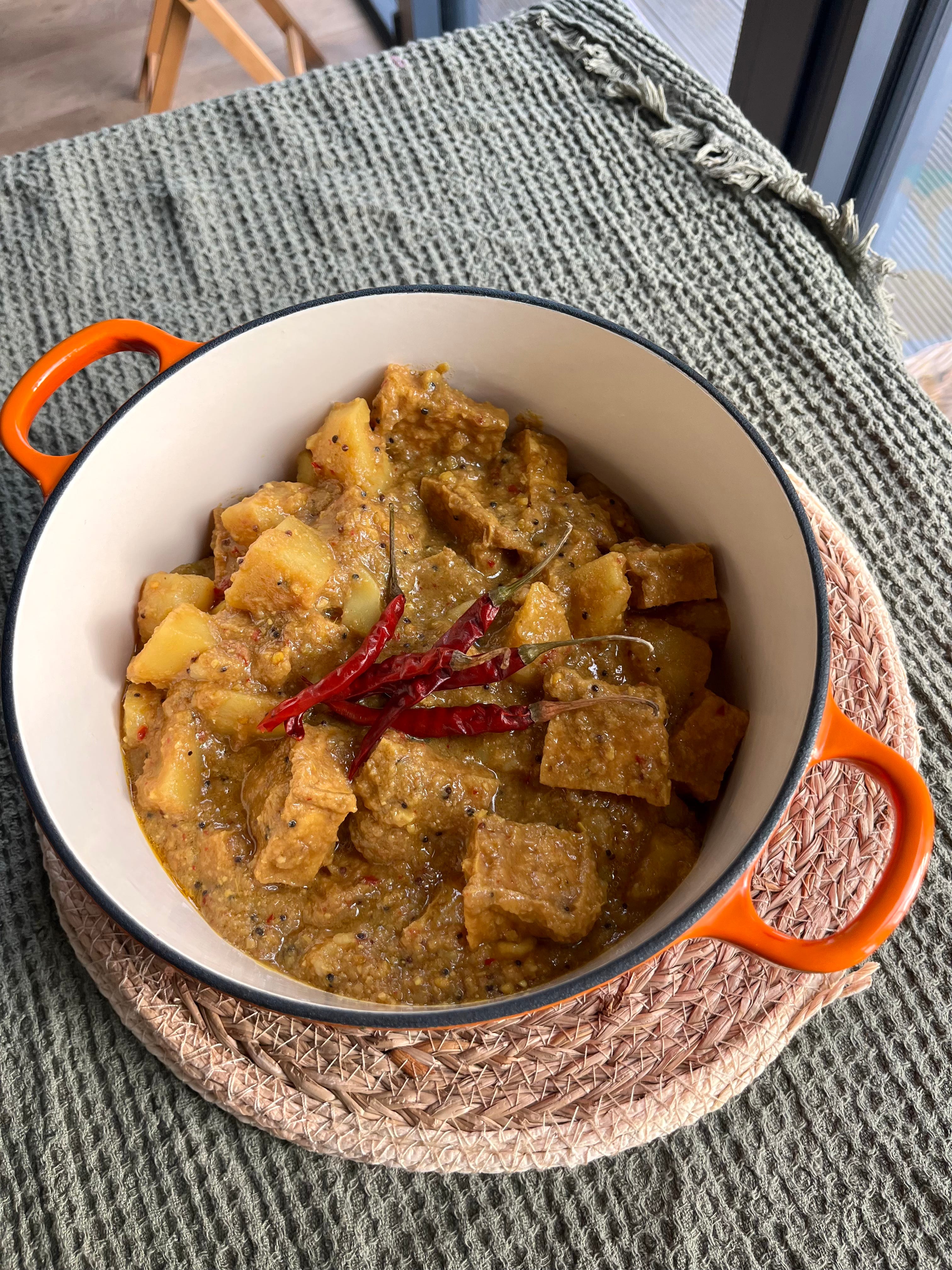
Every family has its own unique language, a collection of inside jokes and nicknames that can immediately transport you to memories formed long ago. In my family, one of our hidden languages has a name – Kristang.
The language of the Kristang people, who are of Portuguese–Malaysian descent, is classified as ‘severely endangered’ by UNESCO, with only a few hundred speakers left worldwide. I was born in Malaysia to a Kristang mother, and an Australian father, and moved to Australia as a child. Still, many childhood Christmases were spent in Melaka’s Portuguese Settlement, the small seaside village where most of Malaysia’s Kristang people are based. By day, my sisters and I would ride scooters to fetch charred chicken sticks from the satay vendor. By night we strolled Jonker Street, the fumes from the night market scenting our hair. Back in the family home, aunties, distant cousins, nearby neighbours and even the local priest would gather around a spread of Malaysian roti, Australian barbecue prawns and the uniquely Kristang dishes: seybak, pang susi and, of course, curry devil.
Curry devil is the dish most commonly associated with Kristang culture. As a child, its name often bent my brain. To me, a curry devil was someone who’d eaten so much of the hot, hot curry that they’d transformed into Satan (given that I was raised on a combination of midnight mass – Kristang translates to ‘Christian’ – and a Southeast Asian penchant for superstition and myth, it’s little wonder I held such confused beliefs). I was in my twenties when I found out that curry devil was in fact called ‘kari debal’, from ‘debal’, which means ‘leftovers’. The dish was traditionally made with what’s left of Christmas dinner, and because it was spicy, the suffix ‘devil’ was added.
The main components of kari debal are an aromatic base of lemongrass, galangal, garlic, shallots and chilli, with a swirl of vinegar added near the end. The vinegar, which was traditionally included to preserve the dish in pre-fridge times, is the perfect enlivening note to complement the fragrant bursts of lemongrass and chilli and the brown sugar sweetness of the dish. Every family’s version is different: while we use fried mustard seeds, others prefer English mustard. Some homes include sausages as the main protein, whereas we go all in for chicken or pork. But even if the dish is flexible, there are some hard limits, I discovered.
One Christmas, I returned to Melaka’s Portuguese Settlement with box-dyed copper hair and hips that had suddenly made their presence known. I was fifteen. The family took these changes in their stride, but then I dropped the real bombshell: I was now a vegetarian. Feedback flooded in from a battalion of aunties. To them, forsaking meat meant I was as good as dead, so the idea of a vegetarian kari debal was out of the question.
Last year, I started to think about this question again. It had been six years since I left Australia for London, and just as long since I’d last visited Portuguese Settlement or heard the familiar rhythm of Kristang. But I knew I could rely on food to bring me back. I wondered if making kari debal – my own vegetarian version – could bring me closer to the family and the traditions I’d grown up with. There was just one problem: I wasn’t sure I had the right to. Who was I to touch this vast, beloved legacy? I asked my Uncle G, who is also now based in the UK, for his opinion on who makes the best kari debal. His reply – ‘Well, mine is the best to me! That’s because we all make it how we like it’ – felt like tacit permission to give it a try.
I began reaching out for stories, recipes and guidance, all while knowing I would likely stray from what I was told. The following two weeks were a frenzy of ingredient hunting, cooking questions over WhatsApp, and kitchen experiments. While fresh turmeric, lemongrass stalks and galangal were no bother to find, candlenuts proved harder to obtain than a same-day GP appointment. I finally found some at an Asian grocer in Deptford, where a debonair cat held court.


The actual cooking was a breeze – just a matter of grinding the aromatics in a blender and then throwing everything into a pot – but I tried many variations to get it as close as possible to the family recipe. I learned that I preferred the taste after an overnight soak because it gave the tofu more time to absorb the flavours. I also chose to up the umami with soy sauce and liquid Maggi.
Then came judgement day. When presented with the dish, Uncle G sniffed the air. ‘Smells right, but the colour’s off. Use Kashmiri chilli powder next time.’ He paused. I held my breath. ‘It works,’ he said. ‘It just needs ... pork!’ When shared in our extended family WhatsApp chat, messages of approval rolled in (though one uncle, echoing Uncle G, wrote: ‘Yep, Pork on your fork, luv !!!’). I waited for someone to decry my culinary edits as sacrilege, or to be visited in my dreams by my frowning great-grandmother, but the fallout never came. Uncle G even went in for another bowl – proof that meat wasn’t what made Kari Debal worth eating. With so many elders gone and our language disappearing, maybe changing the recipe wasn’t heresy. Maybe it was another way to keep Kristang alive.
Vegetarian Kari Debal
Serves 4
Time 1 hr 20 mins