

The Unstoppable Rise of Natoora
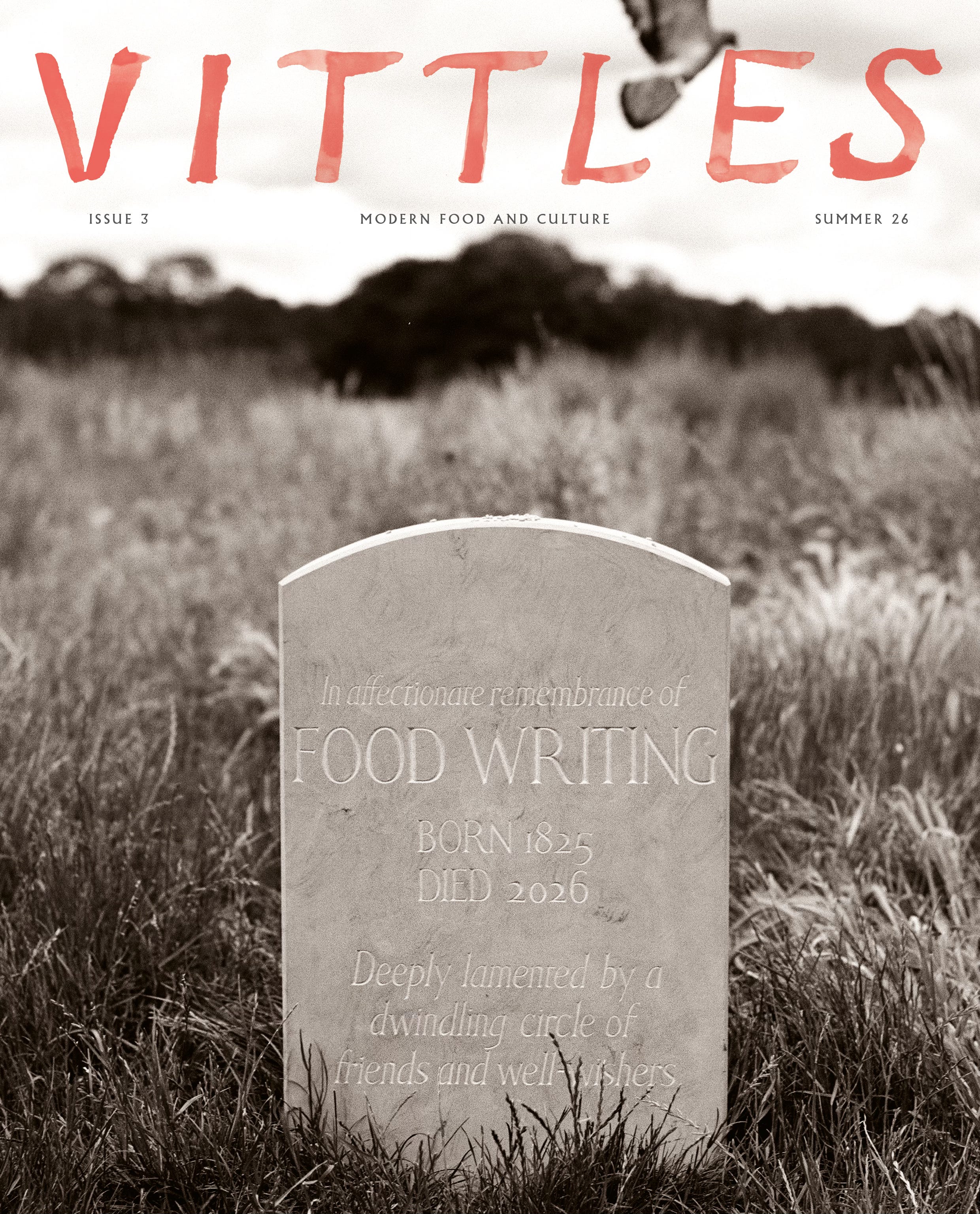
Hester van Hensbergen on the supplier that writes London's menus. Illustrations by Alex de Rivaz. Cover artwork by Julie Asquith Coghlan.
Good morning and welcome to Vittles. Today’s piece is the first article we’re publishing online from our third print issue, The Influencers. It is a deep dive by Hester van Hensbergen into how Natoora became the de-facto fruit and vegetable supplier for much of London’s restaurant scene and whether its remarkable growth has potentially compromised its commitment to ‘radical seasonality’.
Today’s article is paywalled. To read the other pieces in the issue – which contains everything from investigations into how restaurant influencers make their money to long reads on the history of MFK Fisher’s hidden role in introducing Japanese food to mainstream US culture – order your copy now! We’ve also published various online-only pieces related to The Influencers, which you can access here.
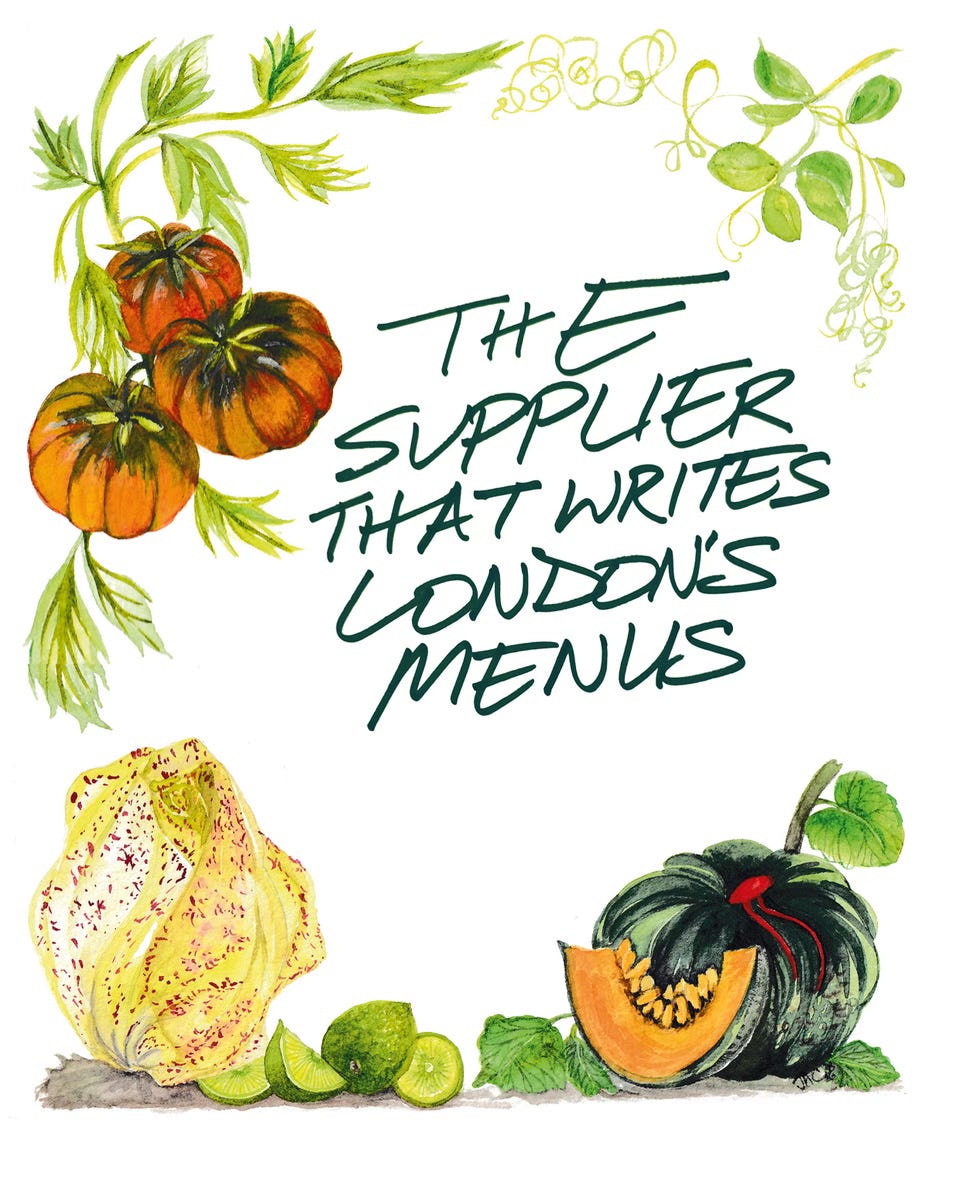
Good tomatoes in winter ought to be an impossibility, but on the last Friday in March – an overcast and cold day in London – exquisite tomatoes are everywhere I look. I spot them first on the counter at South London restaurant Dockley Road, plump and shining, a mixture of glossy scarlet and bruised green. A table of two orders the ‘winter tomato’ salad, which features strikingly rippled Black Iberiko and Marinda varieties, stirred through with chilli oil. Soon after I leave, I pass a delivery lorry printed with a message urging passersby, with the fervour of a preacher, to ‘seek seasonality’ and ‘find flavour’. I reach the Greek taverna OMA in Borough Market, where a chef rapidly slices through the same tomatoes – this time to be mixed with carob rusks and cheese.
An hour later, in West London, I buy the tomatoes to take home for a salad from a shop just off Portobello Road, the awning of which declares ‘a food system revolution’. Nearby, identical tomatoes are diced onto sour cream at Dove, served alongside ricotta and gordal olives at Dorian, thrown together with mozzarella and olives on pizza at Canteen and dressed to accompany the half-chicken at Straker’s. At Waitrose that evening, there are the Marindas again, on discount now. Just in time: elite produce wholesaler Natoora’s Pro app for chefs has announced the arrival of datterini season. Soon the winter tomatoes will be gone and the datterini will be everywhere.
Whether or not you’ve heard of Natoora, if you’ve eaten out in London in the last decade then you’ve almost certainly had its produce. Since arriving in London in 2004, Natoora has been at the heart of an ingredient-led, seasonally committed approach to sourcing that has become a point of pride for hospitality businesses across the city. Through working closely with farmers and some of the most influential restaurants in the country, it has grown to shape what gets cooked, and how this is conceptualised, more than any individual chef or producer. A restaurant salad will often contain the telltale gauzy pink of Natoora’s pale radicchio or the fractured pigments of its Castelfranco; in summer, a crudo might contain Natoora’s green-skinned oranges; in autumn, a roasted pumpkin dish might feature its chestnut-sweet Delica. A change on the Natoora Pro chef app – the introduction of a new ingredient; a sale on one going out of season – will send ripples through the entirety of London’s restaurant scene. ‘Fergus Henderson’s dictum is to “Let nature write the menu”,’ the chef Thom Eagle once wrote, ‘but too many chefs now are content to let Natoora write it for them.’
Natoora’s ambitions are growing. Today, the wholesaler serves roughly 2,000 restaurants and has expanded from Paris and London to Copenhagen, New York, Malmö, Melbourne and Miami. In London alone, it works with 700 restaurants, and supplies businesses that range from neighbourhood bakeries to multi-Michelin-starred restaurants like The Ledbury. It has its own retail shops as well as a mill and bakery, and supplies Ocado, Waitrose, Whole Foods and Gail’s. During the Covid pandemic, a hugely successful pivot to retail facilitated Natoora’s further expansion into home delivery, and it now has a customer app which offers boxes of seasonal produce. In 2024, Franco Fubini, the owner of Natoora, published his manifesto, In Search of the Perfect Peach, in which he outlines his vision for a ‘flavour-driven revolution’, with eating habits guided by nature and the delivery of high-quality farm produce directly to restaurants ‘at a scale never attempted before’.
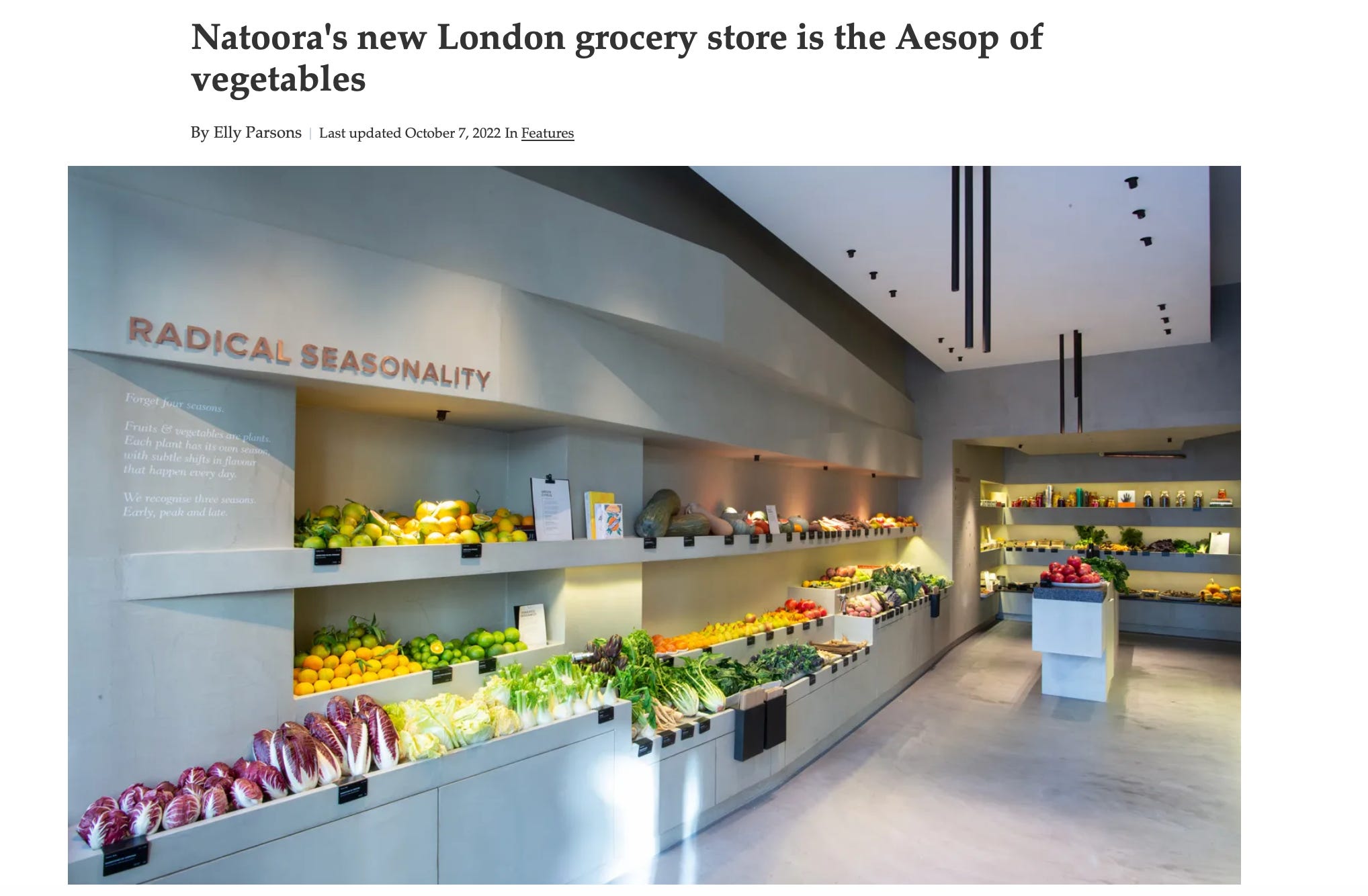
The flourishing of the London restaurant scene over the last twenty years is entwined with the remarkable success of Natoora. The company has raised the baseline standard of imported produce and helped to create a culture in which paying higher prices for quality is more widely accepted. It has introduced new ingredients, ideas and trends into the city’s cuisine – not only did it create the ‘winter tomato’ category, it put in place the distribution network that made it ubiquitous. It has sculpted understandings of what ‘good’ food is, of seasonality and sustainability, and of the role restaurants play in visions of a better food system. And yet there is a central contradiction at the heart of Natoora’s success: in a food system dominated by monocultures and monopolies, the business that in theory is so devoted to diversity, heterogeneity and small-scale growers has arguably achieved a monoculture all of its own. For all Natoora has transformed in London and beyond, it begs the question: how did one company come to have this much influence on the way we eat out?
It is hard to imagine now, but there was a time before Natoora. Wind back to the turn of the century, and the city’s restaurants bought their produce from New Covent Garden Market in Nine Elms, where hundreds of fruit and vegetable wholesalers had moved from Covent Garden in 1974. Everyone ‘from PizzaExpress to Marco Pierre White’ shopped there, as an episode of 1998’s Waiting for Marco claims. The programme follows wholesalers M G & Sons as they search for produce at the market for White’s restaurant, Mirabelle; we follow them as they pick through courgette flowers, button mushrooms, baby aubergines and bunches of asparagus of unclear provenance. They barter and cajole, quibble over quality (‘Nah, that’s shit mate! They’ll be rolling round on the floor with stomach-ache if we give these people that!’), despair over rotten lettuces (‘That should be fucking condemned, that gear!’) and make deals. The produce is almost entirely imported, the quality ultimately ‘God-given’ – and M G & Sons send it off to White with fingers crossed that he won’t send too much back.
‘There is a central contradiction at the heart of Natoora’s success: in a food system dominated by monocultures and monopolies, the business that in theory is so devoted to diversity, heterogeneity and small-scale growers has arguably achieved a monoculture all of its own’
Looking back, there is a more general sense that London restaurants in these years weren’t so much inspired by as limited by their suppliers. ‘When I first arrived [in 2004], it was more based on what you could get [than] what was amazing,’ New Zealand-born chef Chantelle Nicholson, who owns Apricity in Mayfair, explains, ‘and it didn’t matter where it came from.’ However, even then, there were already some restaurants that would go out of their way to find new sources of quality produce. At The River Cafe in Hammersmith, Rose Gray and Ruth Rogers were sourcing from a wholesaler of Italian products called Portobello Food, as well as working directly with UK growers. Chef Stevie Parle, who joined the restaurant aged seventeen in 2002, remembers how Gray would persist in wrangling over the size of the courgettes or how best to grow cavolo nero. But in those days even The River Cafe ‘couldn’t get everything’, says Parle, and some of the ingredients now tied up with the restaurant’s identity – like puntarelle or agretti – were incredibly difficult to source.
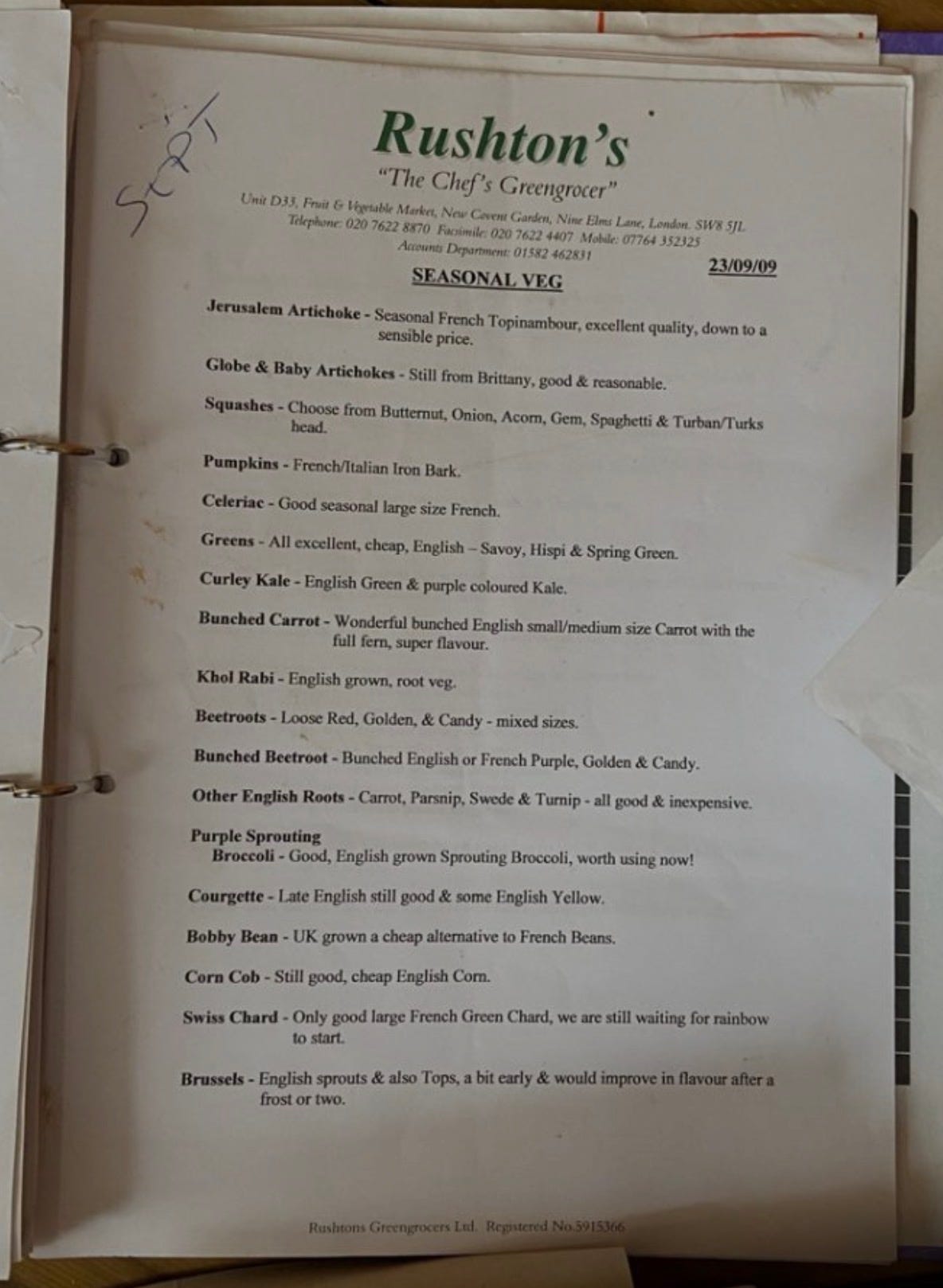
In 2001, Natoora was founded in Paris with the aim of delivering farm produce directly to homes. Franco Fubini joined in 2004 and spearheaded its launch in London, with a focus on domestic deliveries of French produce and artisan delicatessen items. There were cabbages and comté, radishes and reblochon, pears and pâté, but none of the produce that would later become the company’s signatures. A couple of years later, there came a change that would prove transformative for the company: Natoora merged with Portobello Food. This expanded the business into the world of cavolo nero and radicchio, but more importantly, it expanded the business into the world of The River Cafe. It was this merger that catalysed Natoora’s transition to restaurant wholesaler; at this point, the company was buying direct from markets in Milan and Paris, as well as from New Covent Garden. Other influential accounts followed, and in the later 2000s, Natoora could name high-end Mayfair and Knightsbridge establishments like Theo Randall’s InterContinental, Heston Blumenthal’s Dinner and Claude Bosi’s (now closed) Hibiscus as clients.
Beyond the paywall: the story of how Natoora came to have such an outsized impact on the London restaurant scene, and of how the scaling up of its business model potentially complicates its commitment to artisanal, seasonal produce.