

The Vittles Knafeh Guide
Reviews of the eight best knafeh in London, plus two outstanding examples from elsewhere in the UK, by Aina J. Khan.

Hello and welcome back to Vittles Restaurants.
Today, we’re publishing an essential piece of service journalism by the writer (and now knafeh expert) Aina J. Khan. Last year, Aina asked us if she could eat at as many places in London that serve knafeh as she was physically able to — an enviable task. We can’t think of many single dishes as beloved as knafeh, or as many whose merits are as debated over. The result is this guide, which takes in various styles of Arabic knafeh, along with Turkish künefe — primarily in London but with two exceptional examples in Manchester and Bradford that we couldn’t leave off the list.
If you have never eaten knafeh before then we hope this list is the start of a new obsession; if you have, then let the debate begin!
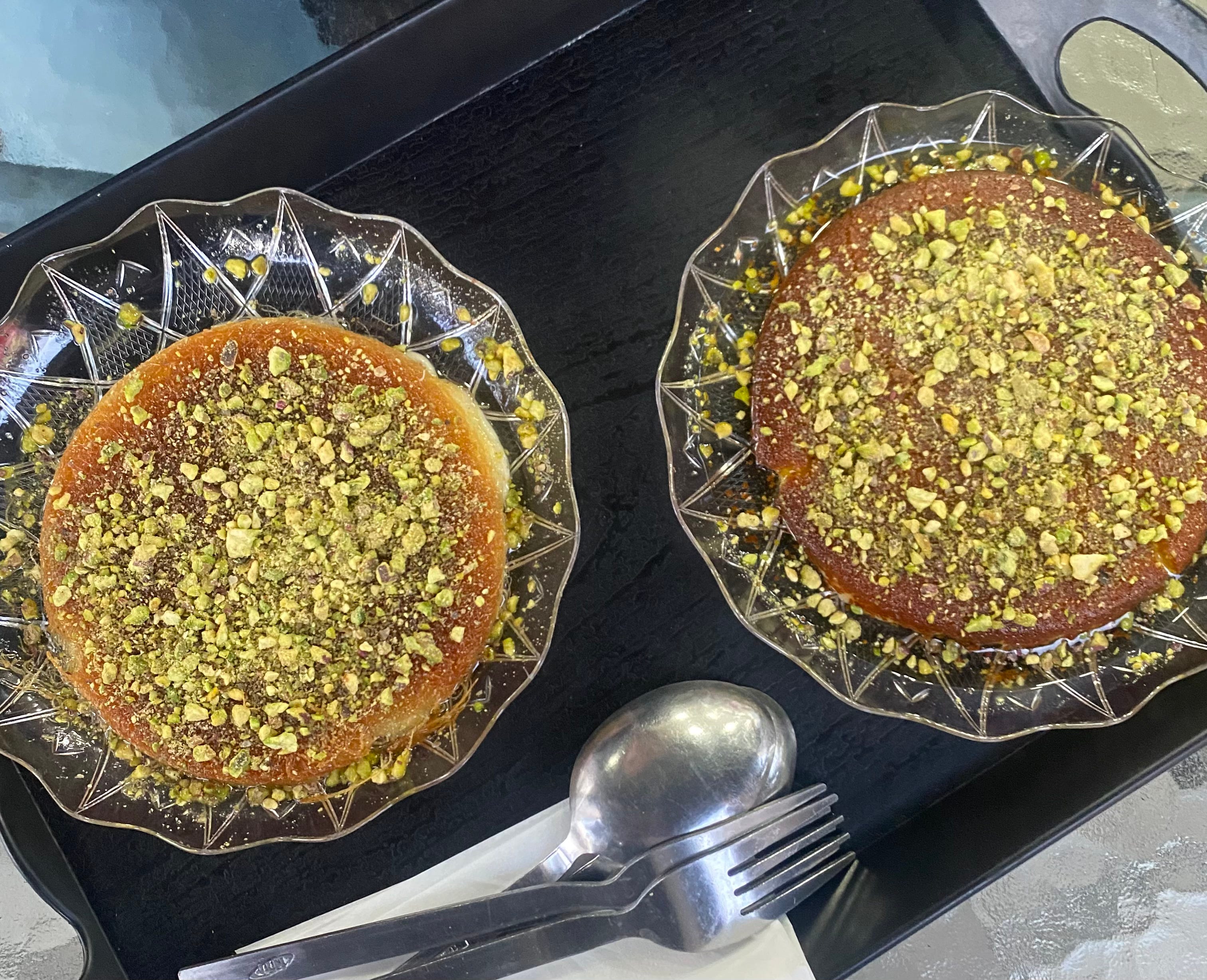
My love of knafeh began on the cobbled streets of east Jerusalem in 2016, two weeks after Britain voted to leave the European Union.
Bitter over our divorce with Europe and the ubiquitous presence of armed Israeli soldiers at almost every entrance, corner and street of the ancient streets of the Muslim quarter of old Jerusalem, I found myself drowning my sorrows one evening inside Jafar Sweets, a Palestinian-run sweet shop opened in 1951 only three years after the Nakba that expelled over 700,000 Palestinians from their homeland.
Buzzing with families sharing sweets and ammus sipping pensively on cups of black tea and mint, it was there I tasted my first ever slice of knafeh, a savoury dessert made from a base of akawi: a phenomenally stringy, stretchy, and mozzarella-like cheese that originates from the Palestinian city of Akka. The steel-pan hot cheese is topped with either a layer of baked, orange-coloured semolina na’meh, or a crispy vermicelli-like khishneh. Both variations are bathed in a moat of sugar syrup and ghee-like butter, topped with a verdant green crown of ground pistachios. Without any prior knowledge of this sweet, I opted first for the knafeh na’meh.
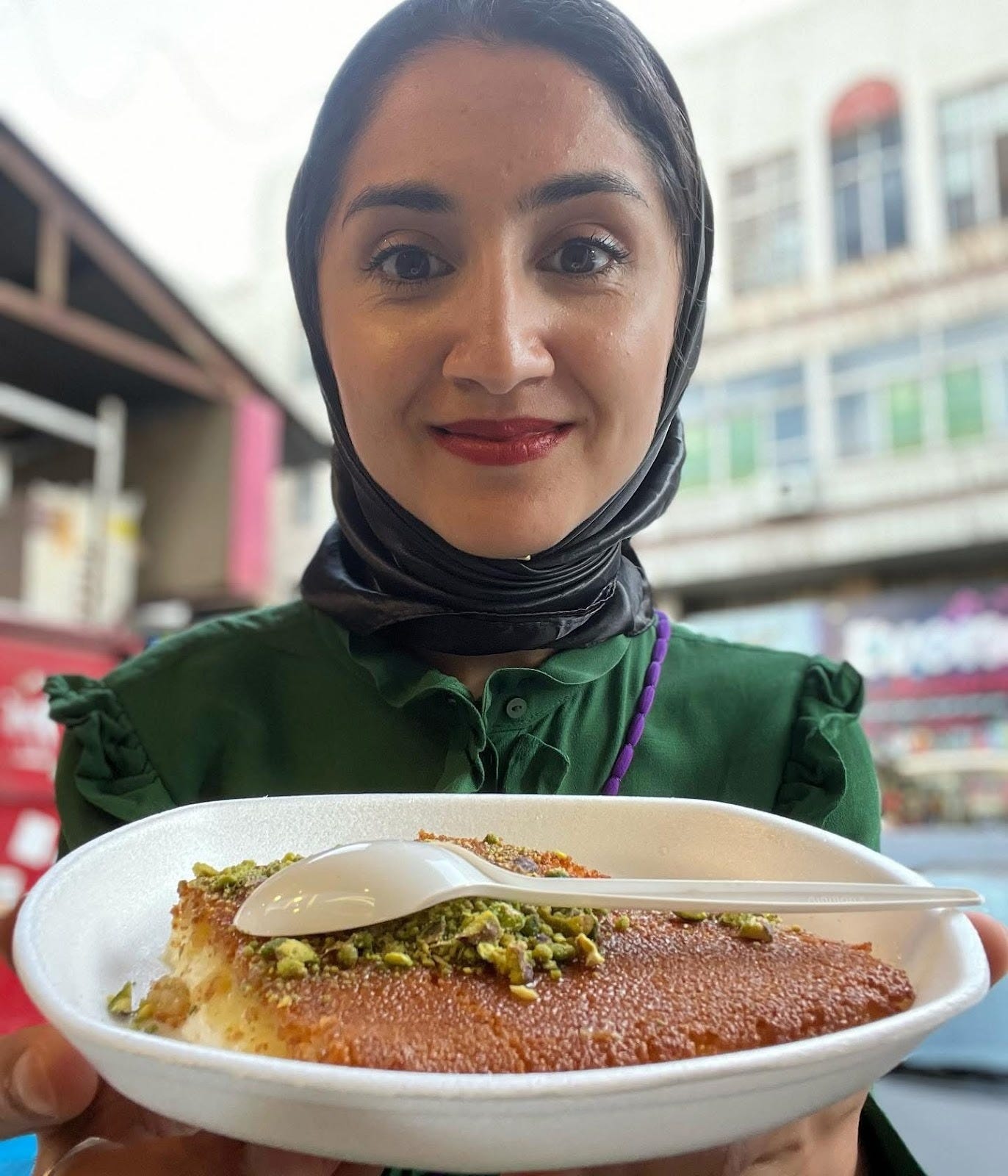
I can’t articulate the precise sensations that flooded my multi-hyphenate British, Londoner, Bradfordian, Pakistani, Pashtun tongue. All I know is that, in that moment, knafeh upended my culinary world. As a diaspora kid of Pakistani-Pashtun origin growing up around Iraqi, Lebanese, Iranian, Turkish and Sudanese kids and often shopping at Damas Gate, the Syrian-run supermarket opposite Shepherd’s Bush mosque where as a girl I’d buy bags of falafel and trays of baklawa, by some miracle, I had never taken a bite of knafeh until that moment. That’s when the obsession began.
Knafeh. Knafah. Kunafa. Kunefe. Knaffeh?!
The English transliterations of knafeh from Arabic to English are as varied as opinions around its origins, and which version is the greatest. Because as I learned tasting dozens of knafeh around the world – in Turkey, Jordan, Palestine, Egypt, Saudi Arabia, Lebanon, and even in Uganda at a Somali-run dessert parlour - knafeh invokes visceral culinary nationalism: My Egyptian friends will inevitably tell you the origins of knafeh are… Egyptian. They even go so far (sacrilegiously in my non-biased opinion) to say that only those topped with crispy vermicelli-like kata’if pastry, the knafeh khishneh… is knafeh. No cheese, just the khishneh layer, as my Cairene friend Omnia insisted. When mango season swings around in the summer, Egyptians add slices of mango to their ‘knafeh’; Palestinians generally defer to knafeh Nabulseyeh – named after the Palestinian city of Nablus – as the best knafeh. As a journalist, my peers prize ‘objectivity’: a false veneer of neutrality that is often a euphemism for how white, middle-class men view the world. But I have no shame in admitting that Palestinian knafeh is the best in the world.
In the last 10 years I have tried dozens (to the extent that by this point, I’ve lost count) of different knafeh slices around the world. During this time, I’ve developed a methodology to determine a good knafeh. Is it fresh from the steel-pan? How crispy is the khishneh layer? Is it soggy? Is it drowning in sugar syrup? Is the semolina na’meh layer stodgy and too thick? Is the akawi cheese base hot with a glorious stretch once the spoon plunges in? Does the akawi taste like a diluted version of mozzarella? Or does it have that silky, subtle depth to it only the best akawi has?
Despite all of this, it has been near-impossible to find knafeh in the UK as good as the ones served fresh in Palestine and in Lebanon where demand means multiple trays of it are made fresh, particularly in the mornings. Nevertheless, the last 12 months I’ve conducted reviews of knafeh joints from the Turkish and Arab diasporas in London, Bradford and Manchester. I tried knafehs of three different regional variations: Palestinian, Syrian and Turkish. No Nutella gimmicks, no ice-cream innovations. Just traditional knafeh in its naked, cheesy, original glory (sorry Egyptians, no Egyptian knafeh review here for now).
Knafeh
1. Palestine House
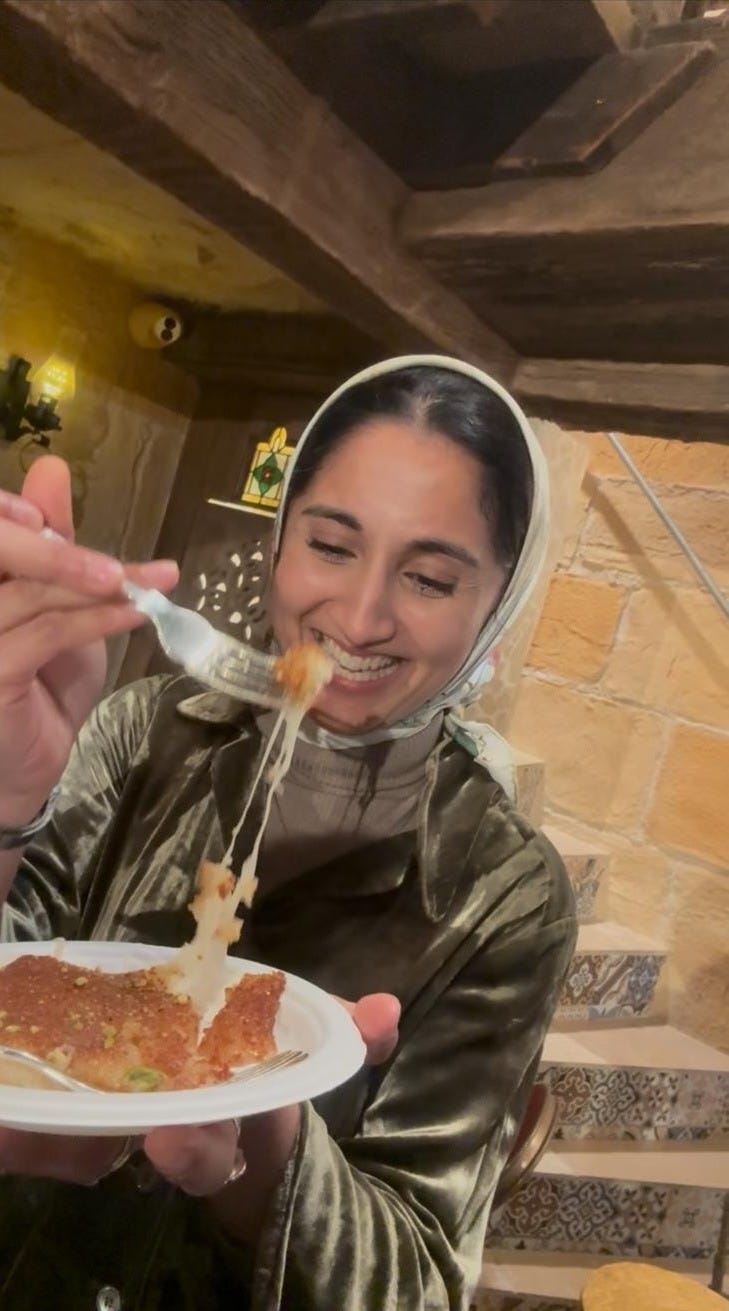
After spending a month in Lebanon last year eating my way through as many knafeh joints as I could in Beirut, the southern cities of Saidah and Nabatieh, and Tripoli in the north, I was comparing every knafeh in the UK to the high standard I’d experienced in Lebanon, where knafeh is made fresh by the steel pan every single day. Knafeh is to the Lebanese what toast is to us Brits. But to paraphrase the late Sinéad O’Connor, nothing compared. Every knafeh I ate in the UK felt like a microwaved imitation.
Anyone who knows knafeh will tell you that one of most fabled ones is from the northern Palestinian city of Nablus that it’s named after. The slice I had in Palestine House was the real deal. I let out an involuntary exclamation of ecstasy, satisfaction and praise – ’La Illaha Ill’Allah!’ (‘There is no God but God’) the Islamic declaration of faith – for the Palestinian chef responsible for its creation. Finally, it felt like I had come home.
113 High Holborn, WC1V 6JQ