Vittles #3: The Influencers Issue
A magazine about who influences the way we eat
With the talented contributions of:
Stephen Buranyi, Hester van Hensbergen, Vaughn Tan, Ozoz Sokoh, Nigel Slater,
Jonathan Lovekin, Rob Martinez, Helen Cho, Hussein Kesvani, Ariel Saramandi,
Claire Ratinon, Barclay Bram, Yanyu Sun, Lily Kelting, Calum Jacobs, Rebecca Perry,
Sithara Ranasinghe, Lama Obeid, Lavender Au, Sanam Maher, Efe Levent, Adaorah Oduah,
Adam Almeida, Ruby Tandoh, Jonathan Nunn, Christy Spring, Polly Russell, Drew Smith,
Chitra Ramaswamy, Andy Hayler, Roopa Gulati, Fay Maschler, Adam Coghlan,
Maureen Mills, Ahaana Khosla, Rushina Munshaw Ghildiyal, Angelia Teo, Samantha Culp, Devon Powers, Ellen Rogers, Gayle Lazda, Sing Yun Lee, Kenneth Lam,
Maria Georgiou (Mam Sham), Mike Massaro, Sophie Monk, Cold War Steve,
Ibrahim Rayintakath, Raj Dhunna, James Clapham, Edison Ling, Elio Ferrario,
Jeremy Ngatho Cole, Bea Ysolda, Wendy Wong, Amrit Randhawa, Alex de Rivaz,
Julie Asquith Coghlan, Elliot Gray, Antoine Cossé, Sophie Whitehead and Liz Tray
Designed by Dan Biddulph
Vittles #3 will be published in late July 2026. Pre-order here.
A Eulogy from the Editor
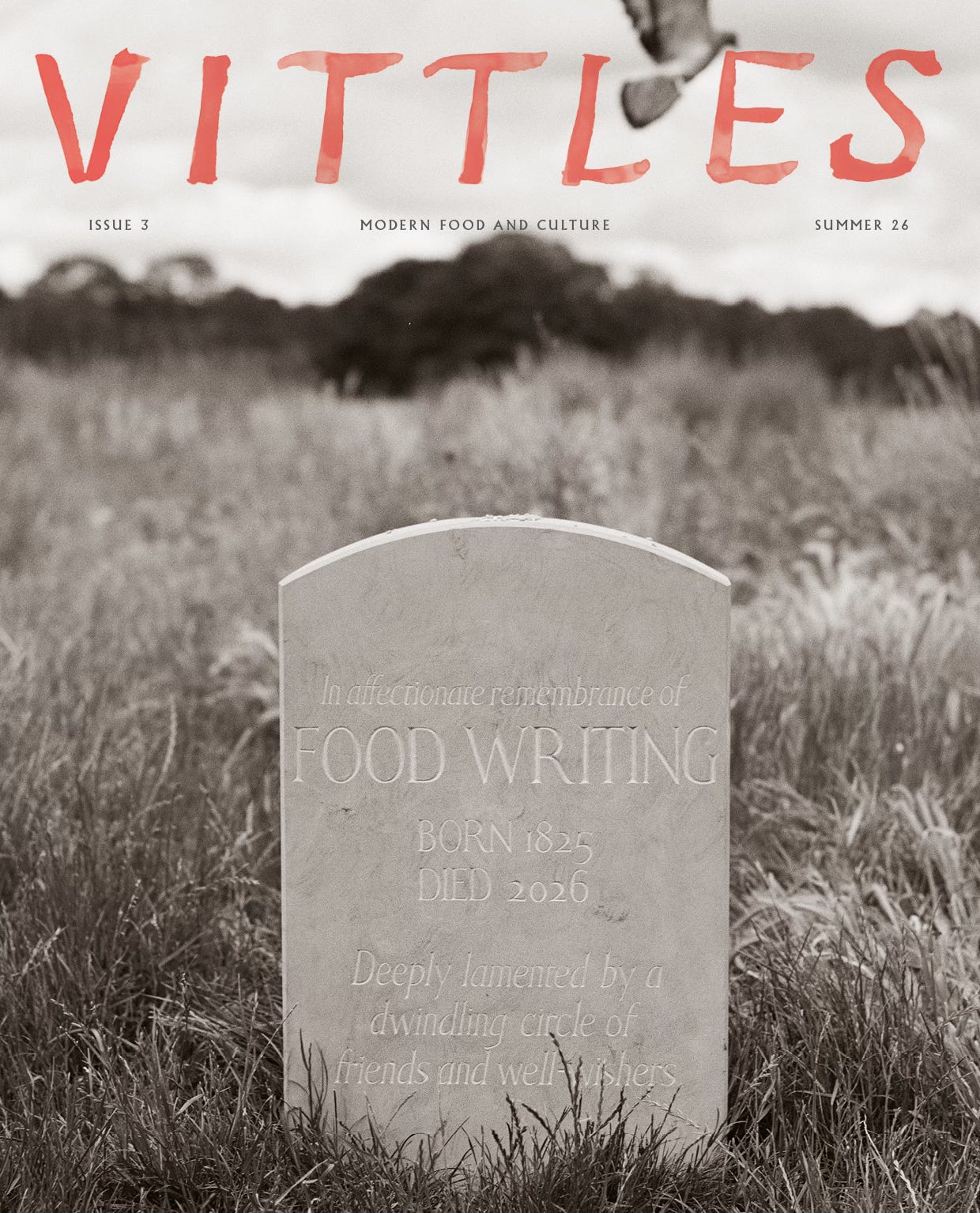
Food writing is dead. We had a decent run of it – an unbroken 201 years from the publication of Brillat-Savarin’s Physiology of Taste in 1825 (to which our front cover attests). But nothing lasts forever. Over the past few years, short-form video has become mass media’s dominant format. Food culture is now being moulded by a new generation, who do not have to rely on the gatekeepers of legacy media to reach their audience: young cooking influencers who use montage and jump cuts to sell a dizzying array of recipes; enterprising YouTubers who put together travel content and dispatches in the exploratory spirit of Bourdain; restaurant influencers who have supplanted the critic with the art of kayfabe, performing ludicrous characters to grab our attention. This transition has contributed to the homogenisation of food media into a series of tics and formats that please the algorithm, and yet it has also allowed people shut out of food writing to speak about their culture on their own terms. The content they produce is chaotic, tasteless, infuriating, diabolical, unpoliced and, sometimes, brilliant. The age of the influencer is upon us: you can love it or hate it, but either way, you have to take it seriously.
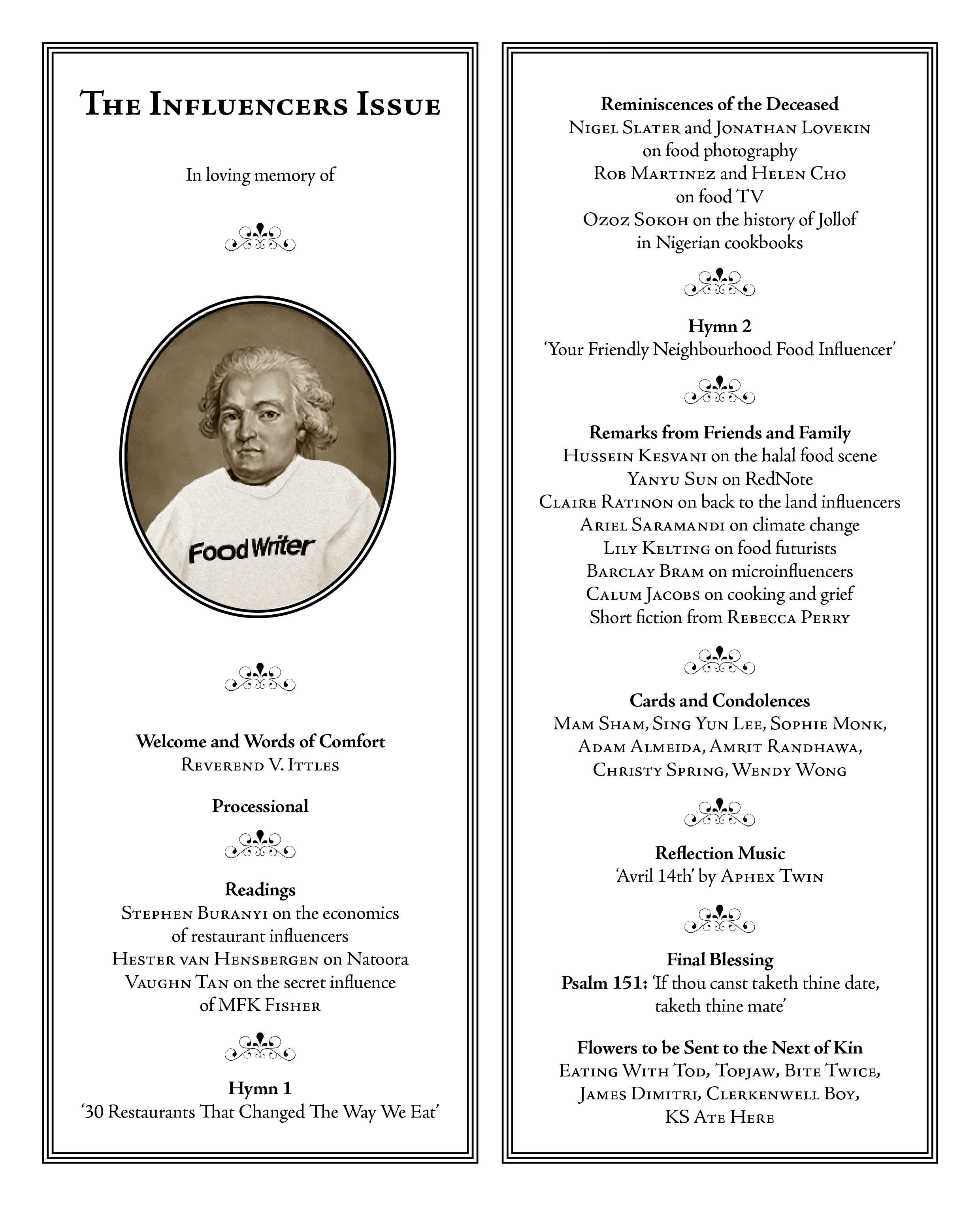
This issue, which we made instead of going to therapy, is our attempt to do just that. It uses the new figure of ‘The Influencer’ as a jumping-off point to talk more broadly about who has had the power to influence food culture, and how this is changing.
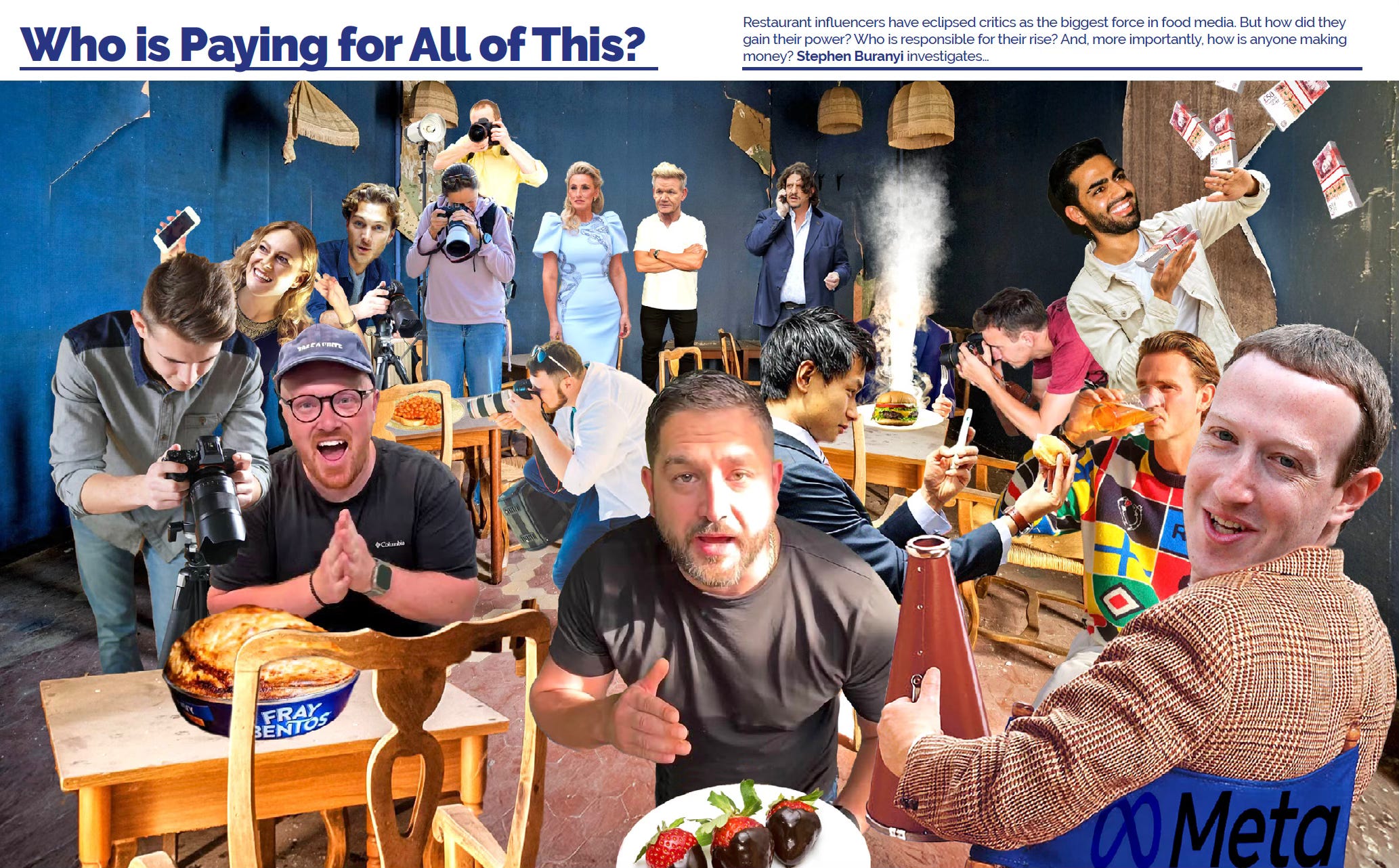
Our lead essay – an investigation by Stephen Buranyi into the economics of restaurant influencing – is the biggest piece we’ve ever published. Over the past six months, Stephen has spoken to more than fifty influencers, chefs, restaurateurs, PR professionals and other industry players to find out where influencers came from, how they gained such power in the industry, and how the business of influencing works day to day. What Stephen has uncovered is not the usual narrative that pits influencers against traditional journalism; instead, he tells a more complex story, one in which influencers, journalists and restaurants are embedded in a system that obscures when we’re being advertised to. Over the course of the investigation, it becomes clear that this is really a story about old and new forms of advertising, a proxy war being fought between the real powerbrokers of food media: PRs and the social media platforms themselves. If you want to learn how it all works, how much people are charging, and why Eating with Tod isn’t picking up our calls, then this essay is worth the price of admission alone.
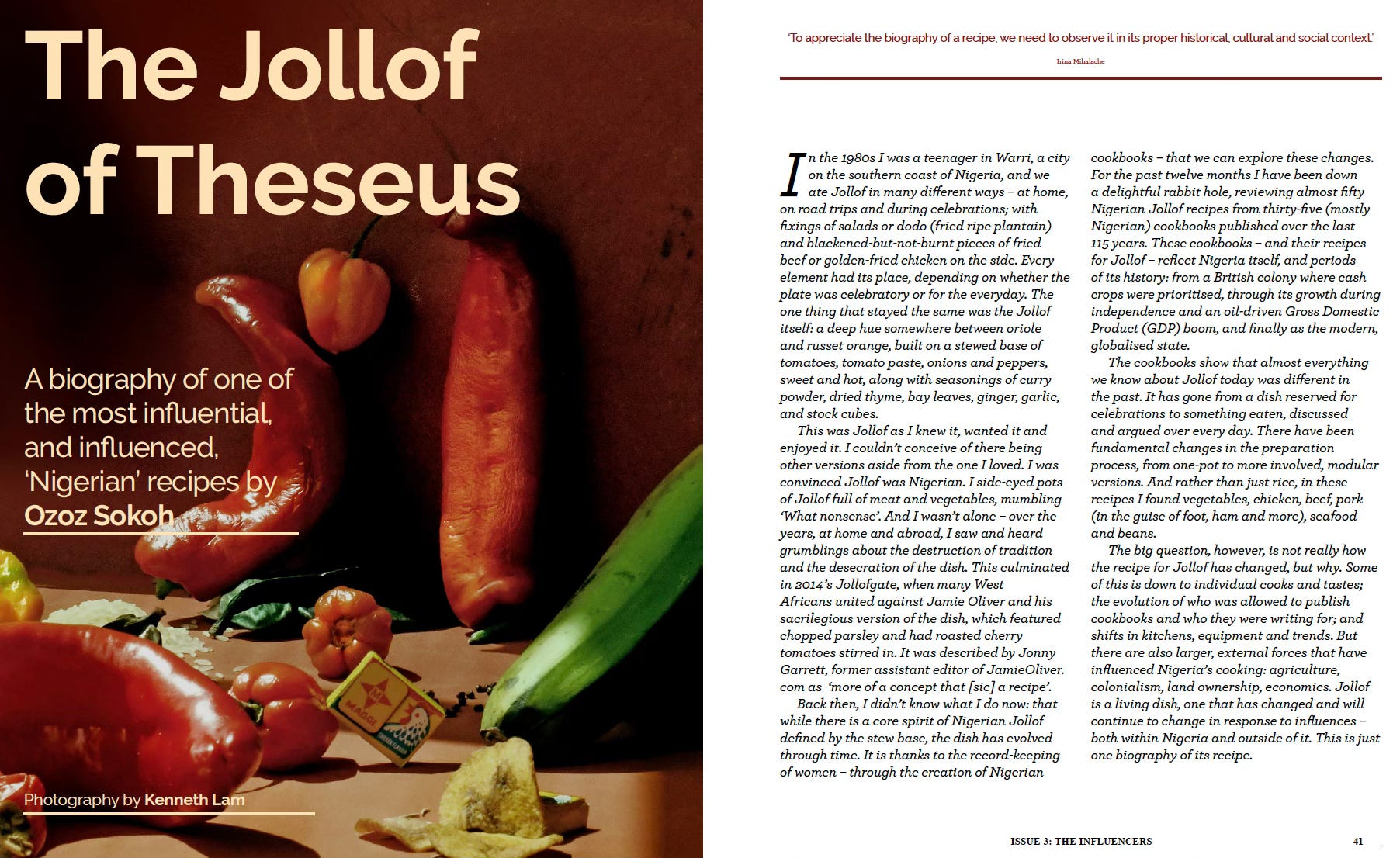
We’re also honoured to be publishing two major pieces of food history writing in this issue. In the first – a story we’ve wanted to tell for almost a decade since we first heard about it – Vaughn Tan unearths the secret influence that the food writer MFK Fisher had over the mass popularisation of Japanese food, and specifically how documents in her archive prove that she orchestrated a behind-the-scenes PR campaign to change American food culture. In the second, Ozoz Sokoh has spent many months in the cookbook archive to write the definitive essay on the history of Jollof rice in Nigeria, and how (and why) the recipe has changed over the past century.
Across Issue 3, you’ll find stories about the people – and systems – that shape the way we eat, often in hidden or clandestine ways. Hester van Hensbergen has written the long read on the wholesaler Natoora that we’ve all been waiting for, tracking how, over the past two decades, it has risen to become the most influential player in the London restaurant world. Ariel Saramandi reports from Mauritius about how climate change has influenced the crops that people can eat. Yanyu Sun looks at the Chinese app Xiaohongshu (RedNote) and how it is creating a new canon of London restaurants – from Ecuadorean offal soups to Bulgarian barbecue – based on ‘the Chinese stomach’. Lily Kelting talks to trend forecasters from around the world about predicting the future of food, while Adam Almeida maps out the impact of private equity on the British dining scene.
One of the big themes of the magazine is how online food culture is creating new genres of influencer. Hussein Kesvani writes about halal food influencers and how Muslim consumers have become some of the most important drivers of food culture in Britain today. Claire Ratinon interrogates the ‘back to the land’ influencers who have made their names advocating for a rural lifestyle, but who rarely divulge the reality of what it costs. Barclay Bram delves into the world of so-called microinfluencers and how, ultimately, the entire food media world runs on comps. We also asked six of our favourite writers across the world to write about influencer culture in their own country, which reveals that, despite a globalised media system, influencers can still remain local.
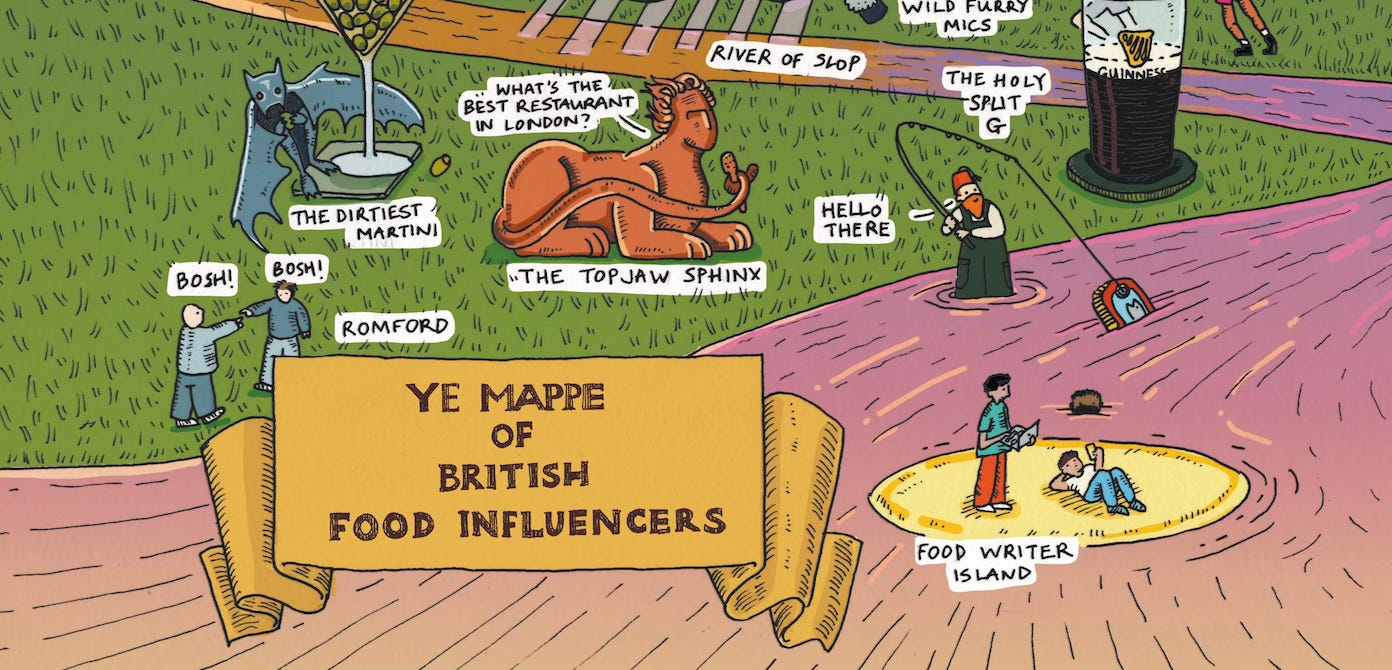
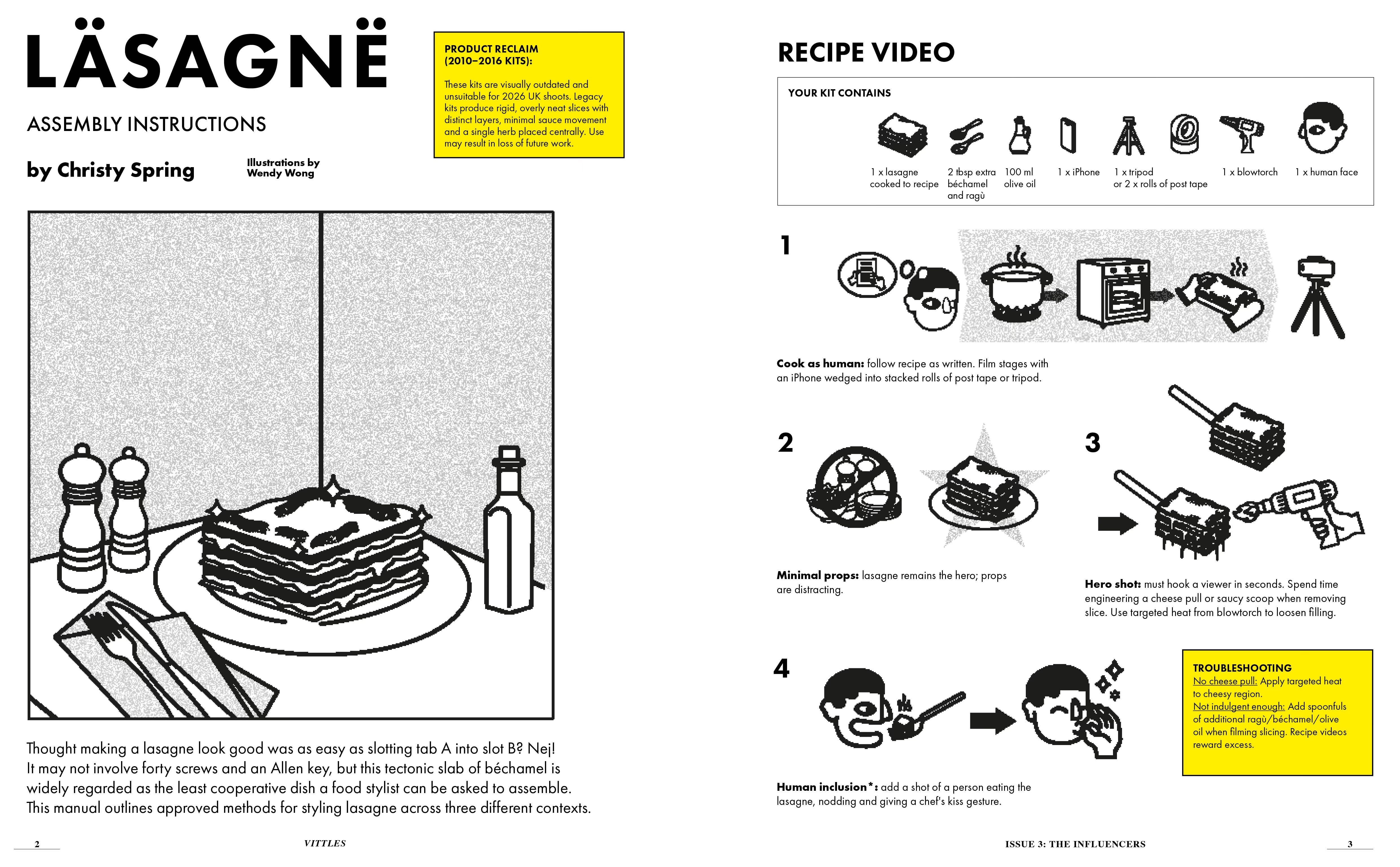
If that’s not enough, we’ve also put together a panel of experts to determine the most influential British restaurants from the last seventy-five years and how each one has changed the way we eat out, for better or worse. In a landmark interview, we speak to cookery writer Nigel Slater and photographer Jonathan Lovekin on food photography and their twenty-eight-year working partnership, which has transformed how we look at food. We sit down with the influencer Rob Martinez and Anthony Bourdain’s collaborator Helen Cho about the similarities (and differences) between food TV and Instagram reels. Calum Jacobs writes movingly about how our parents can inform the ways in which we cook, and his failed attempts to cook the food of his heritage. And in an eerie piece of fiction, author Rebecca Perry retells a familiar fairy tale about how hunger can drive people to make the most desperate of decisions. Plus there’s adverts from Mam Sham, diagrams, maps, cartoons, gravestones and more!
Influencers are here to stay. Food has a sensuality attuned to the virtues of short-form video, and because of our reliance on the phone screen, online food content has the capacity to reach millions of people, including those who don’t usually consume food media. With this magazine, we wanted to acknowledge that, but also make a case for what food writing can do when it’s given a bit of room to stretch its legs. By the time you reach the end of the issue, we hope you’ll agree that the reports of food writing’s death have been greatly exaggerated – not least by us.
Pre-order Now!
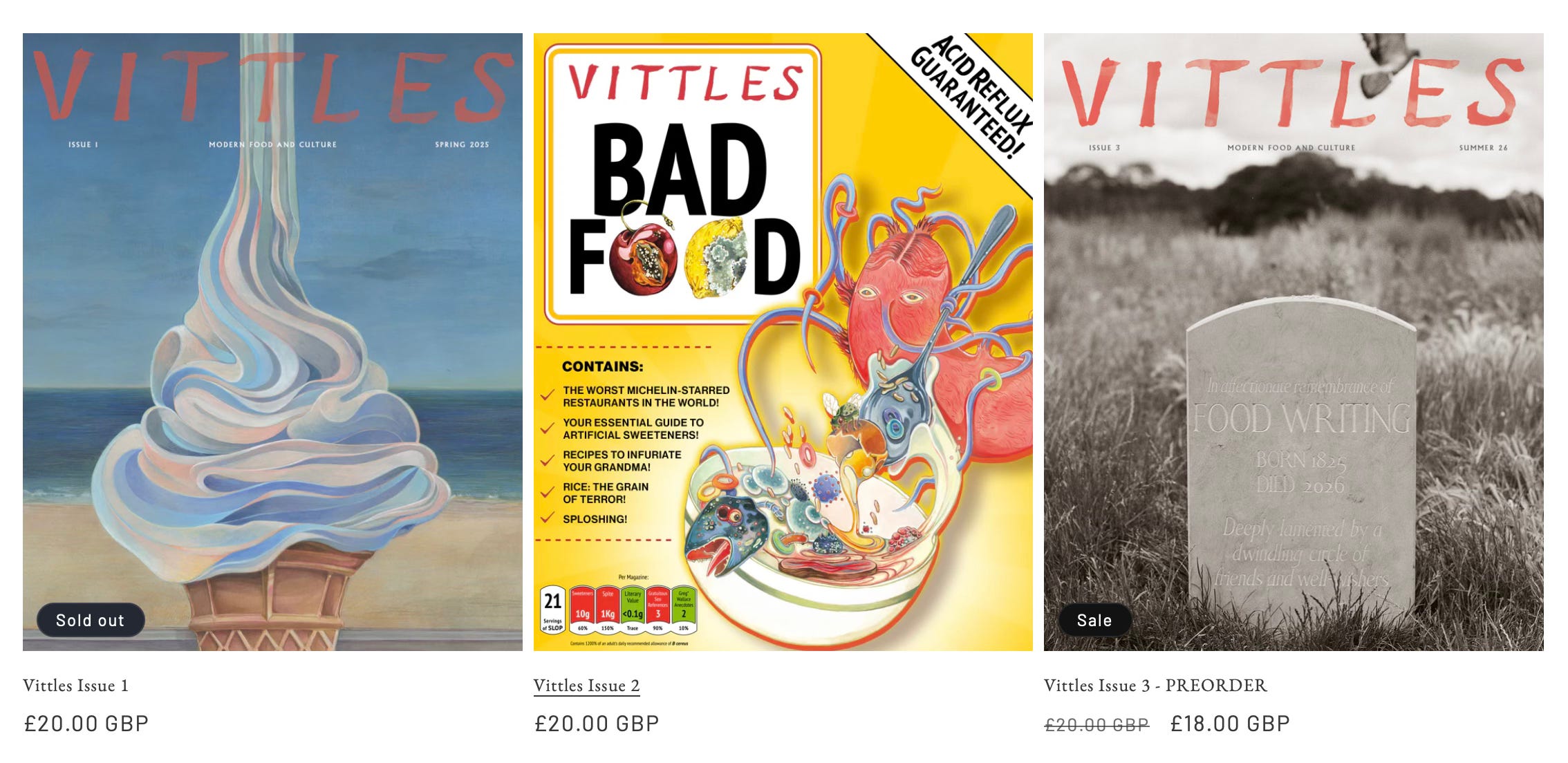
Like with Issue 1 (sold out), Ice Cream City (almost sold out) and Issue 2 (just about not sold out), this magazine is entirely self-published and funded only through user subscriptions (no adverts, no spon con). Pre-orders are vital for us. If you pre-order the magazine by 27 July the magazine will cost £18, down from the RRP of £20. Paid subscribers will get a further reduction to £16 – there’s a discount code after the paywall.
If you are a retailer and wish to stock Issue 3, then please email our distributor Antenne Books: mia@antennebooks.com.