Good morning, and welcome to Vittles! Today’s essay by Saba Imtiaz digs into the archives in Karachi to see how women have continuously forged and documented culinary histories in Pakistan.
Aloo mattar– potatoes and peas – is one of Pakistan’s canonical everyday foods, but the most notorious version can be found in an incredible interview clip from 2022, during which a woman is accused of poisoning someone with the dish.
Woman: He brought me Ativan pills and I served them in the food.
I know little about the case, and there isn’t much that can be found about it online, but now, in Pakistani internet speak, ‘aloo mattar, shorbay walay’ turns this otherwise routine dish into a cultural reference to murder.
Much of contemporary conversation about Pakistan’s cuisines exists in piecemeal form like this, in undated newspaper scans, clips, memes and reels. These trump the more formal tomes of Pakistani food legacies, there is no all-encompassing online guide to its gastronomic culture, which means that there are no quick answers to the questios that plague me. Mysteries like: why am I addicted to putting crunchy, spicy crisps on everything? What is the origin story of the fantastical creation that is qeema achari macaroni in a box?
To answer questions about Pakistan’s ever-changing food histories, I had, for years, relied on fractions of anecdotes from the internet. This was until 2019, when, during research for my book, I spent days rummaging through decades-old newspaper files in the cramped study room of Karachi’s Liaquat National Library. On one of these days, I found a piece on Chinese cooking, complete with recipes for sweet and sour sauce and fried rice and prawns, tucked in a 1971 issue of the Pakistan Times. Following this, I came across an article on Lahore’s Anarkali Bazaar in a 1948 edition of the Civil and Military Gazette, which mentions ‘a number of small stalls and pushcarts, making made-to-order “kebabs”, potato cakes served [with] fresh sliced onions and green chillies and other indefinable and doubtful-looking delicacies for the jostling crowd’.
Both of these articles were in the women’s pages, which are often found in older newspapers and magazines in South Asia and across the world. As I looked further, I found more recipes written by women, alongside dispatches and observations about how their appetites, techniques and roles in the kitchen were changing in a newly independent Pakistan. While today, talking about food is often the domain of dudebros on TikTok, women have been documenting Pakistan’s food since the country came into existence. What else could the archives tell me?
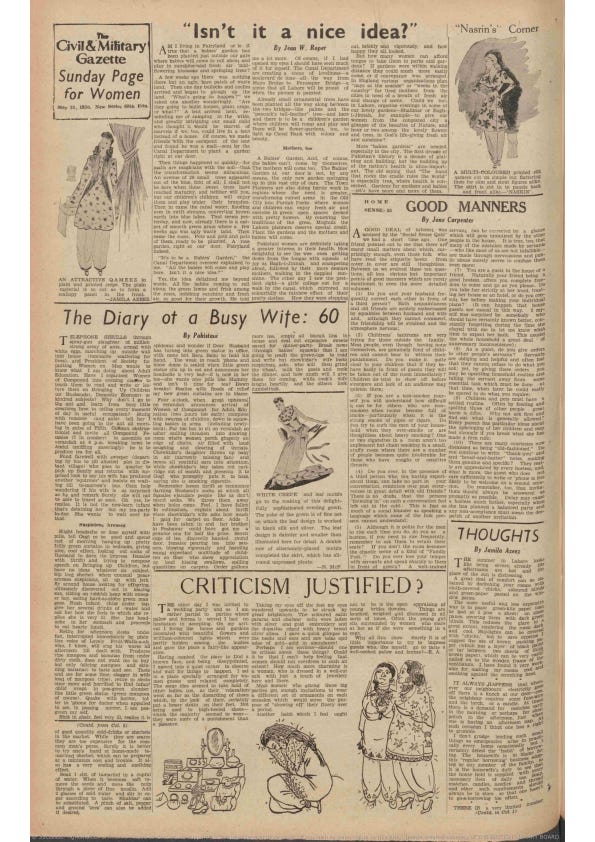
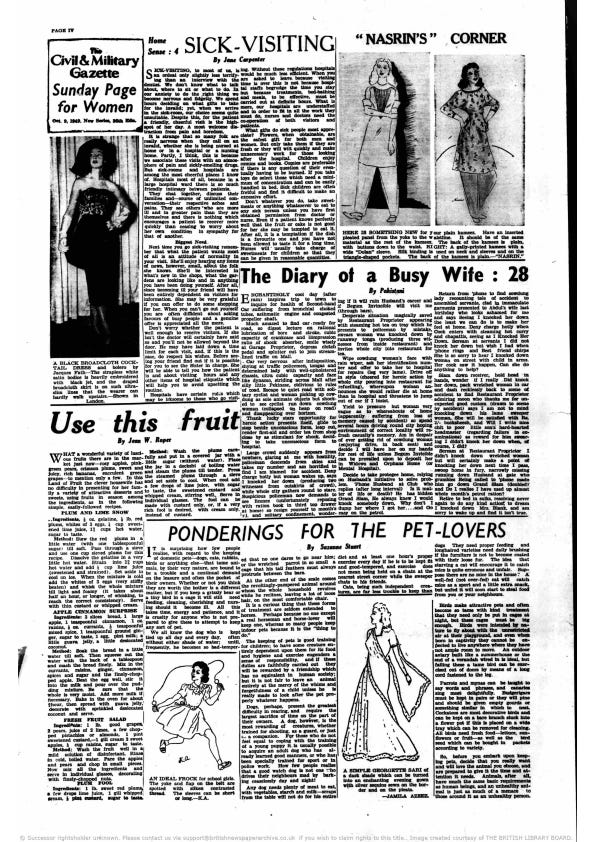
Women’s magazines have long held clues to culinary and national histories. Before the era of the celebrity chef, ‘cooking’ was largely considered to be women’s work, and coverage of trends and recipes were often found in publications marketed to women. In Pakistan, this existed mostly in newspapers like the Pakistan Times and the Gazette. The Gazette was one of the newspapers that catered to the elite in colonised, pre-partition India (Rudyard Kipling was, famously, one of its writers) and was printed in Lahore and Simla. Its women’s page was published on Sundays – which, during British rule, consisted of content for memsahibs (a common term for colonial officers’ wives and elite Indian women). The Gazette continued to be published during and after August 1947 – the month of Indian independence, partition, and the creation of Pakistan – but eventually folded in 1963.
Throughout and after partition, the lives of memsahibs – who were both the audience and writers of the paper – seemed largely disconnected from the situation in the Punjab province at the time. A million people were killed, and around 15 million were displaced and in a state of destitution, living in camps across the newly created borders and using makeshift stoves to cook with limited rations. Amidst the carnage, the women’s page in the Gazette continued to run articles about fashion trends, embroidery patterns and recipes.
Despite circumstances for the Gazette’s columnists being very different from those displaced, we can still find material traces of the political situation in the paper’s women’s page. Throughout the decade, the British colonial government had plundered the Indian colony’s resources of everything from wheat to sugar for its war efforts, eventually leading to a devastating famine across Bengal. Ten days after partition, the Gazette published a recipe for lime-juice barley that could serve as an alternative to nimboo pani or lemonade, which was no longer being served in cafes or at private homes ‘now that sugar is even more strictly rationed’. Another article by a writer called G L advocates for the use of honey as a replacement ‘when you find your stock [of sugar] is almost out, and ration day is far ahead’. Similarly, in the 14 September 1947 issue, N McF – possibly a British or Anglo-Indian writer – offered a recipe for coconut toffee made with shakar (jaggery powder) instead of sugar. It feels surreal to think of the elite complaining about a lack of sugar, given that ‘sugar barons’ is a term now casually used in Pakistan to refer to wealthy mill owners, who have an outsized influence on politics, the economy and chai.
What I found illuminating about reading the dispatches in the Gazette in particular is that women – even these women - were grappling with the larger questions of what their role would be in a new, free country. There was a spirit of make-do in the kitchen, and a cautious optimism about the way upper-class women’s roles beyond the home could change, too.
While in 1949, Shehla Shibli wrote that ‘Washing, cooking, and sewing will be done better if the housewife does each thing herself’, she soon offered an alternative vision, suggesting that a talented, intelligent woman will ‘be more valuable to the country and the nation if she employs the best of laundry-hands, the best of cooks … to deal with humdrum domesticity, and employs superior talent where its utility would be more worthwhile.’
By following the women’s page of the Gazette through the archives, we can see how, in Pakistan, society began to engage with the idea that for (some) women, a world should exist beyond how to feed a sugar-obsessed child as the country moved from survival to aspiration. And while for Pakistani women of the upper class, these fantasies did come true, the reality is that many – privileged or not – are still navigating the same roadblocks they did back then.
In the 1960s and 1970s, Pakistani women entered the urban workforce in cities like Karachi and Lahore, working as everything from newspaper writers and computer programmers to receptionists and glamorous flight attendants on Pakistan International Airlines. As the writer Noor Agha put it in Woman’s World magazine in 1967, it had not yet occurred to the Pakistani man that ‘the demure little thing at his beck and call is capable of turning into a vote-demanding, fire-breathing creature.’ Agha notes that, while at the time of partition, the idea of wives working was considered ‘preposterous’, husbands (from the privileged classes) were now someopen to letting women work in jobs like teaching, or to dabble in the arts or music.
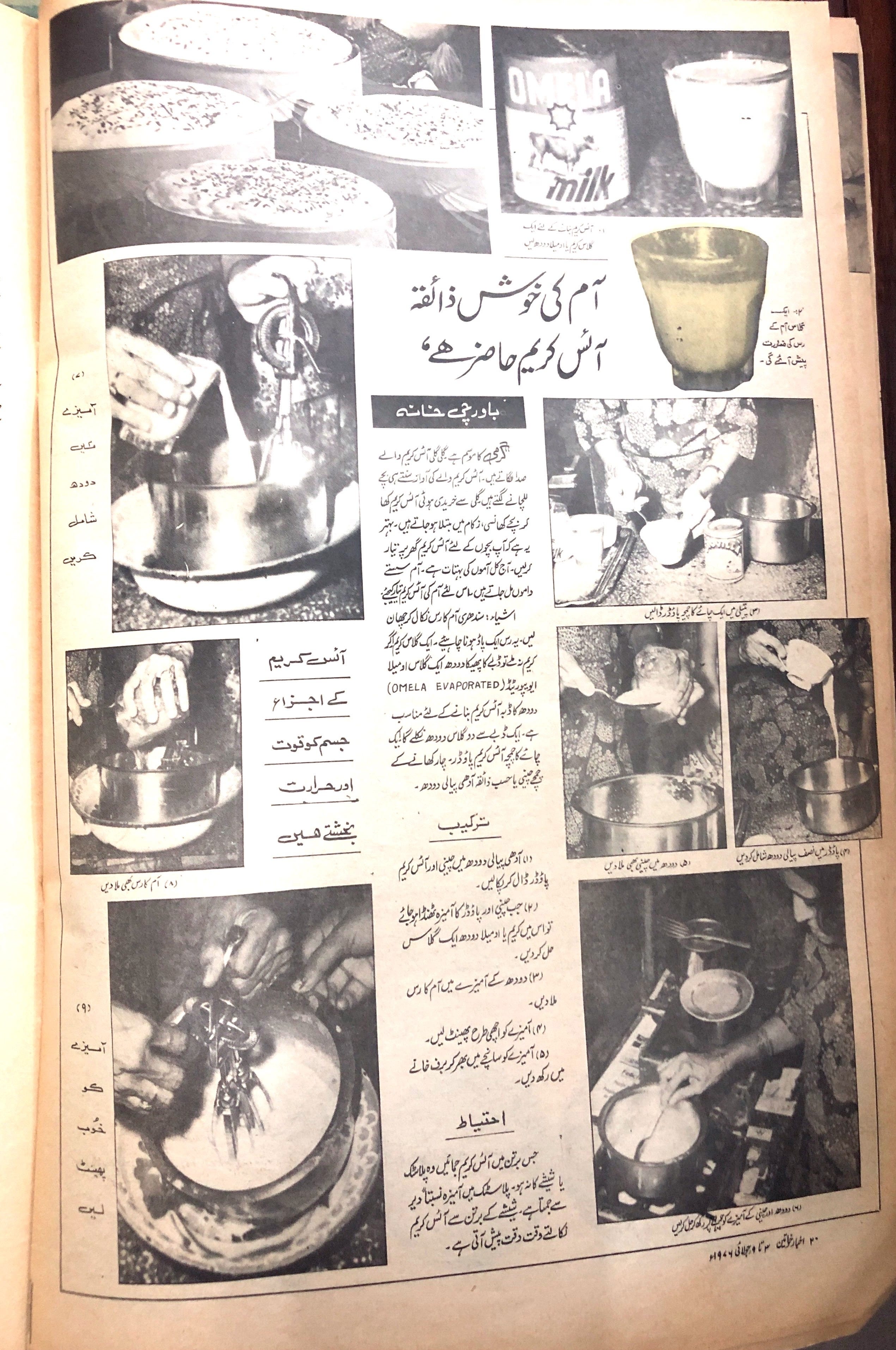
As women’s employment changed, so did the conversations about food. The recipes featured in women’s publications began to stress quickness and convenience over the hours of labour associated with traditional recipes. Take the recipe for walnut fudge cake that appeared in the Urdu language Akhbar-e-Khawateen magazine in 1971, which mentions that ‘the best quality of this dish is that it does not require baking’ because many women would only have had access to a stovetop, not an oven. Or the ‘coffee orange’ – a combination of coffee, hot water and orange juice – which appeared in Woman’s World magazine in 1967 and would probably go viral on Instagram today. There are also useful tips for cooking and hosting – for example, a recipe (possibly an advertorial) for mango ice cream in Akhbar-e-Khawateen that cautions readers not to use a plastic or glass bowl to freeze their ice cream.
As women in Pakistan began to make time for themselves away from the kitchen, the culture of dining out expanded, and so some of the first documented criticism directed at the women whose lives had stopped revolving around the kitchen began to appear. In the introduction to Begum Bilquis Jehan Naseeruddin Khan’s 1970 cookbook Khush Zaiqa, Begum Tazeen Faridi wrote:
Women of an older generation didn’t have college or university degrees, or the experience of foreign travel. But they had foresight; and they had arrived in their marital homes with the secret of how to keep men happy. They knew that men light up if they get delicious food on time.
She added that now – and the snideness is apparent here – ‘people are too busy. Men are forced to go to restaurants and hotels to get something new to eat, as their wives don’t bother to put any effort into making delicious meals.’
Simultaneously, in the 1970s, the kitchen began to be documented in the popular, low-brow writing of digests (pocket-sized magazines a la Reader’s Digest) published in Urdu. Digests - like Khawateen Digest, Shu’aa and Pakeeza - feature everything from novellas and household tips to advice columns. With a readership of predominantly women, drawn from the lower and middle classes, these continue to be one of the few – maybe the only – thriving print industries in Pakistan.
The academic Javaria Farooqui refers to the concept of digests in Pakistan as ‘kitchen literature’. She argues that the kitchen is often a setting where lovers meet: hands hover while the heroine is cutting cucumbers, a bite of a paratha is snatched away by an aspiring lover, pots crash, the hero marvels about how he’s never had such amazing food in his life (a favourite trope is the making of tea). The kitchen is also where women read digests – it’s the space in the house they are expected to occupy, a space that is actually theirs and that won’t be intruded on by others (particularly men). The stories in these digests are a depiction of women’s lived experiences and beliefs, and the lines between writer and reader are often blurred. (Kiran Nazir Ahmed’s ethnographic study of digests describes an editor and writer of Pakeeza being inundated with phone calls from readers, who then took inspiration from them for her novellas.)
Today, one aspect that has changed is the focus on careers. Farooqui pointed me to Sumera Hameed’s Urdu novella Rah e Naward e Shauq, published in Khawateen Digest in September 2017. The story centres on Dina, the young daughter of a village caterer who wants to become a chef. Dina’s travails through cooking school in Lahore are beset with incredible challenges, class differences, backstabbers galore and more tragedies than one should bear in a lifetime. While studying in Lahore, she stays with her maternal aunt, and she is called on at all times to make food, even after her gruelling time at the cooking school. ‘They all stayed up until 3, 4 am, and wanted her to do the same’, Dina laments. ‘They could stay up and eat at all hours, but at the very least they could let her sleep for just four hours.’
This is a story of ambition, but that ambition is tempered with the reality that women in the fiction published in digests are expected to be homemakers, too. There is still the idea, as Farooqui put it, that ‘a woman should be ambitious – but she should come back home and cook food’.
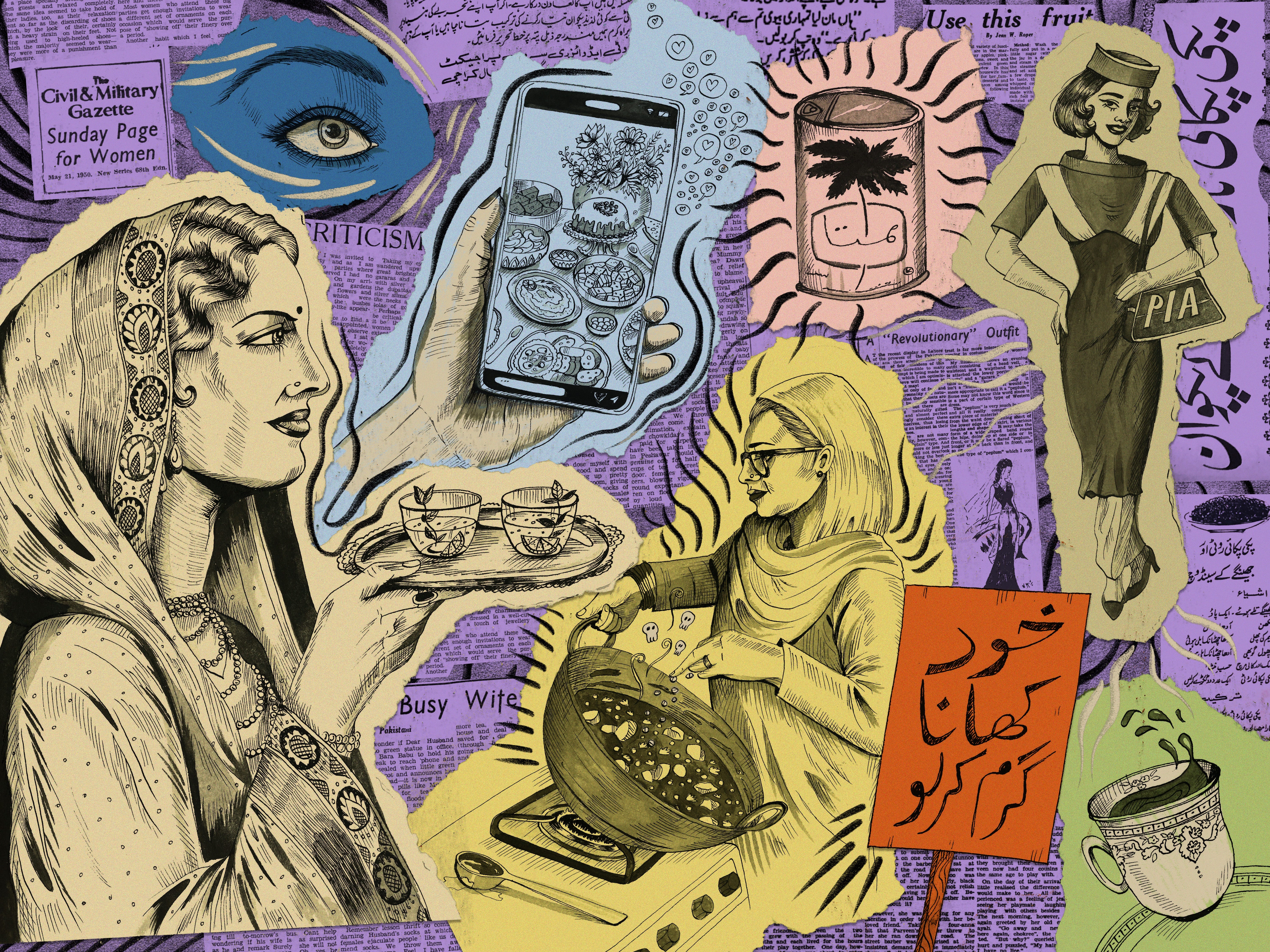
In Pakistan today, the idealised female cook isn’t just the homemaker who can cook well. Now we’ve got the domestic goddess. Fashion influencer and domestic goddess. Friendly neighbour, just popping by to tell you how to make dal. The hostess with the impeccable house. There’s a dizzying montage: fresh produce, frying onions, a perfectly laden table, the perfect guests, the perfect selfies at the end of the night. The message is clear, regardless of the trope: building a community around food is still, very much, women’s work, and while much has changed, has it really?
This expectation to cook fresh, hot food for every meal governs women’s lives in Pakistan to devastating effect. The alleged motive behind not one, but several, murders of women in recent years has been ‘not preparing food on time’. Right-wingers were driven into apocalyptic rage in 2018 (and the years that followed) by a placard at a women’s march that simply proclaimed ‘khud khana garam karlo’ – ‘heat up your own food’. The culinary history of Pakistan cannot exclude this conversation.
Ignorance about how women’s labour makes a household function still extends to most food content. Women cook, men tell stories. And yet people love to make fun of blogs that include stories before their recipes – not taking into account that recipe developers (who often give their work away for free) and women passing down recipes have got one thing right: when they include the story of how a dish was cooked in their home, it constitutes a little piece of how Pakistani cuisines came together. I can only hope that in seventy-odd years from now, someone will read about the murder meal Ativan-laced aloo mattar somewhere – in a dusty digest they dig out of a kitchen, or in a blog where, hopefully, there will be a story before the recipe.
Note: The Civil and Military Gazette articles referenced are from the British Newspaper Archive (britishnewspaperarchive.co.uk); images digitised by the British Library Board.
Saba Imtiaz (sabaimtiaz.com) is an author and researcher living in the Netherlands. She writes about culture, food, and urban life, and her work has appeared in the Guardian, Saveur, and Roads and Kingdoms. She is the co-author of Society Girl: A Tale of Sex, Lies, and Scandal (societygirlbook.com), a true-crime investigation and social history of the mysterious death of a poet in Pakistan in 1970. She is currently working on a novel, and blogs.
Shehzil Malik is a Pakistani artist and illustrator who focuses on human rights, feminism and stories from the Global South. She raises issues around justice through illustration, street art, publications and the internet. She is currently based in Berlin.
Completely fascinated by this narration and congratulations to its author. Despite the fostered enemity of leaders across borders, one could smoothly substitute India for Pakistan in this story- the expectations from women in the kitchen seem to be the same in both the countries- must be the shared pre-Partition DNA🙂. Time and again one will hear this phrase about a career-minded Indian woman as ALSO being a very good cook. No doubt a new generation of young women is pushing back by hiring cooks. Still, there is the underlying assumption that the kitchen is the woman's domain and she is responsible and judged for what is served from there. Perhaps Pakistani and Indian women can work together by sharing kitchen stories, including the drudgery, to find the peace that has long eluded the sub-continent.


Completely fascinated by this narration and congratulations to its author. Despite the fostered enemity of leaders across borders, one could smoothly substitute India for Pakistan in this story- the expectations from women in the kitchen seem to be the same in both the countries- must be the shared pre-Partition DNA🙂. Time and again one will hear this phrase about a career-minded Indian woman as ALSO being a very good cook. No doubt a new generation of young women is pushing back by hiring cooks. Still, there is the underlying assumption that the kitchen is the woman's domain and she is responsible and judged for what is served from there. Perhaps Pakistani and Indian women can work together by sharing kitchen stories, including the drudgery, to find the peace that has long eluded the sub-continent.
loved it!