

The British Influencer Invasion!
Topjaw, Eating with Tod, Jolly and Thomas Straker in America. Words by Aaron Timms. Illustration by Alex Brenchley.

Good morning, and welcome to Vittles Restaurants. In today’s special dispatch from Issue 1 of our magazine, Aaron Timms reports on the invasion of America by a new wave of British food influencers — Topjaw, Eating with Tod, Jolly and Thomas Straker — and asks ‘what is it about privately-educated Englishmen that has such a hold over American society?’
There are still a few copies of Issue 1 left - to buy it, please visit our website.
The British Influencer Invasion!
Topjaw, Eating with Tod, Jolly and Thomas Straker in America, by Aaron Timms
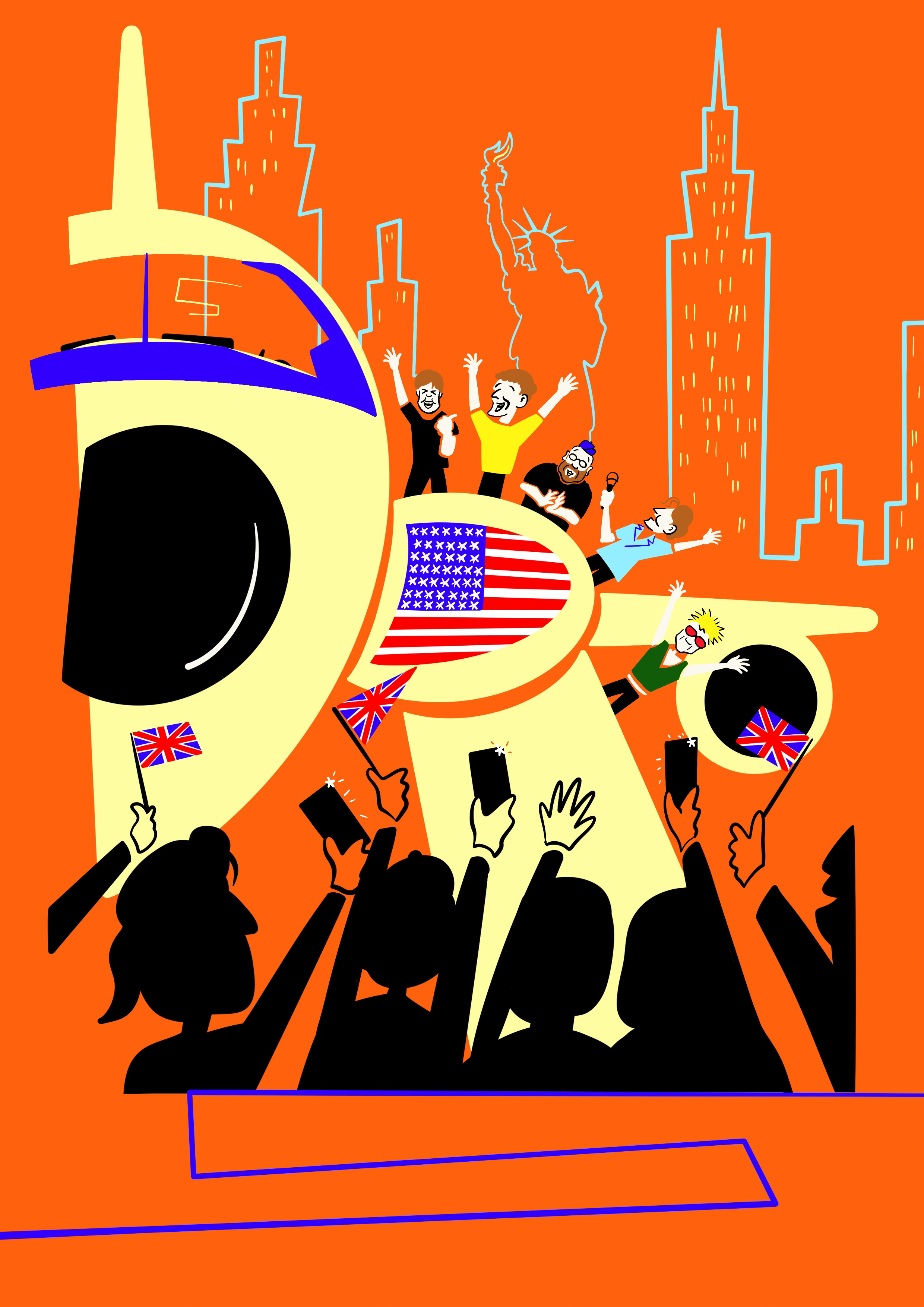
Ever since John, Paul, George and Ringo touched down at JFK airport in 1964, the British have been masters at feeding America back to itself. Today that metaphor works increasingly literally, as a fresh generation of British food influencers crosses the Atlantic with the aim of cracking – and eating – America. Topjaw, Eating with Tod and Jolly are among the leaders of this wave; more recently, they’ve been joined by chef Thomas Straker, a kitchen ‘bad boy’ so wild and unpredictable he is planning to capitalise on his online fame by doing the unthinkable and opening a restaurant in New York. These social media gourmands share a background (private school), a dress sense (gap-year casual) and a skin colour (white); their success in ingratiating themselves to the locals offers proof of the enduring hold that posh-sounding English blokes with floppy hair have over the American psyche.
All of these influencers are creatures of video, existing in a permanent state of reel-packaged wow. But they each bring unique stylistic inflections and gimmicks to the earnest work of staying maximally amazed. Topjaw are a classic dom–sub duo in which one slightly better-looking friend (Jesse Burgess) commands the screen, while the other (Will Warr) is relegated to camera duties, rarely appearing in videos unless it’s to squint from a small gimp box tucked into a corner and say something like, ‘Er, what’s that mate?’ Jolly are another pair of ‘best friends’ who mostly operate on YouTube (‘We’re Josh and Ollie, and we’re very Jolly :D’ announces their bio, which gives a sense of the irrepressible smileyness of their online output); they strike me as the type of guys who put ‘haha’ at the end of every text to make sure it’s clear that they’re in a good mood.
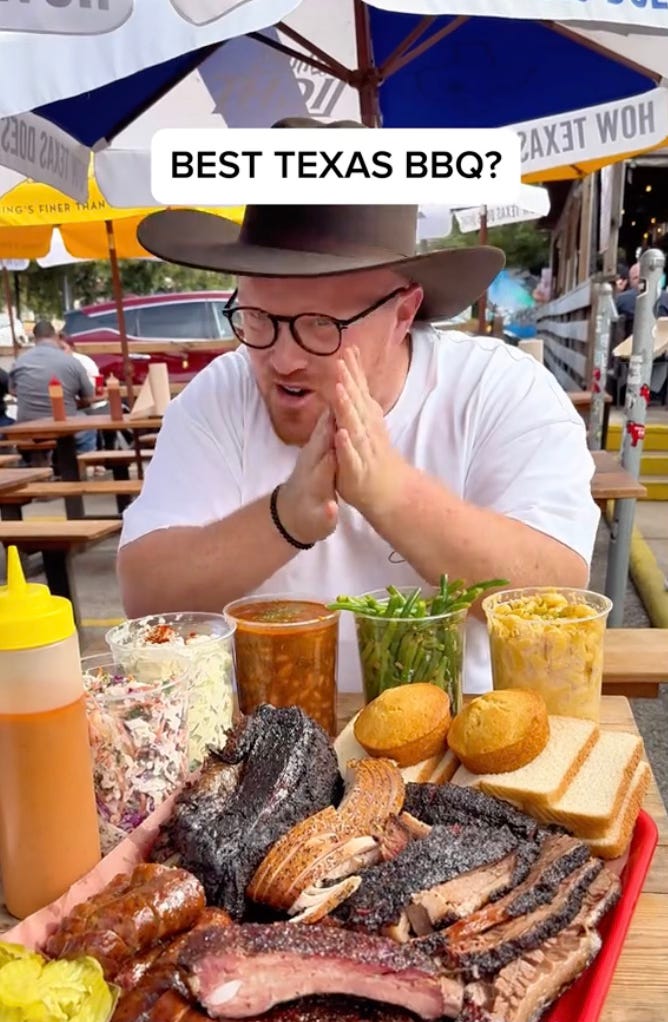
Toby Inskip, the man behind Eating with Tod, has a sheer, hand-rubbing enthusiasm for the business of tucking in; indeed, the hand rub is his visual signature, usually performed with mouth agape and eyes bulging, a Soyjak-lite expression Inskip maintains through bone pulls, cheese spills, crumb displays and taco squeezes. Then there’s Straker, who’s notable in this universe not so much for the food he eats (though his mouth is a site of regular violence) as for what he makes: wood-fire cookery, seasonal small plates, and spunked-up British classics (pies, pasties, mashes and roasts) that follow contemporary dining trends so militantly they often seem like they’ve been generated by an algorithm. (Straker’s father was second in command of the SAS, so perhaps there’s a genetic explanation for this martial discipline.)
“A monkey left to its own devices in front of a typewriter may eventually produce the complete works of Shakespeare, but a British food influencer hitting their phone keys at random will only ever end up recommending that visitors to New York eat a pastrami sandwich at Katz’s before bouncing over to Lucali for pie.”
Over the past year and a half or so, each influencer has feverishly filmed and posted videos of their eating exploits across America. Around New York, where I live, the interest in these characters is as palpable as it is mystifying: with the possible exception of Straker, who at least knows his way around a mallard, none of them has any great talent, charisma, or wit. But their cross-state jaunts and rising popularity are more than a mere testament to how far a modicum of confidence and a punctuating ‘Yeah?’ can still take you on these shores.
Self-esteem is the real fuel of America, and in that sense the trans-Atlantic super-eaters are best understood as engines of production, vital cogs in an economy that runs on marketing and hype. Consumption may be their primary activity, but the real task is to nourish the American soul: their hungry-eyed wonder at this country’s size and appetite confirms that across culture and in the kitchen, America still has the juice. And the British are here to drink it.
These athletes of the dining table are not strangers to the world beyond the UK and the US, but it’s in America that their collective cultural project has found its real shape and identity. Straker has spent much of the past few months jetting between London and New York, where he’s collaborated on a number of buzz-building pop-ups ahead of the planned opening of his own restaurant later this year. His Manhattan jaunts have seemingly been less about making food or location-scouting than about refining a particular vision of himself as the playboy chef, the bratty Brit gone wild in America: one Instagram post was filmed to make it look like he’d partied so hard he’d passed out on a bed of boxes.
Topjaw, Jolly, and Eating with Tod, meanwhile, are all frequent visitors to Europe, but so much of what they do there is eat and celebrate American food; hence Valencia becomes gastronomically notable for having the ‘best burger in the world’, London distinguishes itself for its Texas-style barbecue scene, and in Paris the big draw is the place run by the ‘pioneers of the smash burger in Europe’. Jolly even have a whole series in which they feed American fast food to people in the UK: ‘British College Students try Shake Shack for the first time!’; ‘British Highschoolers Try American Soft Drinks for the first time!’, and so on – as if such things aren’t already widely available in most British cities. The British foodfluencers are elite propagandists for the American-led, social-media-accelerated monoculture, leading us down the culinary drain one ‘amazing’, ‘bomb’, or ‘unforgettable’ BBQ platter at a time.
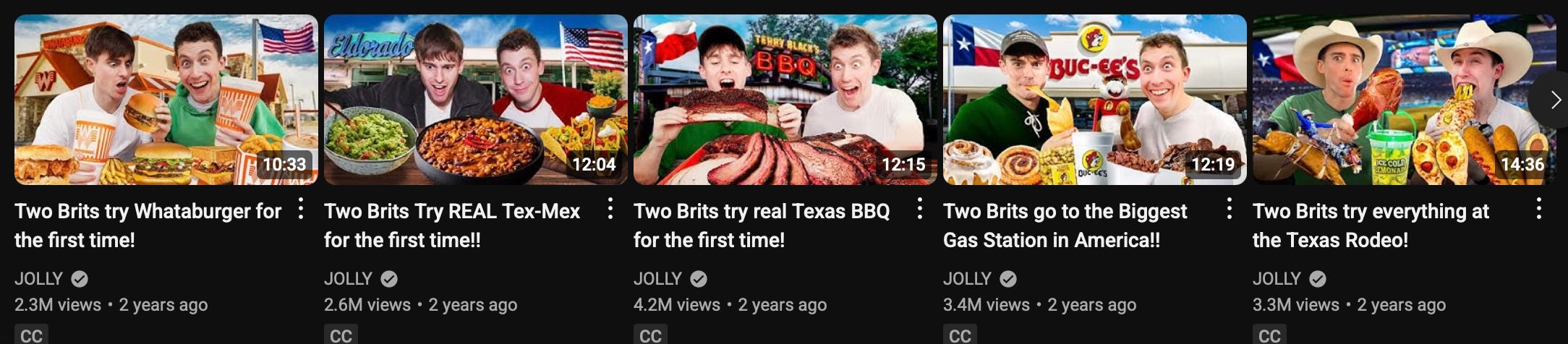
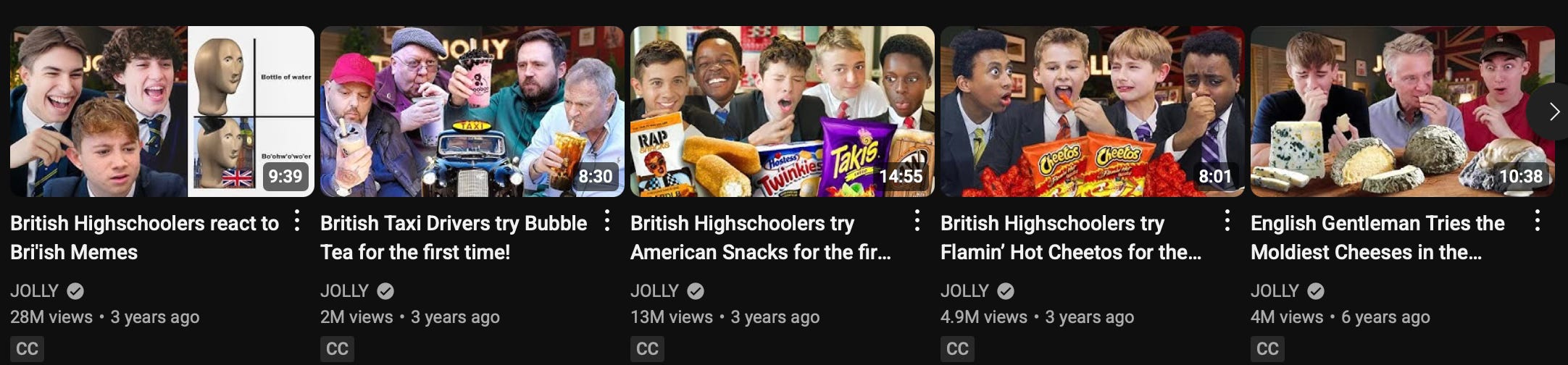
But in America, Topjaw, Jolly and Eating with Tod’s real mission becomes clear: to restrict, not expand, collective taste. The type of food tourism that they engage in is regurgitative rather than exploratory; it avoids risks, relying instead on the advance party of traditional and social media to set its basic course, and the work that results is often designed to game the algorithms that govern the main social platforms. Jolly in particular present themselves not only as eternal students but eternal virgins. Their journey across America is experienced as a sequence of firsts, a non-stop popping of the cherry that’s captured in the titles of their videos: ‘Two Brits try Shrimp and Grits for the first time!’; ‘Two Brits try Southern Desserts for the first time!’; “Two Brits try Detroit Pizza for the first time!”; “Two Brits try Wendy’s for the first time!”; “Two Brits go to Trader Joe’s for the first time!”. Tonally, this is very different to the pantsy vamping of Topjaw, who mix longer, documentary-style features on YouTube (‘48 HOURS IN NEW YORK’; ‘48 HOURS IN BROOKLYN’; ‘New York’s Best Restaurants’) with shorter interviews with New York chefs and food-world figures on Instagram and TikTok, popularising the (mostly untrue) idea that chefs know best. It’s perhaps no surprise, then, that most of the New York chefs featured on Topjaw recommend eating at the same places: Red Hook Tavern for burgers, Halal Guys for street food, Le Bernardin for fine dining. A monkey left to its own devices in front of a typewriter may eventually produce the complete works of Shakespeare, but a British food influencer hitting their phone keys at random will only ever end up recommending that visitors to New York eat a pastrami sandwich at Katz’s before bouncing over to Lucali for pie.
Discovery – of the country, of the self – is the common core of the foodfluencers’ mission in America. New York may be the first port of call, but it’s in Texas that their idea of America – as a place of irresponsibility, possibility, and excess – really comes to life. Inskip, a regular visitor to Austin, has posted reel after reel in which he essentially does nothing but stare agog at the majesty of a fully loaded Texas barbecue platter. Everything about this type of food – the size of the pits, the number of cows the restaurants plough through every day, the length of time the joints of meat spend in the smokers, the bounty of sides, the idea of payment by weight – is so dizzyingly maximal it seems tailor-made for the hypebeast economy, licensing a complete abandonment of critical proportion: in the space of two days last November, Inskip declared both the short rib at Terry Black’s in Austin and its equivalent across town at Interstellar ‘hands down the best short rib I have ever had in my life’.
“The type of food tourism that they engage in is regurgitative rather than exploratory; it avoids risks, relying instead on the advance party of traditional and social media to set its basic course”
Still, the achievements the British foodfluencers celebrate here don’t belong to America alone. In the forward-thrust of these cultural emissaries, it’s tempting to detect a post-imperial fantasy which faintly transmits a kind of pride in the United States as an optimised repackaging of their colonial progenitor. In their own small way, all these encomiums to the majesty of New York’s historic coal ovens, the steam-locomotive-sized smokers of West Texas and the trompos of LA amount to a claim for a piece of the hegemonic action – or, at least, for credit: in every epiphanic visit to In-N-Out or Taco Bell, there’s a tacit reminder that none of this would exist without Britain. The comfort the platform gluttons feel here, submerged under the riches of the American table, is a comfort born in part of familiarity.
Given the waning influence of post-Brexit Britain – this all makes a rough, if mildly perverse, kind of sense. The British are not to the Americans what the Ancient Greeks were to Rome (the font of all beauty, grace, and wisdom); they’re more like the Phanariots of the Ottoman Empire, the post-Byzantine Greeks who elbowed for influence and power in the Sultan’s court after the fall of Constantinople. Topjaw and co are pilgrims in the imperial core, pledging their allegiance to the great god America, building their prestige one life-changing birria at a time. When Topjaw ask, ‘Is Emily’s the best burger in New York?’ but don’t answer the question; when Jolly eat pizza with Cug and laugh just a bit too hard when the Italian–American influencer describes their first flopless slice as having taken Viagra; when Straker grunts ‘mmm’ as he applies the olive oil crown to another triumphant canotto at yet another downtown Manhattan pop-up; when Eating with Tod calls the chicken cutlet alla vodka sandwich from Mama’s Too ‘sex on a sub’ – well, it’s not quite The Beatles at Shea Stadium, but it’s still something. The next best thing to having an empire is getting views in someone else’s.
The Influencer Stats
Eating With Tod

Real Name: Toby Inskip
Followers: 1.9M (Instagram), 242K (YouTube), 886K (TikTok)
Schooling: Princethorpe (private)
Former side Job: Project manager at property consultancy Circle Development.
Vibe: A sheer, hand-rubbing enthusiasm for the business of tucking in, usually performed with mouth agape and eyes bulging.
Topjaw
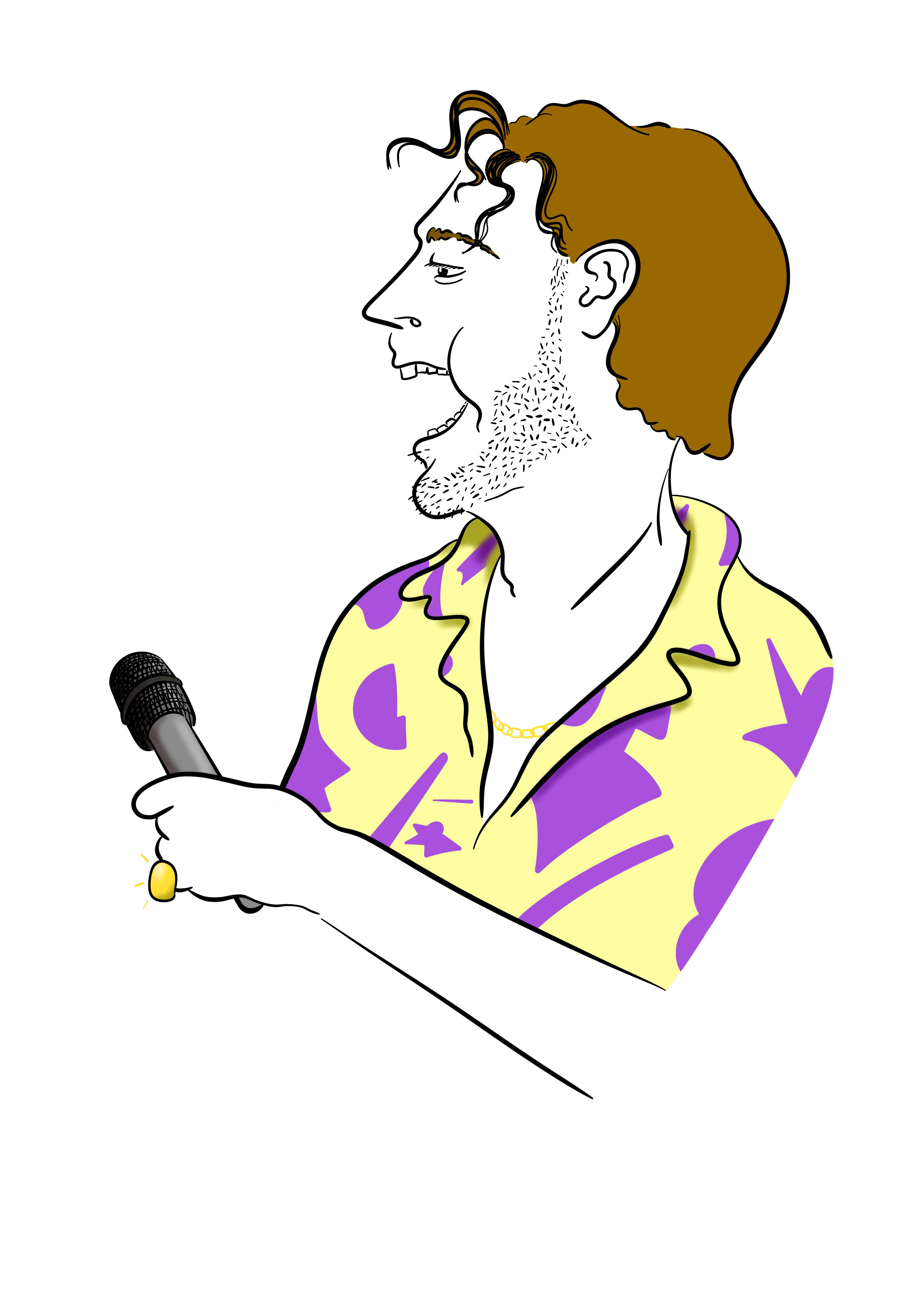
Real Names: Christopher John (Jesse) Burgess and William Warr
Followers: 825K (Instagram), 416K (YouTube), 203K (TikTok)
Schooling: Burgess — Kimbolton School (private); Warr — Bloxham School (private)
Side Jobs: Burgess works at 44chance, which delivers ‘design led property developments in London and surrounding counties’. Warr was responsible for directing the Duke and Duchess of Cambridge’s comeback PR video.
Vibe: Jesse plays a kind of Etonian cad, purring through interviews with loose-shirted insouciance, projecting a complete absence of inferiority before his food celebrity subjects and their creations. He seems perennially horny, and he’s made cheeky-boy Are You Being Served?-grade innuendo a cornerstone of his online persona. Opening littleneck clams in the kitchen at Emilio’s Ballato during Topjaw’s guide to New York, Jesse winked at the camera: ‘I’ve never opened a clam before – not one of those ones anyway’. (Elsewhere, he explained that the dough at a Brooklyn pizza joint was stretched out ‘thinner than knickers’.)
Will’s vibe? No real vibe.
Jolly

Real Names: Josh Carrott and Ollie Kendal
Followers: 4.7M (YouTube), 515K (TikTok)
Schooling: Carrott — International School of Qingdao (private); Kendal — masters degree in Biblical Studies
Side Jobs: Unclear
Vibe: Jolly operate in a strict ocular range between puppydog and gooner, and reactively they do little more than say, ‘Oh my god this is amazing’ over and over while biting into the next hunk of steak or cake.
Thomas Straker
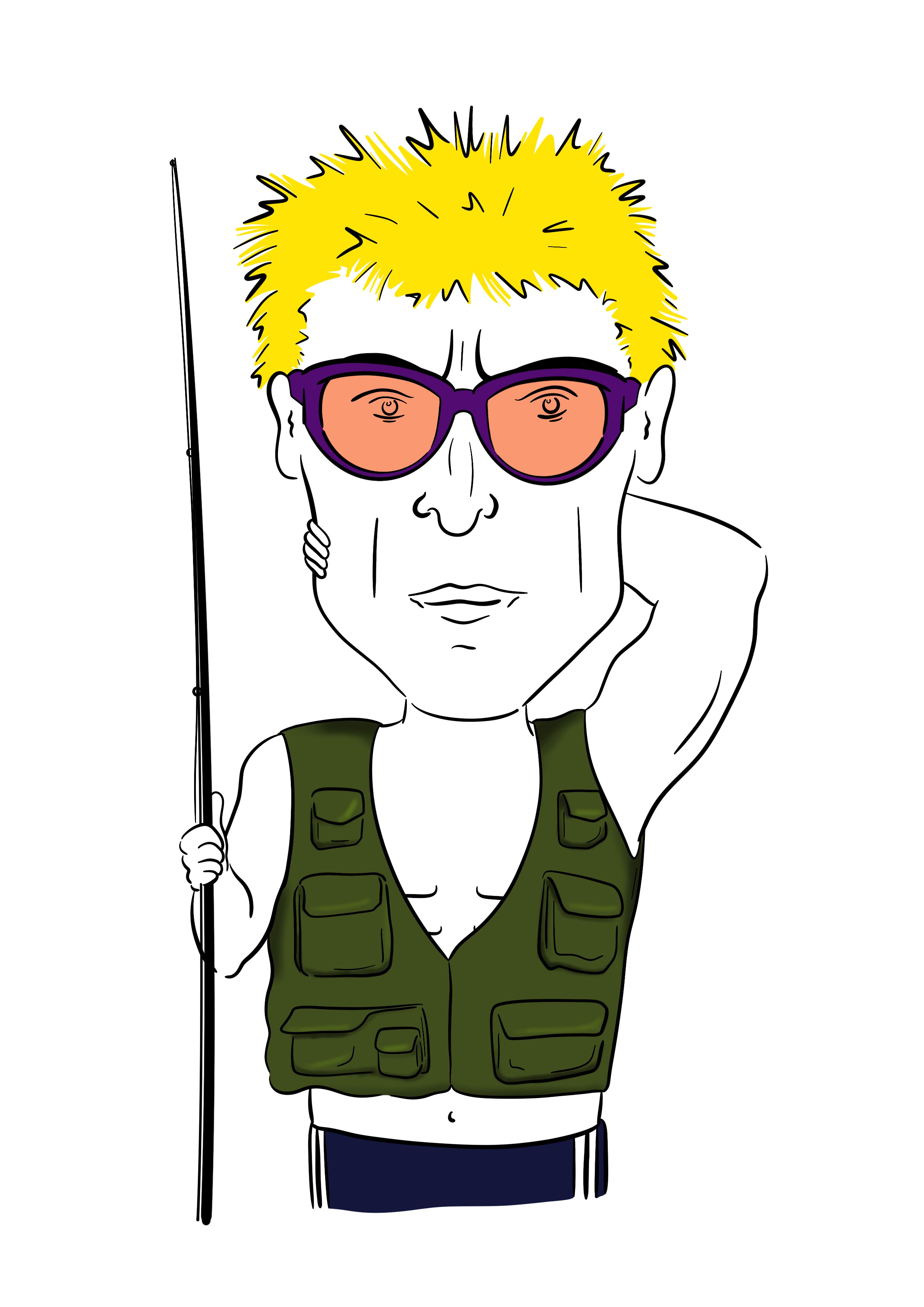
Real Name: Thomas Straker
Followers: 2.6M (Instagram), 420K (YouTube), 2.5M (TikTok)
Schooling: Shrewsbury School (private)
Side Job: Chef
Vibe: A bleach-blond minstrel of the modern British flatbread, Straker projects a permanently hungover, just-fucked energy, groaning and moaning through his kitchen preparations with the drained languor of a morning-after raver rolling away for a post-coital nap. Last summer, he appeared in most of his videos shirtless, and the spectacle of his glistening, hairless torso weeping into various crudos and salads offered an ‘All Things Nipple’ distraction from the relentless promotion of his ‘All Things Butter’ line of compound butters.
Credits
Aaron Timms is a writer living in New York.
Alex Brenchley is an artist and illustrator based in London. His work has been used by the NHS, BBC, Universal Records and TheWellcome Collection. His ‘This England’ cartoon series ran in the New Statesman from 2017–2023.
The full Vittles masthead can be found here.
Interested on thoughts about Jolly’s other channel - Korean Englishman - which actually does feel to have some weight. They’re fluent in Korean and explore the food and culture. I particularly enjoyed a series where they introduced british school children to Korean food for the first time - was actually really great to see. So maybe they have a bit more depth than portrayed here :)
Fascinating read — particularly interested (given I’ve just published a book gawping with a similar lack of subtlety at US food culture) in the idea of deliberately reframing that to appeal to a navel-gazing American audience. Most people I met on my travels were very comfortable asking me if I’d come to the States to get away from terrible British food, which made me laugh given the sneery attitude towards (yet paradoxically enthusiastic appetite for) American “cuisine” that prevails here, as elsewhere in Europe. It’s a weird and very interesting relationship in which, as ever, Europe thinks it has the upper hand when in reality the US holds all the power. (Also, how have I missed this less than stealthy invasion?)