

The history of London's squat cafes
Chaos in the Streets. Order in the Kitchen. Chris Jones on squat cafes and their discontents

Good morning, and welcome to Vittles! Today’s article, by Chris Jones, is a history of the squat cafe scene in London at the end of the twentieth century – a tale of skip runs, vegan wars and dubious recipes with titles like SquatSlop (International). It also features a host of original imagery from the era – mostly event flyers and posters, all of which are archived at 56a Infoshop in Elephant and Castle.
This essay is taken from our second print issue, on the theme of ‘Bad Food’ – which focuses on the messy, unglamorous and chaotic aspects of food culture. You can read other pieces from the Bad Food Extended Universe here, but we highly recommend buying a copy.
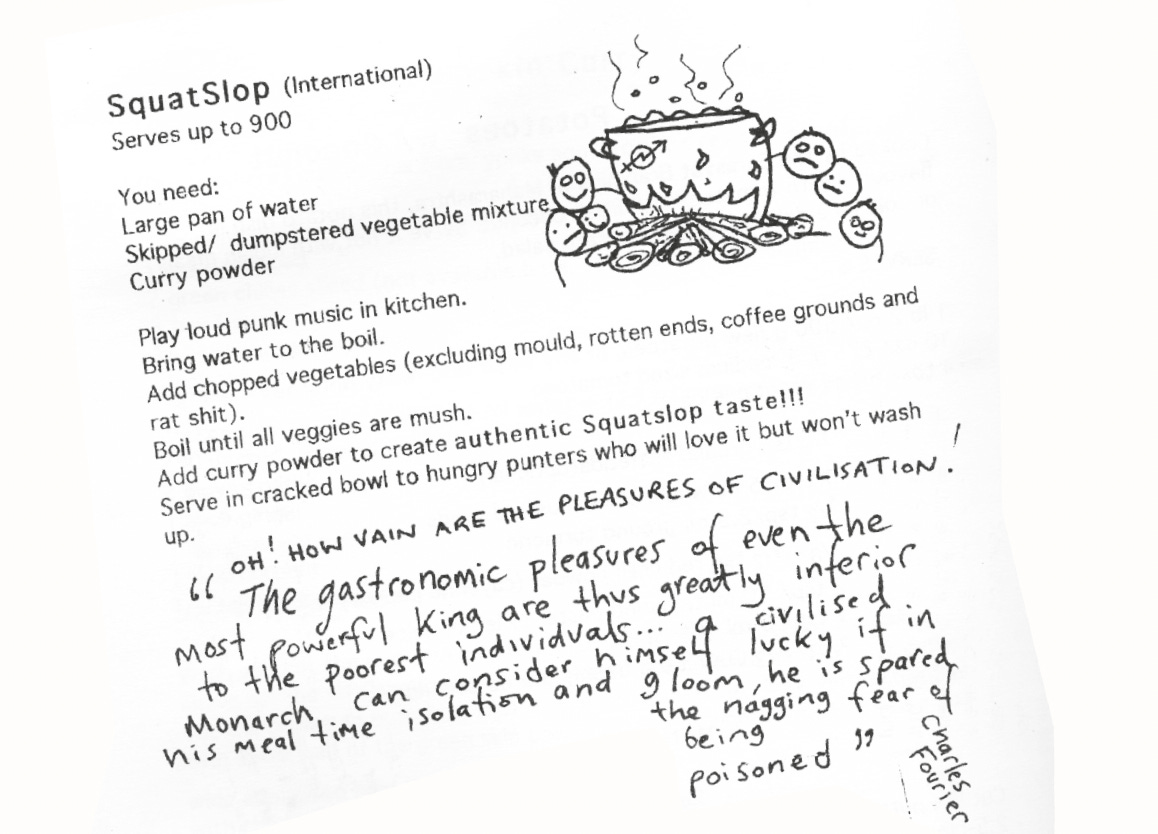
You’re standing in front of your new home and you’re happy. There are a few things to think about, though. First, you have to break in to secure it and, second, you’re gonna be evicted at some point. Oh, and third: you’re also going to have to learn how to cook for thirty-plus strangers. But, hey, it’s your new home, a beat-up, closed-down community centre in Tottenham, and you’ve found the perfect recipe in some battered anarchist cookbook:
But we’re getting ahead of ourselves.
From 1968 to, let’s say, 2012 – when the Legal Aid, Sentencing and Punishment of Offenders Act finally criminalised squatting in residential buildings, ending six centuries of English law enshrining a squatter’s right to occupy – there was a visible London counterculture of squatting empty houses, pubs, warehouses and embassies, often as part of a wider movement challenging housing conditions like high rents, mouldy interiors and a lack of council housing for those who needed it. When you’re ‘sharing’ other people’s empty buildings, it doesn’t take a great mental leap to extend that sharing to others in need. You might start cooking for all your squatmates but then find yourself opening your place up to strangers for a regular cafe night. All you needed to do was make a cool flyer and let it circulate for a bit.
These cafes could often be found in places like Brixton, Euston or Dalston – areas that would be gentrified by the late 2000s. We can still enjoy some of the squat cafes’ names anyhow: Molly’s Cafe, That Tea Room, Demolition Diner, Kollaps Kafe, Big Plates Cafe, Bar Sate, The Radical Dairy, Use Your Loaf, House of Shango, House of Brag, ACAB Cafe. From a look over the archived collection of flyers and minutes at 56a Infoshop in Elephant and Castle, where I volunteer, it’s possible to learn about a fun range of subcultural ways of being, doing and eating – ‘Good vibes. No Rules’ (Eton Mission squat, Hackney Wick), ‘Heavy Metal Cafe. Chicks ’n’ Booze, Tattoos and Food’ (56a Infoshop), ‘Slop Shop, Good Cheap Vegan Food’ (The Nevill squat, Hackney) and ‘Marco loved his mother, loved her home-cooked liver casseroles … but he always dreamed of a better place’ (Arlingford Road squat, Brixton).
It is hopefully not a useless exercise in nostalgia to look back at what that long arc of squatting, and the associated squat cafes, brought to London. In fact, the point is to be inspired. People always come together to create alternative ways of life in moments of abundance or scarcity. In our current time of food crisis for many, can these tales – of DIY culture, mutual aid, and squatting communities sharing wasted food to feed themselves and others – provide some hope and vision?
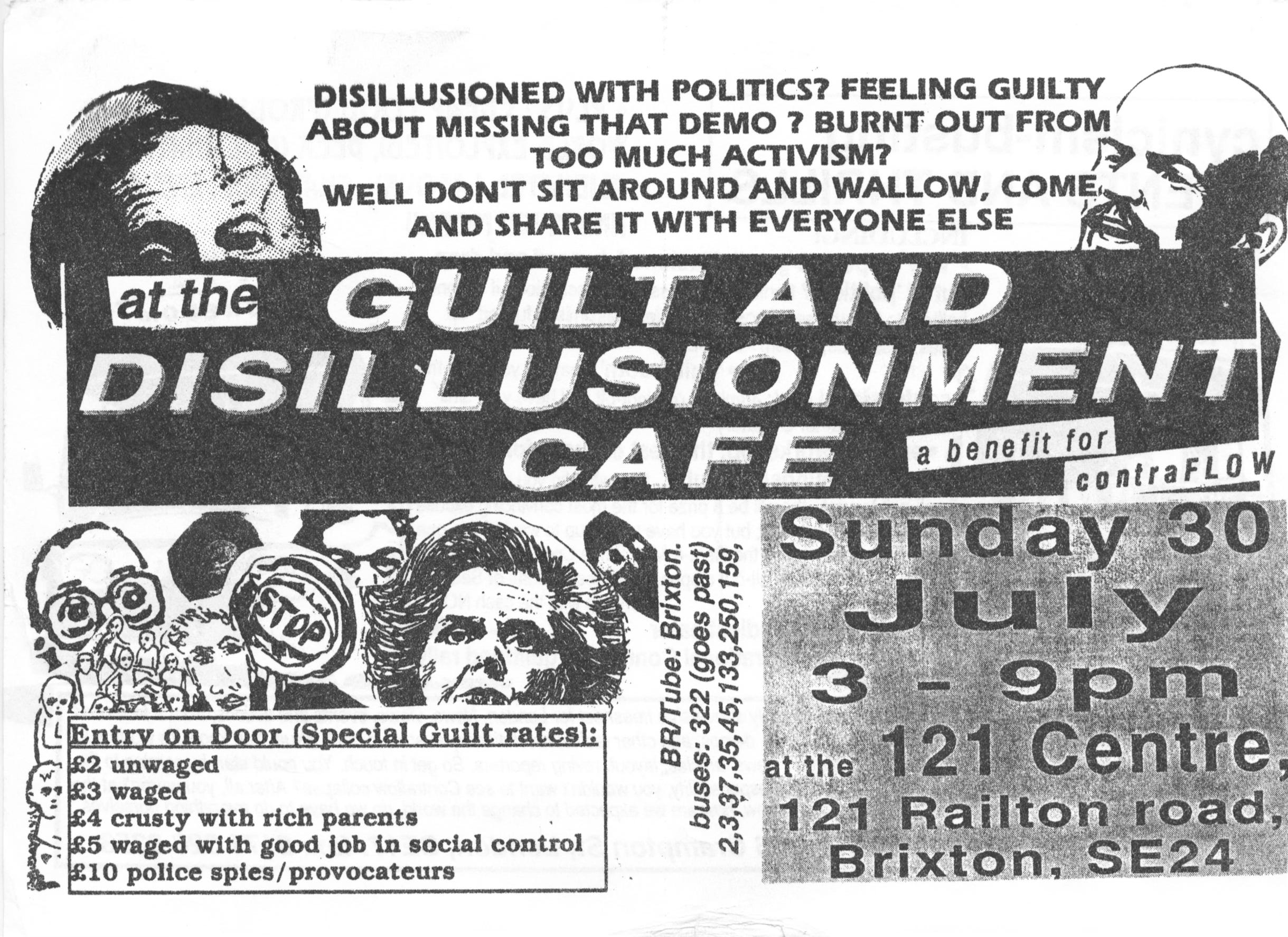
Running a communal cafe is where putting a free roof over your head meets the desire to share it. How that is done – and what problems it brings up – is a part of the thing itself. Some squat cafes were more about socialising, and people often opened up empty places solely to run events; food could be accompanied by DJs, bands, puppet shows, cabarets or film screenings. There were no chefs, just squatters learning how to make enough food for everyone who might come. A good plate of classic squat cafe rice, veggies, fake meats and salad, served on found plates and portioned up to everyone when it was ready, might cost a diner two or three quid. Or it might be pay what you can.
Archival minutes of meetings from the cafe at the 121 Centre squat are fun to read, and can clarify these moments of political expansion and personal contraction. In August 1991, there was talk of advertising the cafe ‘in hostels, dropin homeless centres, local tenants’ centres, unemployed centres, libraries’ to truly make it a resource for all who needed or wanted it – any profits from the cafe nights would go towards campaigns and political groups. We can also read, however, that the cooker broke in November of that same year; the minutes report that it took until February 1992 to mend it. ‘Fucking crap day. Everyone got nicked on the veg run,’ one entry says. ‘But the cafe goes on.’
Squatters were always pretty pro at getting food for free. The back of supermarkets were a good game, jumping into massive skips to recycle and repurpose all that trashed food. Cafes were also great late at night for the retrieval of chucked-out bags of pastries and bread. The million skip runs taken over the years to the free food paradise of New Covent Garden Market in Nine Elms have worn a rut in certain back streets of South London. Avoiding the security guards was a useful skill to learn, and if you evaded them then you could haul thrown-away boxes of bog-standard vegetables – and the occasional tub or punnet of something exotic – home with you. Coming back to your squat with kilos of skipped Jerusalem artichokes, pomegranates, chanterelles, celeriac and mandioca would certainly circumvent the typical London equation: that ‘high prices = good food’.

Conversely, the ‘SquatSlop’ recipe that opens this piece is sadly no joke. At a squat in 2000s South London (which I won’t name), I was not allowed to add onions or much curry powder to the curry I was preparing because the other ‘chef ’ didn’t like them. The coup de grâce to this curry was the ton of cornflour they poured in at the end to give it ‘some flavour’. Despite this atrocity, reports came back to us that it was ‘delicious’.
More often than not, you’d hit the local squat cafe on a Friday night and there would be a huge pan of bog-standard lentil stew with white rice on the menu. Someone might come running in from a ‘skip run’ beaming at their foraging of a load of Iceland Hot Cross Buns. Someone else might be scraping a bit of mould off some peppers, which would remind you that when you are cooking with people more hungry or strapped than you, your standards of what’s edible might not be the same as theirs. What doesn’t kill you makes you stronger and all that.
Squat ‘chefs’ also had a range of different ideologies. As someone who squatted in London for ten years and organised many cafe nights, I can tell you that The Vegan Wars of the 1980s and 1990s were real (turning up to a vegan cafe night in a leather jacket in 1985 was a real nono!). On the other end of the spectrum, cooking meat at squat cafes in the early 1990s became a weird fad way to prove you were working-class and ‘for real’. Back then, if you wanted meat substitutes, there was really only the awful and dry Sosmix or Burgamix powder or clumps of textured vegetable protein. Soya milk at this point tasted terrible. Sadly the real winners of The Vegan Wars were not the advance guard of plimsoll-wearing punks righteous about animal rights but, as ever, capitalism; these days a million ‘plant-based’ products abound in supermarkets, at hefty prices.


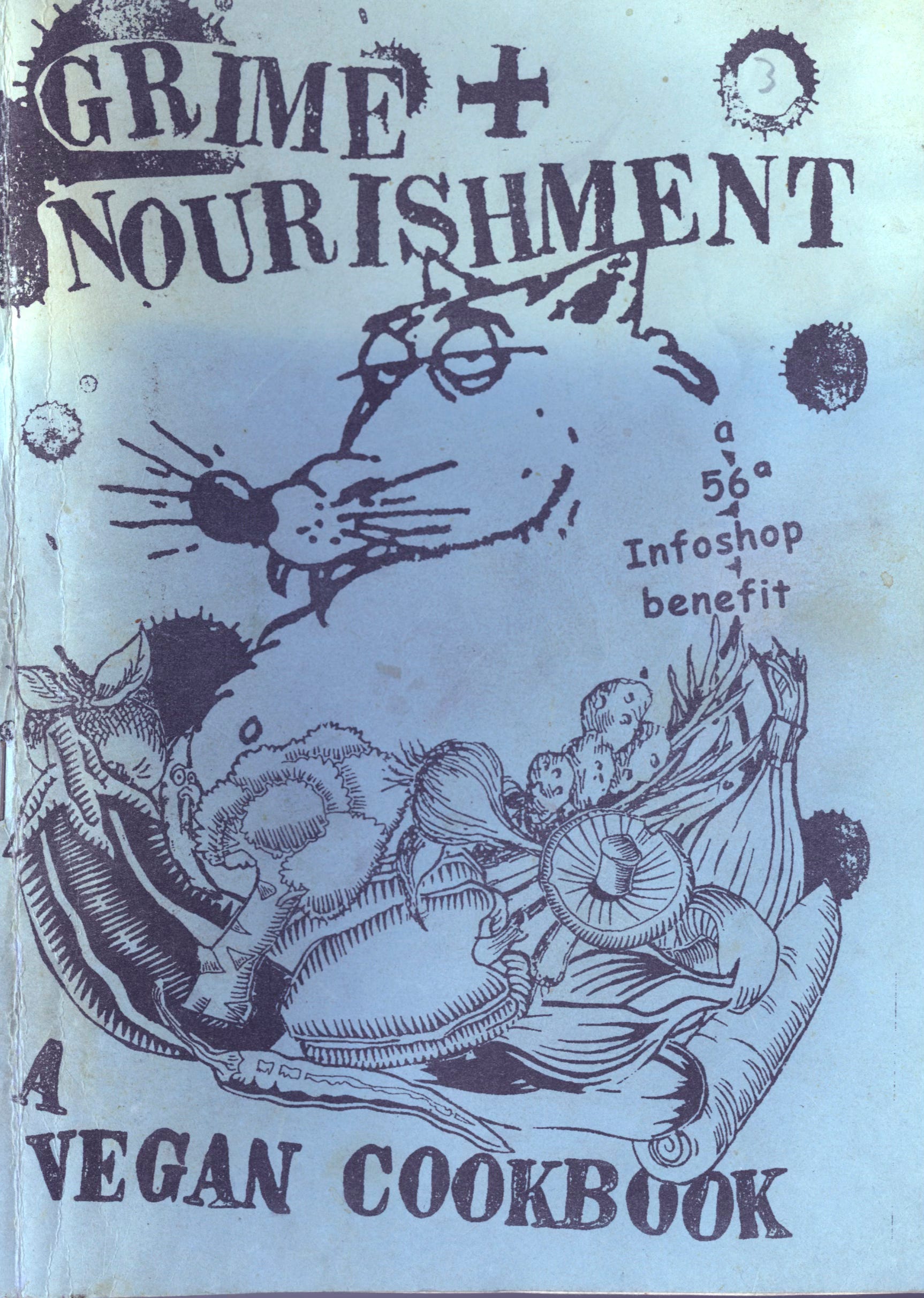
Overseas influences brought fresh hope, although the squatting scene was, against the grain of London at the time, very white. In the 1980s, Italian squatters brought pizzas. In the 1990s, French squatters brought piquant soups and freshly made bread. In the 2000s, Polish squatters brought… well, you get the idea. The best document we have of this shift is the vegan anarchist cookbook Grime and Nourishment, whose recipes for succotash, Pennsylvanian chowder, Argentinian stew, vegan escargot, Brazilian rice and colcannon detail the passing of many peoples through London. By 2005 (the year of ‘Kinky Korma, Salad Kudos, Avocado Krushin’, Mint Tea Klash and Mushroom & Kale fry up, 1 Kwid all in – no blaggers’ at 56a Infoshop), the days of squat slop were being banished for good. Cafe Ramallah at the Bacon Factory squat in Bankside provided people with ‘posh food and Palestinian music’, while the infamous Sex Cafe at 121 Centre served ‘HOT mexican tostadas with beans, salsa, salads and soya sour cream’, promising that this would be such ‘a sensual feast no cutlery will be provided’. If I remember, people were also directed to feed each other. A handwritten sign at the Sex Cafe jokingly advertised ‘Blow Jobs – £5. Round The Back’, but when a live sex peep show was enacted in the basement, it raised zero money from the shy nerds in attendance.
Though 2012’s law change did inevitably send squat cafes into decline, there is a culinary legacy of squats that can still be seen in London today. Most notably, Alara Wholefoods – once a 1970s food co-op squat in Euston’s Tolmers Square – is now, for better or worse, a multi-million-pound muesli business. Fareshares Food Co-op, who occupied the empty grocer’s shop in 1988 and still share a building with 56a Infoshop, characterised their squatted wholefood emporium as ‘not a shop [but] an experiment in community’. A Fareshares newsletter from 1991 reads, ‘Decent food, like housing, is a basic necessity and ideally shouldn’t cost anything at all. Fareshares is a small practical gesture in that direction’. That’s a great pithy encapsulation of what a somewhat lost ‘politics of food’ means!
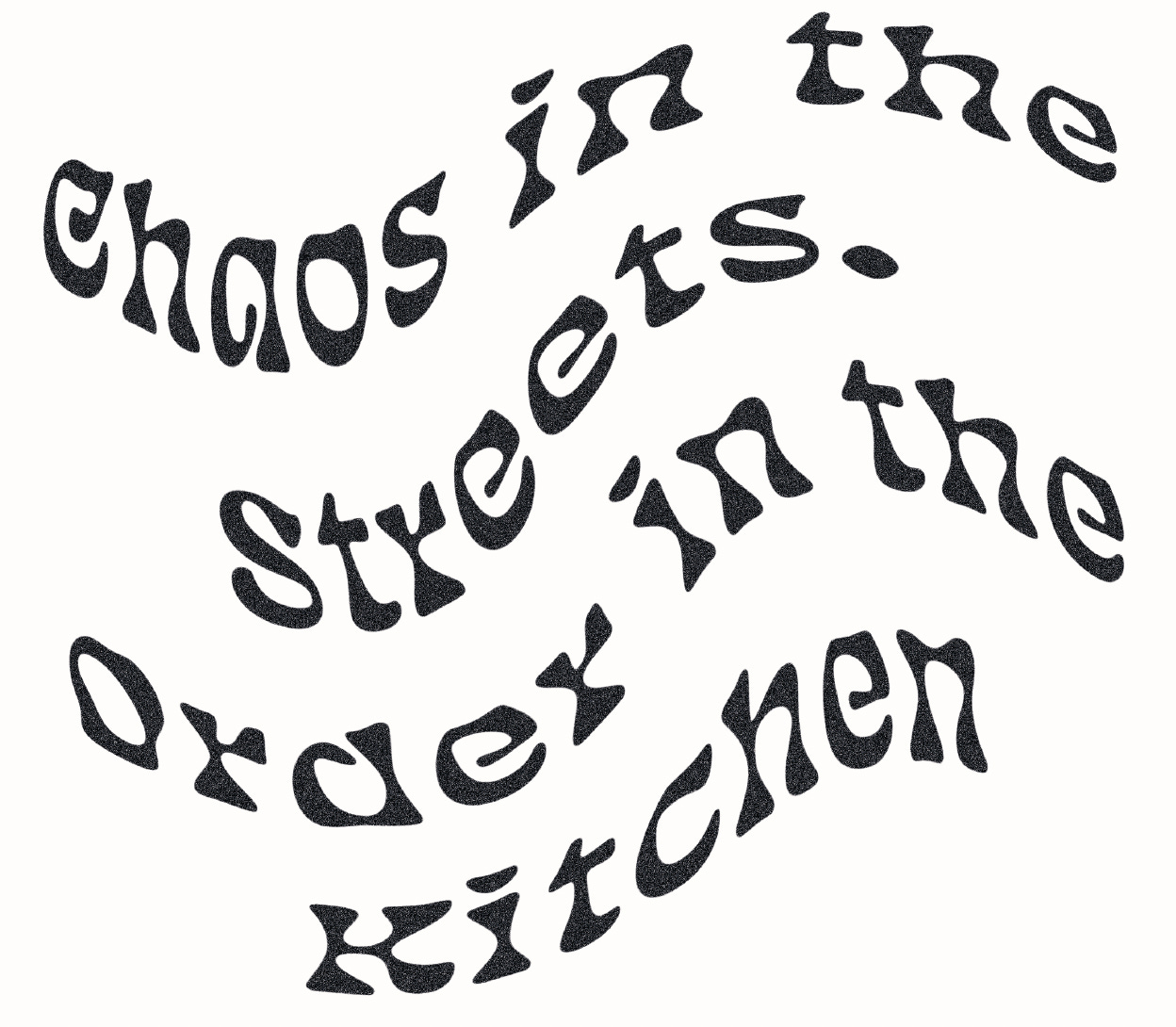
Some squat cafes continued, showing an alternative way of consuming. During the 2010s, the squat Colorama 2 centre, near Elephant and Castle, ran a ‘People’s Kitchen’. On its blog, it wrote: ‘We live in an extremely rich, wasteful, and expensive society, we think that using food which has been thrown away but is in a perfectly fine condition is a really good alternative of providing cheap meals and undermining consumerism on a daily basis.’ Detailing a typical meal, made from skipped vegetables, at the People’s Kitchen, the blog continues: ‘We chopped vegetables for a curry, spiced and boiled beans for a bean salad, herbed and garliced nearly 40 portobello mushrooms for grilling, toasted rolls and made a large green salad.’ It was always cute to see the handwritten sign on the wall of Colorama 2: ‘Chaos in the Streets. Order in the Kitchen’. The implicit message was: Go to your protests and riots but please keep the cooker clean and do the dishes.

Of course, these encounters of squatting and serving and being served food are not free of social tensions, hierarchies of class or different privileges, abuse and crap behaviours, but no experiment is pure. Back then you could be middle-class and dress up as if you were poor in your squat in Brixton or Dalston. These days you can be middle-class and actually be poor in your shared rented home in Brixton or Dalston. Walking around London now, can you imagine how you could live more easily, more playfully? A reflective article in Camden News Journal by former squatter Jeremy Worman captures the utopian feeling of the early squats:
My visionary hope was to join a collectivist libertarian community (the squats had been going since 1974). For the first week it felt blissful. There was a cosy squatters’ cafe at the bottom of Hornsey Rise, providing wholesome food, magazines to read, chess and backgammon boards, people to chat to. This place exemplified my hippy dreams where no one was judged by their backgrounds but only by where we were trying to get to – a place beyond the destructive capitalist world.
Although a flyer from less than ten years ago (for ‘Scum Dine With Me’, a cafe run by ‘Squatters Against Gentrification’) promising ‘a free dinner every Thursday with your local squatters’ now seems from a Golden Age, it’s clear that the criminalisation of residential squatting has not killed things off forever. In April 2024, Gordon Ramsay’s closed-down York & Albany Hotel was ‘liberated’ for use as the Camden Art Cafe. The squatters’ communique says, ‘We aim to open our doors regularly to anyone and everyone … we provide free food, drinks, and a space [for people] to display their art’. The Daily Mail was outraged, of course, condemning the squatters but publishing a few lovely photos of the food.
Elsewhere, the Autonomous Winter Shelter crew have held spaces that function as free homes for homeless people. They say: ‘To open an empty space in order to provide food and clothing is to act in a meaningful way in this time of social emergency.’ According to one report, residents with no money to their name sometimes came with bags of food to share, having negotiated donations from neighbouring shops. Both go beyond satisfying individual housing needs, placing you in the beautiful social solidarities that squatters enact against contemporary London poverty and alienation.
So, here we are in 2026, and we’ve finally caught up with ourselves. Notions of how it was better in the past serve no one. Many of the things we might still enjoy in this currently cursed London come out of those historical energies, which have been transformed into existing wholefood co-ops or community cafes, bookshops, music venues and art spaces, women’s refuges, queer cabarets and Black community supplementary schools. These tales of squat cafes are only meant to point people towards the possibility of trying it out. The question is: what kind of life, in what kind of city, do you want? What kind of radical challenge can we make to the ever-increasing ghost towns of high streets, given over only to the buying of overpriced coffee and pastries? What deep hunger inside you drives you towards something different? Could you occupy yourself and others with a bit of squatting? Could you expand the glories of the glorious Food International? Could you and your mates be the rupture that breaks the impasse? It’s up to you, you good, good people!
Forward to, and beyond, SquatSlop, forever!
Resources
Advisory Service for Squatters,
84b Whitechapel High St, London E1 7QX
(020 3216 0099)
Squatter.Org.Uk
56a Infoshop And Archive,
56 Crampton St,
London SE17 3LH
56a.Org.Uk
Credits
Chris Jones is entering another decade in London Town, mostly at Elephant and Castle, within its recent ruination from regeneration. Chris volunteers at radical social centre 56a Infoshop and Archive and writes pamphlets about Southwark histories. He also writes other stuff and believes ‘better must come’ if we all put our minds to it.
All images courtesy of 56a Infoshop. Thanks to Egle Trezzi for her help with scanning them.
Thanks to Caterina. This piece is dedicated to Squatter Saul (RIP 2025).
The full Vittles masthead can be found here.
Love this essay so much. Just brilliant. Reminds me of writing about the history of the Turkish Kurdish immigrants of the 80s in warehouses of north London. This essay and beautifully researched archive is an antidote to as Chris puts it ‘contemporary London poverty and alienation’
Am I right in thinking The Bonnington cafe in Vauxhall, which is still open, now legal and owned by the co-op community, was a squat kitchen? I thought I might see if mentioned here. I cook there once a week