

‘Why can’t you eat when you have a crush?’
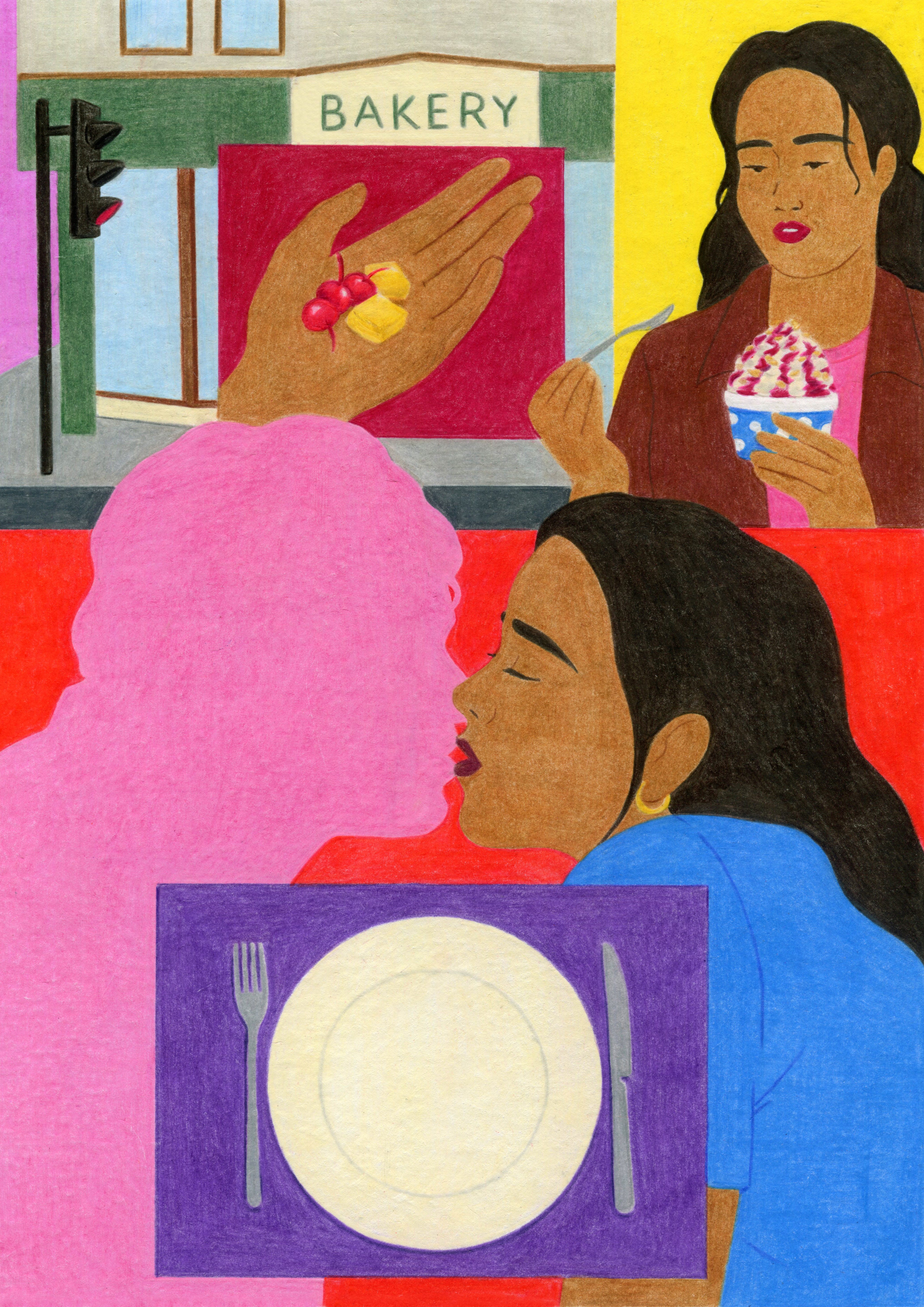
On losing her appetite in the presence of romance, by Sharanya Deepak. Illustration by Lisa Carpagnano.

Good morning, and welcome to Vittles! Today Sharanya Deepak writes about the disappearance of her appetite in the presence of romantic partners.
A subscription to Vittles is £7/month or £59/year. Vittles is entirely subscriber funded, and your subscriptions help to pay all our writers, photographers and illustrators at a fair rate.
I have never loved a man who welcomed my appetite. This thought formed one day at a restaurant in central London, where I was eating among people I had just met.
The group had erupted in familial havoc as soon as we sat down, as often happens when South Asians get together abroad. We were mostly new to one another, and on our walk to the restaurant, casual rivalries had already emerged, with people rallying for others to join their side. When we entered, I thought I felt the room shrink from our raucousness. Two tables of white people – probably real families – began to talk politely to one another, as if conducting conversation simply to compete with ours.
‘Dai! Everyone has ten minutes to order, no more!’ the group’s self-appointed patriarch announced from one side of the table. Another man flung his menu at me, tired of its ornate British manner. ‘Order something for me,’ he said, becoming my annoying older brother for the night. The man opposite me, in contrast, was patient, and ordered quickly after he read the menu, a bowl of noodles. He was hungry, I knew – I had heard him tell someone else he had worked all day, skipping lunch.
My sister was more cutting….‘Why can’t you eat when you have a crush?’
When our food arrived, dishes were passed round, the ownership of each one dissolving as they circled the table. I drank a beer slowly and, because I was sitting at a desolate corner, much of the food disappeared before it arrived on my side. This is when the man opposite me pushed his bowl to the centre of the table. When someone else’s spoon approached, he gently held up his own to obstruct it, as if telling them gently to wait until I had eaten. ‘Why are you doing that?’ he said, laughing, as I served myself some noodles and a few pieces of meat. ‘Take as much as you want, don’t take two helpings and put one back.’
Later, my friends listened patiently to this anecdote. ‘What kind of restaurant was it? Was it good?’ they asked, humouring me. My sister was more cutting. ‘Good man’, she said calmly in a voice note. ‘But why can’t you eat when you like someone?’ Before she pointed out this tendency, I had attributed my inability to eat that night to the chaos that premised our meal. ‘What’s your problem?’ she continued, and I could hear her fiddling with her pressure cooker, letting out steam. ‘Why can’t you eat when you have a crush?’
I once loved a man for so long that I sometimes referred to him as the ‘love of my life’. With stories of this man, friends were less accommodating. They would turn away when they heard me embellish him with fake qualities. After the first few years, my sister would accept no mention of him, marching from the room whenever he came up. One of my embellishments was that he had fed me well. ‘He always knew when I was hungry’, I would say. It was true that he was a good, occasionally great, cook, and sometimes made elaborate meals. But the narrative that he cooked for me as a routine aspect of our relationship twisted that fact into an insidious lie.
I loved watching him cook because I loved watching him do anything. He was a beautiful man, and we were often in remote places that rendered me dependent, more foreign in his country than I already was. Once, I followed him around ten supermarkets looking for a Bundt tin – he needed it to make a complicated Iranian cake. Another time I watched him shell broad beans for hours before eventually adding them to a large omelette (I modified and cooked this recipe after we finally grew apart). He had learned almost no recipes that connected him to the country in which he was raised; his loyalty was to the city of his birth – a beautiful, ancient metropolis that an American military had trampled and destroyed.
I imbued his cooking with extra meaning, but in real life, it was a wavering, sporadic gesture.
For a while after we stopped speaking, I held on to these visions of him preparing food. I considered them the ‘good bits’ of our relationship: there was the time he peeled the skins off peppers for hours to make an elaborate dip; the day he wordlessly shelled langoustines in a restaurant. With these recollections, I tried to erase the memory of the loneliness I felt on other days. I imbued his cooking with extra meaning, but in real life, it was a wavering, sporadic gesture; it did not have the reliable, routine quality of care. I buried the thoughts of the morning when I stayed hungry until he wanted to eat, afraid of starting an argument by turning on the stove. Or the times he left the flat for days without a word, when I wandered around the city looking for him, halving a sandwich in a paper bag so it would last me two mealtimes.
Our physical intimacy was also sporadic and dependent on his mood. If I broached this, even in conversation, he would make it clear that I was asking for something that was beyond him. The rule was this: hunger for more than the crumbs I was thrown would ruin our relationship. I learned to stop expressing my desire, observing myself as he positioned me in his choreography. Recently, I found texts on an old phone in which I begged for forgiveness after expressing longing, desperate texts sent while I waited for him to call me back. Depending on his mood, I was a main or side character: faithful or worthless, good or bad, desirable or not.
Sometimes I try to draw a direct line between the failure of my romantic relationships and the suppression of my appetite. I eat happily with friends, siblings and family, but the same appetite dissipates in the presence of romance. The fraught connection between my appetite and my sexuality can feel like something I’ve imposed on myself – or so I have been told. ‘Bahut sochti ho tum’, someone will say to me now and then, suggesting that these are knots of my own making, that these limits on my body are an effect of the analytical quality of my mind.
The news flashed with moustachioed uncles announcing that women’s cravings for an outing, a snack, a cigarette were the cause of their being routinely snatched off roadsides
But it’s not just me. While it is true that I led a mostly happy childhood, raised by a squadron of friends and neighbours, I was also raised within the code of the land set to police women’s appetites.
Growing up, the news flashed with moustachioed uncles announcing that young women who ate Chinese food from roadside stalls were a dangerous, national liability. That women’s cravings for an outing, a snack, a cigarette were the cause of their being routinely snatched off roadsides – their full, fleetingly happy bodies discarded into street corners in the dark. When we were teenagers, we were forbidden by a friend’s parent from lingering at our chosen chaat stall in the neighbourhood. They said that men lurked there to follow us back. We disobeyed, but sprinted home after we finished eating, wiping our mouths clean as we ran. Twice, some men did chase us, but we were faster than they imagined, so they gave up, stopping midway to masturbate against a wall.
The atmosphere, even on regular days, was heavy with the fact that for women, punishment for initiating touch could be severe. Hunger, whether sexual or physical, seemed safest when it was retracted inside. Now, I often feel like I have no sexuality, as if my desire needs to remain shadowy, suggestive, without a body. And with no body, what do I feed it? How can it have an appetite?
As a child, I would watch my maternal grandmother spend hours in the kitchen, shaving coconuts, soaking tamarind, swatting away the trespassers that entered her domain. She cooked with a prowess cultivated in the dominant-caste culinary ethos, in which rigid and oppressive ideas of purity and exclusion are softened and disguised in recipes. Every mealtime, she would hover unsmilingly over my grandfather, serving his meals with military zeal, each morsel created to match his preferences. Where are yours? I remember thinking then. Now almost ninety, when she asks for store-bought falafel and hot stewed apples, I wonder when, amidst cooking for tens of people for all those hours, she ate what she liked.
My mother, meanwhile, refuses to cede control of her appetite. Hers is keen and jovial. I’m still not sure what she likes to eat best – she seems to enjoy everything with equal fervour – but I do know she likes to eat before anyone else. When there is a spread of food anywhere, she walks over to it, eyes glistening and gaze focused, sneaking to a corner with a full plate like a toddler out of earshot.
I would listen as my mother told us how she oversalted the food as a young bride, hoping that my father’s family would send her back to her sisters.
I did not witness my mother cooking long, elaborate meals when I was young. I would listen as she told us how she oversalted the food as a young bride, hoping that my father’s family would send her back to her sisters. As a teenager, I would grumble at how my tiffin boxes lacked the finesse of hot lunches made by ‘hardworking Indian mothers’. Sometimes I would be given leftover idlis with a smattering of chutney podi, but many times I would open my lunchbox to find two slices of buttered toast with a lone apple or an unpeeled boiled egg.
As an adult, though, I have stopped my demands for hot lunches, and my mother is pleased that I happily eat her cooking. She often makes thin, crispy dosas because she likes her flawless cast-iron pan. Some days, she texts me mysterious one-word menus out of context. ‘Lazzaniya’ appeared on my phone the other day, and I walked to her flat to pick up a cheesy Tupperware of zucchini, potatoes and carrots cooked down with dried red chillies and tomato puree – no pasta in sight. Whenever we share a meal now, I enjoy myself, borrowing her tendency for fun. She avenges me for prior complaints, anticipating my responses to our meals, mocking the lofty way I speak English. ‘Is it shee-sha-shoo? Is it oh so la-la-la?’ she says, doing a pesky jig around the table. ‘Is it like England? Is it like French? Is it like Japan?’
Last year, I fell briefly in love with a man whose appetite was constrained by an illness. Our meals – and words – were carefully curated, with each physical and emotional action performed in the tight mould of restriction. This was a drill I knew well, so I jumped into it mindlessly. When we saw one another, I remained alert, on duty, sharp and performative from the distance between us. Our meetings formed a dynamic so formal that I often called it a ‘courtship’. I felt the familiar sensation of undernourishment, of not knowing where I stood with this man.
‘Wait, what is this?’ he had asked, as if I were standing on my head, not rolling out a cotton sheet for us to eat on as we sat under a flowering fig tree.
Each time we met, I held on to small details that gave me a window into his personality: anecdotes he told me about his best friend, the clumsy way he parked his car. We mostly sat in bland cafes, drinking mugs of tea and eating scanty snacks. One time we ate an overpriced chocolate ganache and I discovered the only real thing I would ever know about him: he had a keen sweet tooth. If I had liked him more, I would have turned these details into something more than they were, used them to sanctify him in my mind. Instead, they remained inconsequential, and my appetite for both food and affection became something I recognised.
On the first day I decided to stop seeing him, I picked my sister up from a metro station in central Delhi. That morning, I had cooked him a picnic he didn’t eat. ‘Wait, what is this?’ he had asked, as if I were standing on my head, not rolling out a cotton sheet to eat on under a flowering fig tree during Delhi’s ever-diminishing springtime. I told my sister this story as we ate the leftovers of my picnic – apple juice from the mountains, kebab rolls and channey-ki-chaat – in the back seat of our car. She pushed most of the food towards me, her cheeks blown out in anger, but also because her mouth was full of seekh kebab.
On the second day I decided to stop seeing him, I ate a piece of expensive chocolate cake
On the second day I decided to stop seeing him, I ate a piece of expensive chocolate cake in a cafe in central Delhi, looking out at strolling families with shopping bags and rich teenagers taking selfies that showed off their diamond-studded bracelets.
On the third day, I took a cab to my friend’s studio in south Delhi, and we drank spiced rum and ate bits of toasted garlic naan on her balcony. I had just spent hours with this man, listening primly to his stories; I was giddy with this weekday indulgence with my friend, realising that this, and any of the pleasures I considered primary, were not things he would understand.
On the fourth day I decided to to stop seeing him, my little brother made me an oily bowl of noodles with leftover keema and scallions, which I ate while reclining on his bed. ‘I’ve been so hungry, dude’, I said to him as he nodded sagely, rolling us cigarettes on the floor where he sat.
While acting on my sexual and romantic agency still feels mythical and challenging, I have started to act when my appetite for food needs me to give it form. I have begun to order sugary beverages with meals at restaurants, a luxury I thought was meant for other, thinner people deserving of such addendums. I have begun to fry myself an egg now and then, styling it with whatever new condiments I may have – coarsely ground lemon-pepper from a market in north Goa; Henderson’s Relish bought from the Morrisons in Peckham when I needed a reason to stroll around the supermarket, quietly weeping about my limited time in the colonial capital, a city I constantly and tragically love. I now eat breakfast every day, a habit I picked up two years ago when I visited a friend in Tokyo. Aghast at how I skipped the first meal of the day, within minutes of me leaving my room, he would quietly guide me to his dining table and place a plate of grilled cheese and steamed fish in front of me.
When it came to that man I loved the longest, my relationship with his city was in stark contrast to the one I had with him. I shared a temperament with its sharp, fast-talking citizens. Like me, they valued neighbourhood loyalty and high-quality banter, and like me, they enjoyed hot meat slid into bread. Often abandoned by this man, I took refuge in his city. ‘Alright?’ I started to say, like everyone else around me, nodding at the local postman when I saw him. I began to look forward to other things – chatty elderly women on the bus, blue patches in cloudy skies.
Without him, I also began to eat my way across the city.
Without him, I also began to eat my way across the city. I would stand in line at a bakery to buy small frosted cakes. I began to buy oysters in a local shop, where I would talk non-stop to the man who shucked them, even though I understood little of what he said. I ate breakfast and drank mugs of tea at an old cafe, reading the local newspaper slowly in imitation of the old men around me. Every day, my favourite among them told me that he was related to the actor Ewan McGregor, even though I assured him that I believed him from the start.
On days when I was homesick, I would look up a nearby ice cream shop run by young Pakistani men, reading the reviews – and the owners’ rebuttals – on their Google page. I began to visit it, eating brightly coloured cups of ice cream and scribbling in my notebook, listening to the boys who ran it argue behind me, waiting for the bickering and bravado from the review pages to teleport into the shop. On one of my last days in the city, I decided to order a sundae, eating it slowly at a table near the windows. As I started to leave, one of the boys stopped me. ‘Sister! You forgot something’, he said in Punjabi, and I shrugged to say no. He gestured that I move two steps back, as if on a childhood cricket pitch, cheering as I caught what he threw at me. He touched his fingers to his forehead in salaams to say well done, but also goodbye.
I left, and started on what would be one of the last walks I took through those streets. I walked a long, circular path past the places in the city that had fed me – a widely debated bakery with an overpriced sausage roll, a beloved falafel cart where I would order whatever everyone else was getting: ‘Halloumi wrap, spicy potato, garlic sauce, fries.’ As I walked, I unwrapped my gift to eat on the way back: two small barfis, a block of candied cherries and a Snickers bar wrapped in foil.
Credits
Sharanya Deepak is a writer from and currently living in New Delhi, India. She is also an editor at Vittles Magazine. More of her work is on her website.
Lisa Carpagnano is an illustrator who lives and works in Rennes. Inspired by cinema and photography, she creates narrative compositions, mostly in colored pencil or felt-tip pen, that blur the line between fiction and documentary.
The full Vittles masthead can be found here.
What a stunning piece on appetite and womanhood. What a time to be alive and read such writing.
Great article, really exploring the full dynamics of emotion and food, for all the craziness that goes with it.
Love the fact that we’re also focussing on the keema……I’ll make some tonight….