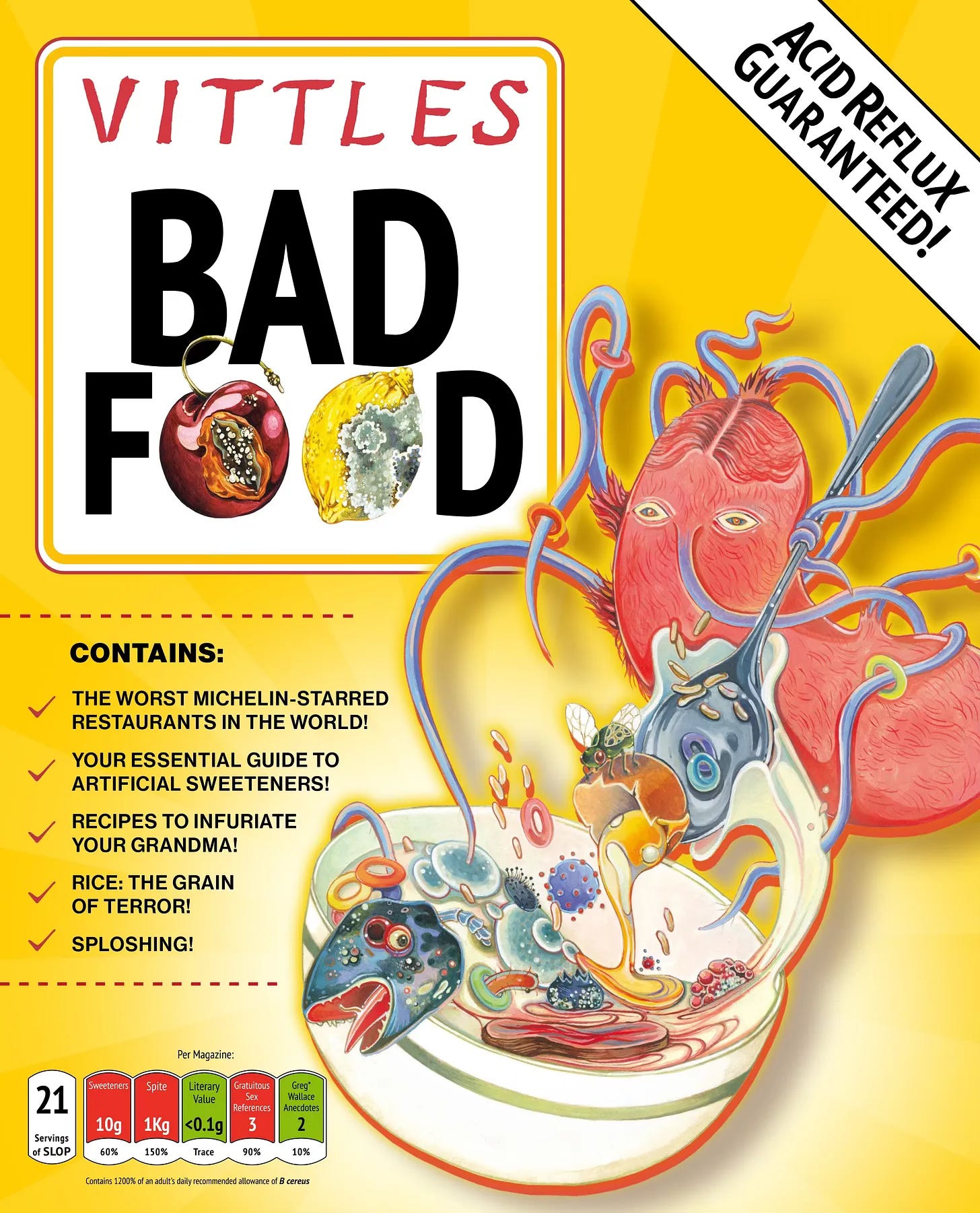
Good morning, and welcome to Vittles! This week, we received the first copies of Issue 2 of our magazine! As of this Monday, we will move from pre-ordering to just regular ordering, so if you wish to get the magazine at its discounted pre-order price of £18, with an extra discount for paid subscribers (see the original email for details), then this is the last weekend to order.
In 2018, I saw two visions of the future. Down one path, there was Ohh Cha, the Japanese matcha pop-up that took place inside Muji Tottenham Court Road over the course of two weeks, serving koicha as thick as molten chocolate and usucha of various provenances – the type of matcha that compelled Japan to create kaiseki dining, tea ceremonies and the architecture of the tea house just to put a bowl of it in its right place. Down the other path, was the tin of chilli kale matcha I spotted on a supermarket shelf that promised to ‘destroy hangovers’. Of course, London chose the second path.
The duality of matcha
Over the last few years, matcha has taken over London, just as it’s taken over everywhere else in the world. As someone who used to work in the tea industry, and spent the best part of a decade trying to get people to drink good matcha, this has been a strange experience. Matcha is everywhere and people – particularly young people – love it, even if it’s low-grade matcha (and, increasingly, not from Japan, but from China). Meanwhile, the scarcity of matcha has pushed the prices for premium matcha up; from what I’ve heard, in the last year the wholesale cost has almost tripled. Whatever the grade, London has an insatiable need for matcha (note: all of these are real!): Biscoff matcha, Terry’s Chocolate Orange matcha, toffee nut Cream matcha, matcha tiramisu, matcha ramen, matcha hummus, matcha biriyani, matcha milk pedicures and, most ominously, daytime matcha raves.
My former colleagues at Postcard Teas now everyone is into matcha
So, in today’s acid reflux, I’m handing over the column to Niloufar Haidari to explain this pivotal moment in matcha culture on a global scale, and why it just might mean the death of civilisation as we know it. Jonathan Nunn
It’s 7pm on Saturday and you’re at a matcha rave in Dubai, by Niloufar Haidari
It’s 7pm on Saturday and you’re at a matcha rave in Dubai. The afro-house is bumping, ladies are swaying around like Sims, taxes are being evaded. There is much pain in the world, but not on this rooftop. Here there are digital nomads, myopic influencers selling dreams, and Europeans who moved to the UAE to escape the creeping tide of Islam in the West. There are also, for some reason, iced matcha lattes. Two Asians, seemingly the only non-white people in attendance, hand-whisk the green powder and serve it up to the partygoers with pink foam. A posh-looking man in a blue shirt and cream trousers offers a matcha ice cream cone to the camera with a smile and the Dubai skyline behind him. There is a complete dearth of swag, personality and vibe.
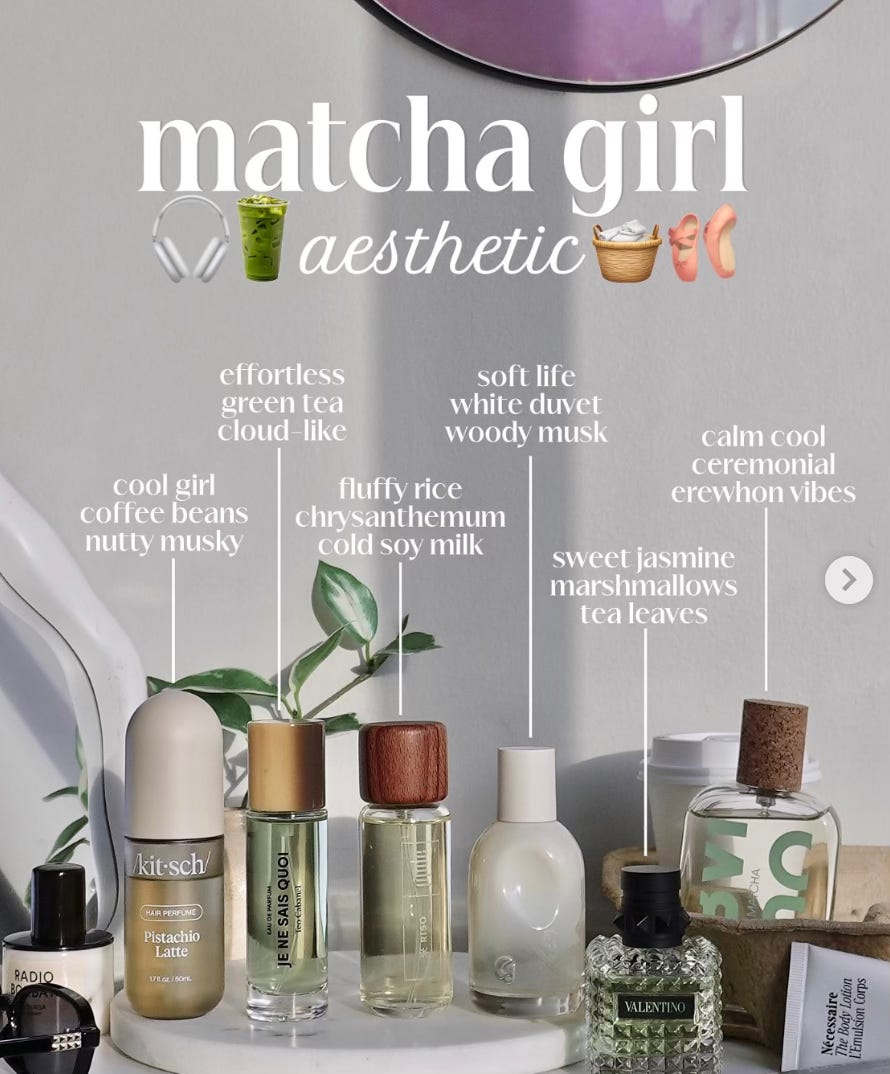
Drinking matcha is obviously not a new practice. Its history in Japan goes back nearly a thousand years, while whisked tea dates back even further in China. Starbucks has been selling (bad) matcha as ‘green tea lattes’ since 2006, the earthy, bitter taste of cheap matcha masked by everything from vanilla syrups to blueberry purées and sweetened coconut milk. But matcha has recently become a status symbol for wealth signalling and wellness culture, propelled in part by ‘aesthetic’ lifestyle TikToks, in which influencers in blush-coloured athleisure pose with matching strawberry matchas at ‘morning wellness raves’.
“Matcha lattes – and memes about them – have become a micro-economy, the beverage of choice for both aesthetic girlies and performative males, two categories of people that mostly only exist online to generate content”
However, such events are not confined to the cursed dropshipper-populated corners of Bali and Dubai. This summer there were matcha raves in Vienna, Madrid, Frankfurt, Perth, Tijuana and Cork. Louis Bekk, a French DJ who seems to have made a career out of playing bad house remixes at pop-up brand activations, allegedly ‘turned the matcha scene on its head’ when he hosted an alcohol-free day-time rave at Marylebone’s How Matcha.
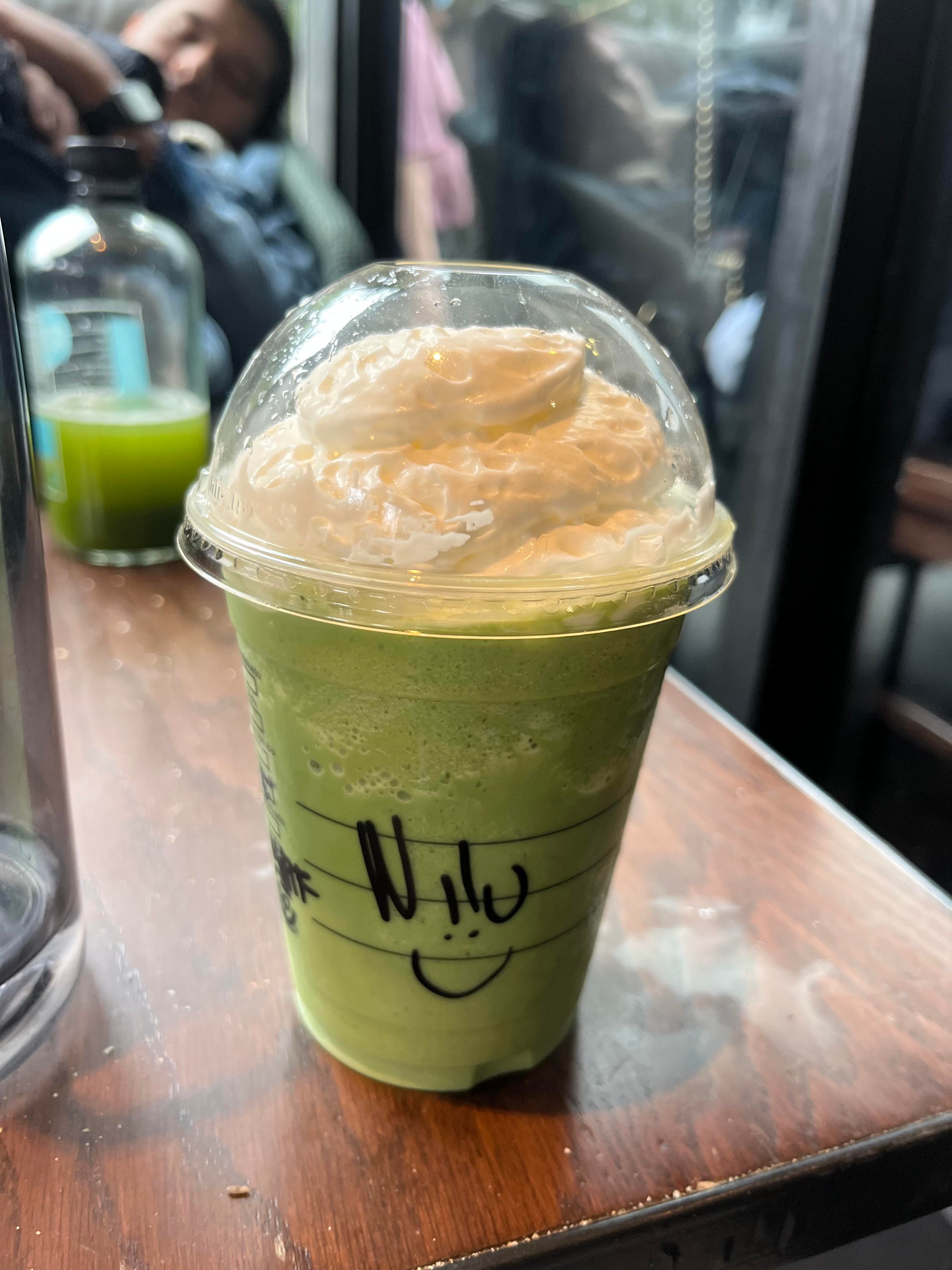
Of course, the reason I know so much about Gen Z green drink culture is not because I think it is a frivolous industry emblematic of impending societal collapse (although it is) but because I myself love this shit. When a matcha spot opened in Brent Cross’s new food court, I was ready to fall to my knees with gratitude at the prospect of finally being able to access a delicious silly little drink anywhere near my home in Neasden – the last place in zone 3 where you still can’t get a half-decent flat white. Its best-selling drink is the peach collagen yuzu; I personally alternate between the vanilla and brown sugar oat milk options, sometimes adding a shot of ashwagandha or bee pollen if I really feel like recreating my experience of the time I lived in LA. I will happily travel anywhere that gives me the option of topping my drink with sweetened cream cold foam, and have on more than one occasion found myself the oldest person in the queue at Jenki, waiting 20 minutes to spend £6.50 on a rose collagen matcha latte just to Feel Something – or maybe to avoid feeling anything at all.
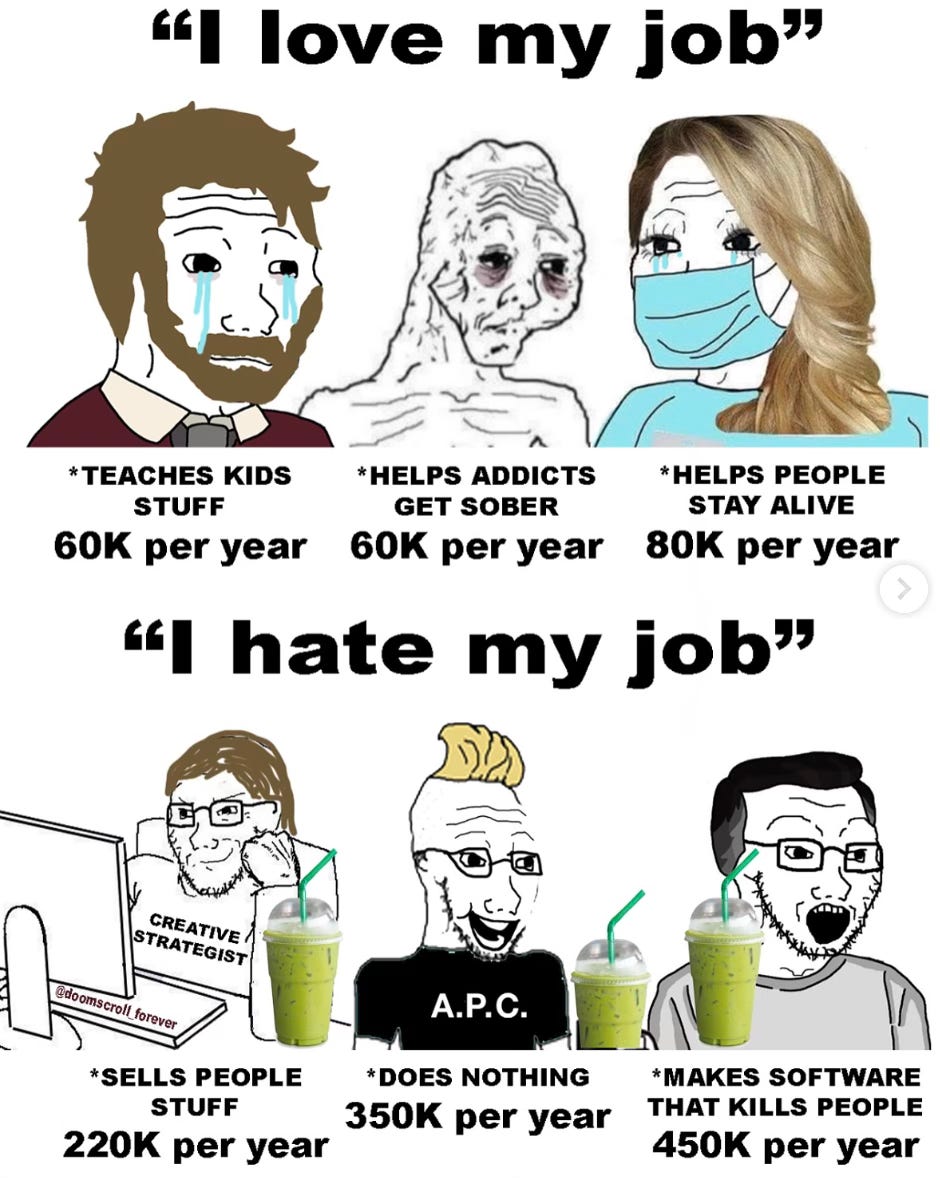
But something about matcha, the aesthetic around it, and these ‘raves’ has left a bad, non-ceremonial-grade taste in my mouth. While coffee became associated with late nights, cigarettes, anxiety, deadlines and millennials (ew), matcha’s connotations are ‘quiet luxury’, youth, pilates, remote working in Bali, slow mornings and stay-at-home-girlfriend culture. Venture-capital-project-turned-Gen-Z-favourite Blank Street no longer even bothers to visually advertise its coffee-based drinks behind the counter, as the matcha latte is now the default beverage of anyone between the ages of fifteen and thirty. Because of this, matcha lattes – and memes about them – have become a micro-economy, the beverage of choice for both aesthetic girlies and performative males, two categories of people that mostly only exist online to generate content.
The idea of combining this with raves is a new development, but not a surprise. As nightlife venues and spaces for genuine hedonism continue to close, we are being pushed to embrace the psyop of ‘soft clubbing’ – the idea being that even while partying we should be practising mindfulness and praying at the altar of wellness. As delicious as silly little drinks may be, there is no comparison between dancing all night on drugs in a dark, sweaty basement and attending a coffee shop rave at 9am. Despite marketing that makes heavy use of words such as ‘community’, ‘culture’ and ‘connection’, these gatherings all have the sad, desperate air of a networking event. They are opportunities for content creation, ‘parties’ for people who can’t afford to be hungover the next day because it would impact their productivity levels and biohacking goals.
If the ‘matcha girl aesthetic’ is one of myopic self-betterment and the type of ‘self-care’ that instructs acolytes to tune out anything that doesn’t ‘serve them’, then it is particularly fitting for a society that has been numbed into the mindless consumption of in-group signifiers (and memes about mindless consumption of the in-group signifiers) as a distraction from the discomfort and rage we should all be feeling. I don’t think it’s hyperbolic to say that the world as we once knew it is crumbling around us. The idea of a liberal international order, if we ever believed in it, is dead. We have spent two years watching a genocide unfold on our phones while doomscrolling through a never-ending stream of brain rot interspersed with photos of our friends on holiday. While millennials worry about renting forever, almost a third of Gen Z is thought to still be living with their parents. We are accelerating climate change and destroying the fabric of society itself so that the richest people in the world don’t lose their investments in a sycophantic AI technology that so far seems to be making everyone who uses it more stupid, self-obsessed or insane.
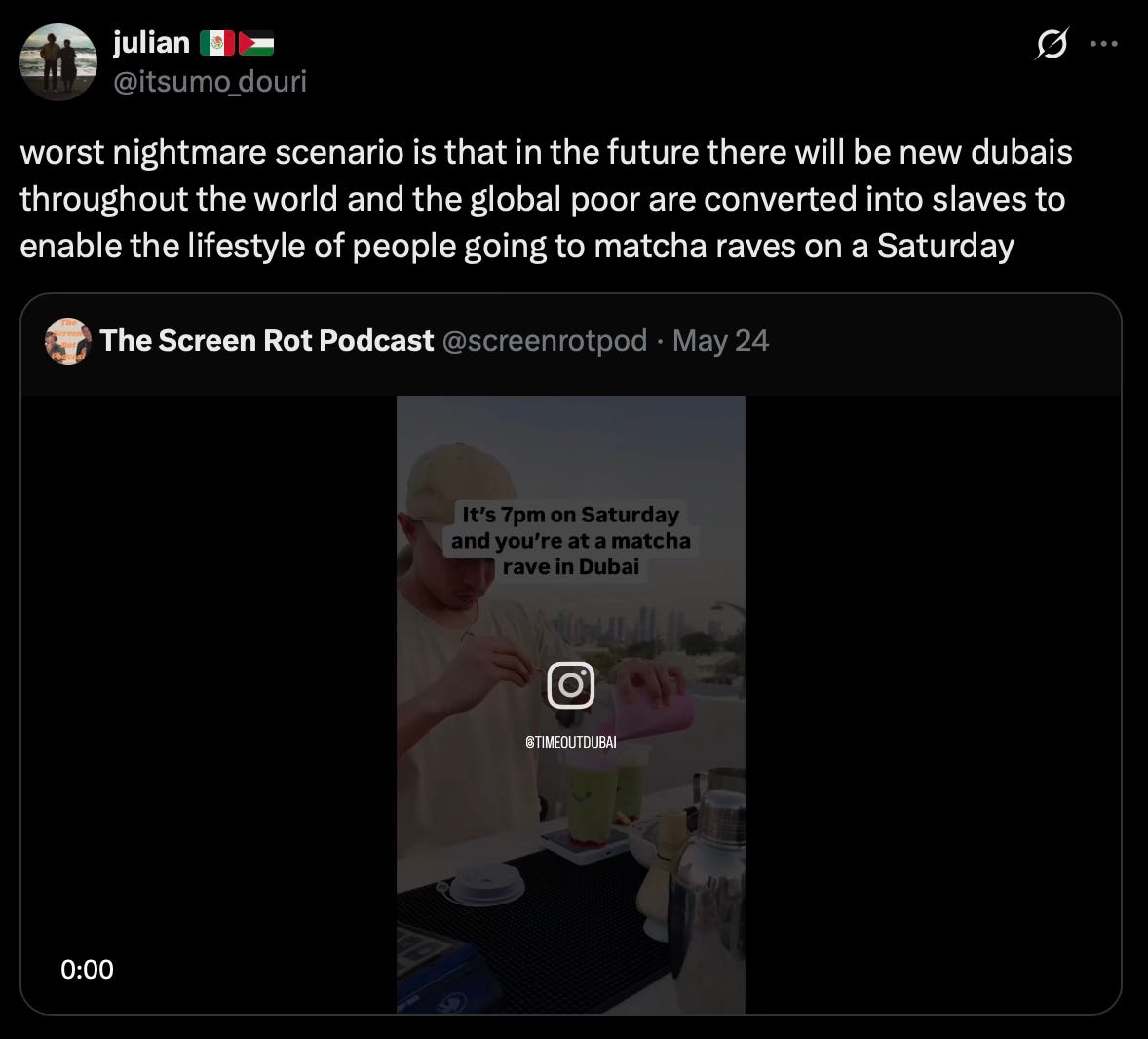
It makes complete sense that the matcha rave and its associated little-treat-as-distraction-from-the-horrors economy is centred in Dubai, a fake country built on modern-day slavery and a commitment to delusion, where you can avoid your sense of civic duty to others and reality itself by spending your life being shuttled around in a glorified air-conditioned 544km2 shopping mall. When the matcha rave video went viral on Twitter earlier this year, one user called it ‘spiritually Israeli’, a phrase that has become shorthand for a tacky consumerism that relies on willfully ignoring the suffering of others. Another user commented: ‘worst nightmare scenario is that in the future there will be new dubais throughout the world and the global poor are converted into slaves to enable the lifestyle of people going to matcha raves on a Saturday.’
Obviously, we are to some extent already living in this future. There are people who believe that underpaid gig workers bringing them their breakfast in the pissing rain is an inalienable human right. Recently, I stood in the queue for a matcha latte behind a woman with a Pomeranian that wouldn’t stop barking as she told the stressed-out minimum-wage worker behind the counter that they should add calorie information to the menu. But it is naive to think that we have reached the zenith of this cursed new world. As wealth inequality grows and our futures grow ever more uncertain and dystopian, it’s not particularly hard to imagine a society in which wealthy elites escape to authoritarian police-state tax havens while the rest of us fight robots for the right to serve them Dubai chocolate donuts and hand-whisk their iced matcha lattes or die. The uncertainty is how much more treat-based self-distraction we have left before getting there.
Thank you for even more fully informing me about gut loathes, e.g. Dubai, and the people who go there. My husband overheard two loud poshos at London St Pancras , bemoaning “everyones moving to Dubai, taking their lives with them , 10s of suitcases, no one has one case any more, everyone’s moving to Dubai”
I loathe Matcha slightly less now, but not enough to taste it. I do like a tea ceremony though.






This is so good!! Laughed and got sad all in one
Thank you for even more fully informing me about gut loathes, e.g. Dubai, and the people who go there. My husband overheard two loud poshos at London St Pancras , bemoaning “everyones moving to Dubai, taking their lives with them , 10s of suitcases, no one has one case any more, everyone’s moving to Dubai”
I loathe Matcha slightly less now, but not enough to taste it. I do like a tea ceremony though.
Yes I’m old.