

Food for the People, By the People
Stella Swain on the forgotten history of the Land Settlement Association, a government-funded scheme of collective smallholdings operating in the mid-twentieth century
Good morning, and welcome to Vittles! Today we are very excited to publish an essay by Stella Swain, the winner of the inaugural 2025 Food Stories Fellowship Award run by the British Library Food Season in partnership with Vittles. Stella’s winning essay is about the Land Settlement Association, a curious chapter in British agricultural history that could offer some solutions to the contemporary farming crisis.
We’re also delighted to announce that we will be partnering with the British Library Food Awards again this year on the Food Stories Fellowship Award. This prize will be awarded to someone who needs to use the British Library’s unique food collections (encompassing everything from manuscript recipe books, published cookery books and oral histories to food magazines and trade literature) to inform a piece of exciting new writing on some aspect of contemporary food or drink culture. The winner will be awarded £1500 to facilitate use of these collections, have access to British Library curatorial support, be mentored by editors at Vittles, and have their finished article published in the magazine.
This is a great opportunity, so if you have a fascinating and significant food story to tell that would be transformed by use of the British Library’s collections and our editorial support, then we urge you to apply for the award here by 27 April.
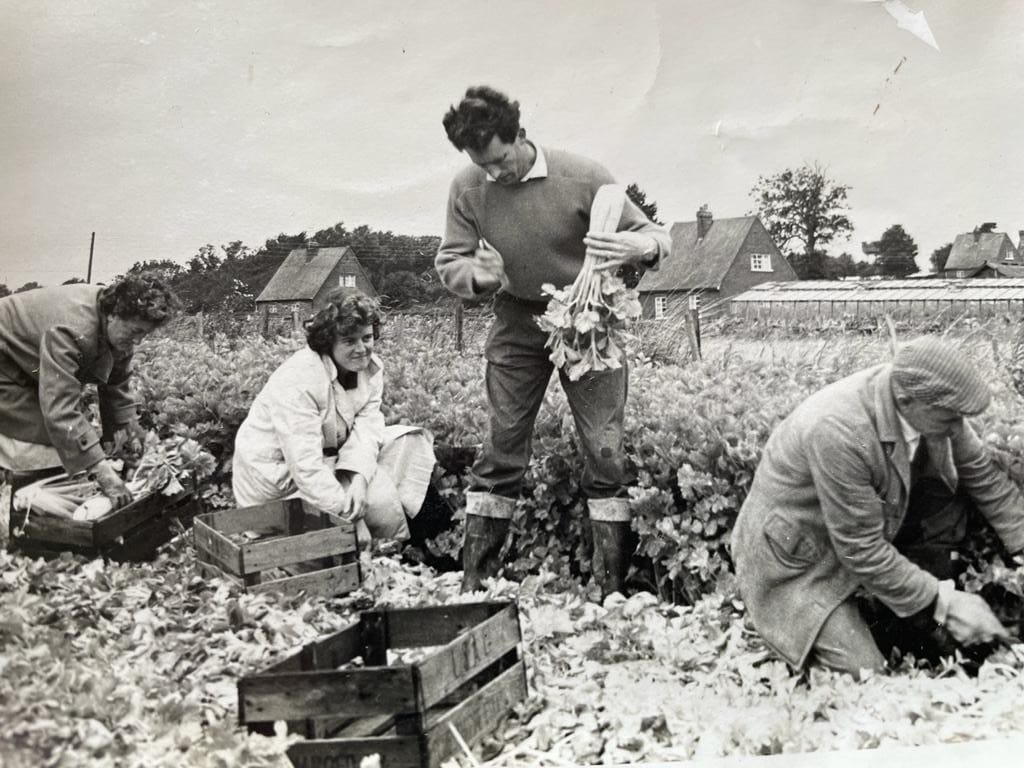
In July 1980, a group of farmers gathered outside a supermarket in Chichester. Described by the local paper as ‘militants’ preparing for a ‘tomato battle’, they took to the streets armed with boxes of freshly grown tomatoes and handed them out for free. Their aim was to draw attention to the plight of British farmers due to the impact that increasing imports were having on their livelihood: while supermarkets were able to drive down the price by importing Dutch tomatoes for next to nothing, the farmers’ tomatoes, grown just a few miles down the road, were barely able to fetch what it had cost to grow them.
One of the protestors handing out tomatoes was my grandmother, Edna Swain. She and my grandfather, John, were part of the Land Settlement Association (LSA), a national scheme that, between 1934 and 1939, set up local farming cooperatives comprising over 1,000 government-funded farms known as smallholdings. Each smallholding was made up of around five acres of land, complete with livestock and a newly built cottage. The largest settlement was a cluster of 134 smallholdings covering 591 acres in Sidlesham, West Sussex – where my grandparents lived and worked, where my dad and his siblings were raised, and where I spent much of my childhood.
At the time of the 1980 ‘tomato battle’, the LSA produced nearly half of all British-grown salad crops. Although repeat protests would be held in the following months, the farmers didn’t ultimately have much success in encouraging supermarkets to buy British vegetables. In 1982 – just two years after the protests – the closure of the LSA would be announced by Thatcher’s government, drawing the curtain on nearly half a century of state-supported cooperative agricultural production. Now, the UK imports 84% of its fresh tomatoes.
These days, farming in the UK has become even more industrialised and corporatised. Small, independent farms are less and less able to survive, and the vast majority of LSA smallholdings, including my grandparents’, have been sold – either subsumed into bigger farms or developed into housing. Unsurprisingly, this has led to an agricultural sector that is set up for maximum profit over sustainability or workers’ rights. At a time when the UK farming landscape is increasingly reliant on the exploitation of migrant workers, and when food inequality and food insecurity are ever more pressing concerns, radical action is needed to ensure a more just future of food production. Perhaps looking back to the collective, centralised model of the LSA can offer a vision of what such a future could look like.
*
The LSA was born in 1933, when Ramsay MacDonald’s Labour government agreed to match the money raised by the National Council of Social Service (now the National Council for Voluntary Organisations) and the Society of Friends for an experimental plan to address high levels of unemployment. This involved relocating those made redundant by closures in the coal and steel industries (and their families) and training them to become farmers in the countryside. The LSA purchased plots of land and built a house on each one; both the house and the plot were leased to participants on a long-term basis. It trained the men and paid for livestock, feedstuffs and tools, as well as the fruit trees, bushes and seeds needed to start production. The scheme proved popular: the first period of recruitment saw 1,709 previously unemployed men joining the organisation to be trained in the basics of farming. By 1951, when the scheme was fully nationalised – moving into the control of the Ministry for Agriculture and Fisheries, with all estates coming under government ownership – there were 740 named tenants in place across 7,768 acres of land. Sidlesham was transformed by the LSA: between 1920 and 1970, its tiny population almost doubled and a new wing had to be added to the school (which was also one of the first in the country to provide hot school meals, in part due to the perceived need for hungry LSA children to be given proper nutrition).
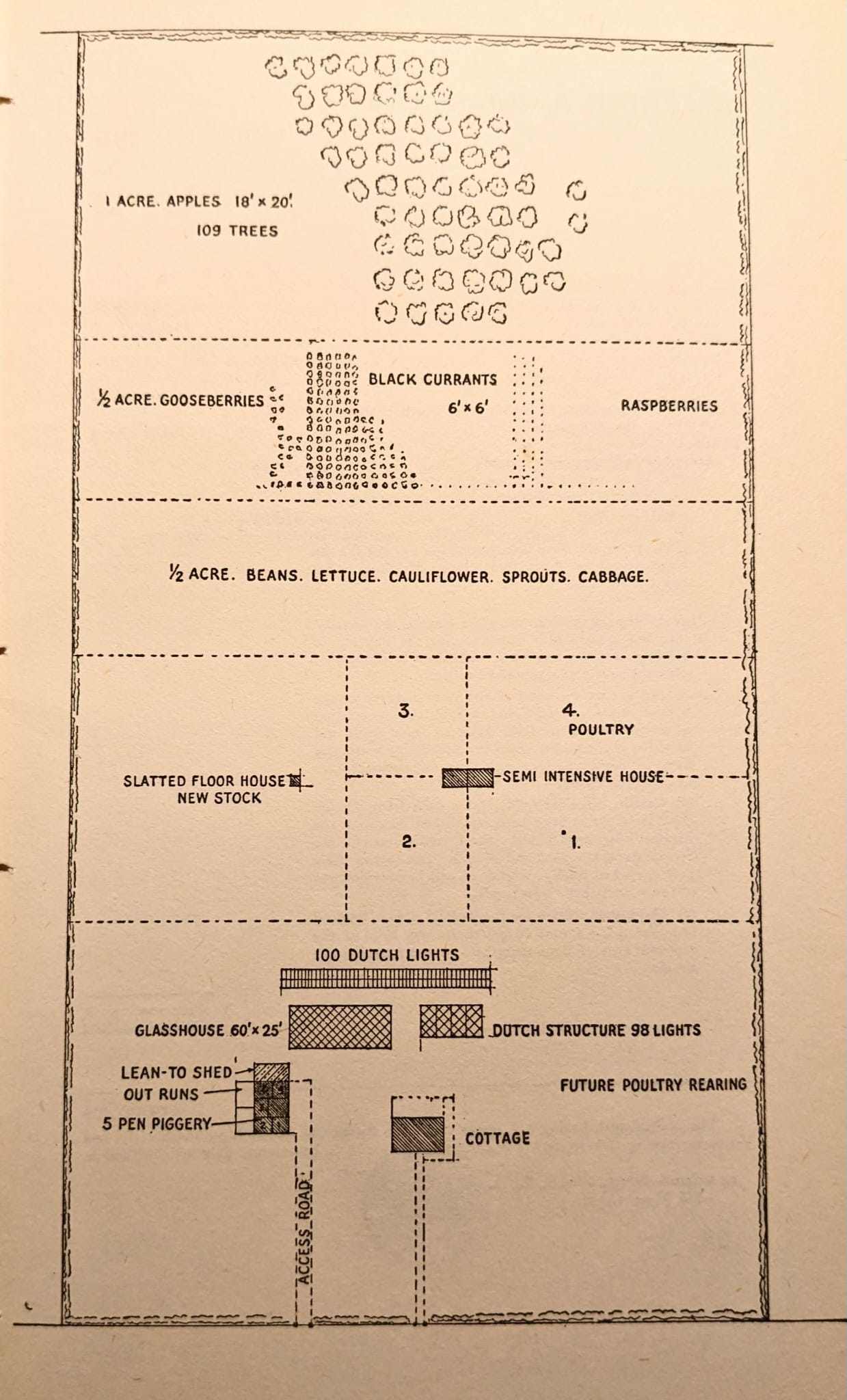
Initially, this land was to be farmed according to the ‘milking stool’ method (which did not include any milking): on each smallholding, farmers would raise pigs and poultry for bacon and eggs, as well as a range of fresh fruit and vegetables that would enable them to sell produce throughout the year. Diagrams mapping the layout for the early farms show sheds for poultry; a pigsty; glasshouses for cultivating tender vegetables like tomatoes; half an acre for beans, lettuce, cauliflower, sprouts or cabbage; half an acre for gooseberries, blackcurrants and raspberries; and an acre for an apple orchard. My grandad recalled his parents growing half an acre of peas, two varieties that cropped at slightly different times. They also had chickens, and mushrooms grown in repurposed wartime plane hangars. But as the LSA developed, farms in different locations began to specialise in different produce. The southernmost farms, like those in Sidlesham, successfully grew huge quantities of soft fruit and salad vegetables under glass and, by 1970, 2,655 tons of tomatoes were passing through Sidlesham every year.
Although it was presented as a radical experiment, the LSA did not exist in a vacuum. In Wales at the turn of the twentieth century, cooperative allotment societies had been formed by struggling mining communities to help make ends meet. However, while these ad hoc, small-scale projects struggled in the face of competition from larger farms, the LSA avoided such problems by being intentionally cooperative from the outset. Although each resettled family was given their own smallholding, the farms were grouped in clusters. Each cluster had a central farm from which packing, grading, sales and purchases were centralised, and the LSA provided machinery pools so that farmers could access newer hardware. All produce was bought, marketed and sold through the LSA, and farmers had to sign an exclusivity agreement to be part of the scheme, which meant they couldn’t sell their produce elsewhere. As the LSA’s second annual report remarked, the scheme was based on the principle of ‘doing for [the farmers] collectively what no one of them could do for himself’.[1]
This political collectivity sounds like utopian socialism, but the early proponents of the LSA were motivated by quite the opposite: on paper, cooperative farming was simply a means through which farmers could make maximum profit. As the Portsmouth Evening News cannily put it in 1936, the aim was to ‘provide the scene for a remarkable transformation … [of] former Trade Unionists into little Capitalists’ – to separate unionised workers from the conditions that produced and sustained class consciousness. Indeed, the scheme was criticised by socialists (like G D H Cole) because it was motivated by the expectation of profit, and because they thought it would only succeed in displacing the problem of unemployment from industrial centres.
This displacement was in fact at the heart of Labour policy: at their annual conference in 1930, MacDonald had made an impassioned speech about moving people ‘off the pavements, which have no roots and no rootable capacity, and put[ting] them in the fields, where they till and grow and sow and harvest’.[2] A doomed, rootless existence in cities would be rendered productive and fertile by the countryside (and, presumably, make those who underwent this pastoral transformation less troublesome than their unionised fellow workers in factory towns).
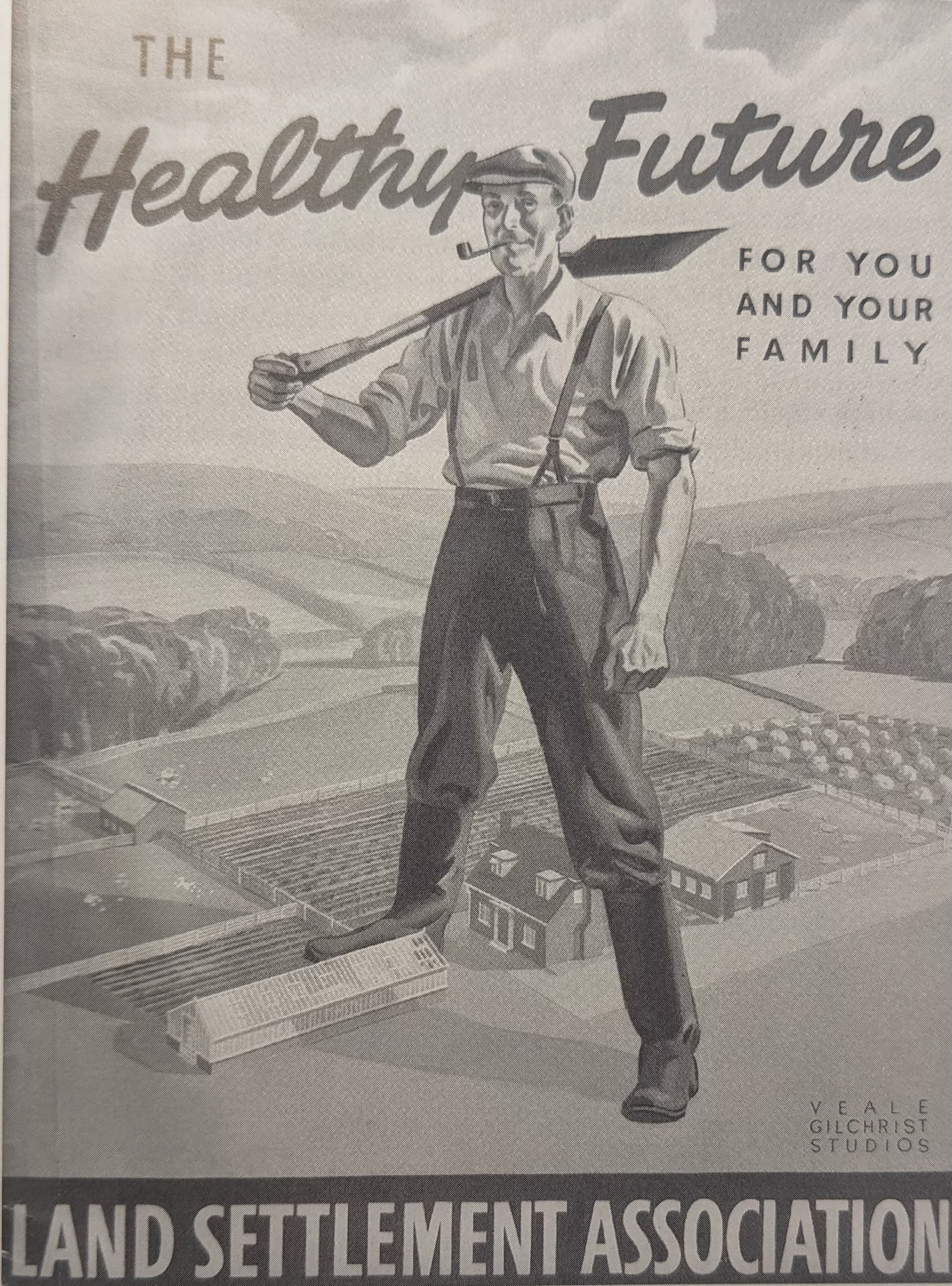
A ‘Back to the Land’ narrative dominated early adverts for the LSA. It presented an explicitly masculine dream of the bucolic British family farm – led by the strong father, who was set against the figure of the unemployed miner, emasculated and unable to support his family. This positioning of the traditional family as the only support a person needs implicitly placed the LSA in opposition to class-based solidarity and an understanding of collective causes that go beyond the four walls of the patriarchal home. The selection process for the LSA involved interviewing the applicant’s wife – he had to have a wife, of course – and placed a heavy emphasis on the (unpaid) family labour needed to maintain the smallholdings. A 1939 LSA report even suggested calling the smallholdings ‘family holdings’, frankly describing the family as ‘a unit of production’.[3] My aunts remember being small enough to stand on the square base of the flat-pack LSA vegetable boxes, folding them into three-dimensions around themselves; my dad, after years of cutting it daily, still doesn’t like celery.
Despite attempts to codify LSA tenant families as individual units, the cooperative structure at the heart of the organisation meant that most LSA members understood themselves to be part of a collective rather than quiet little capitalists. My grandad, who was thirteen when his family moved to a Leicestershire LSA smallholding in 1945 (he later moved to his own in Sidlesham in 1968), remembered the estate manager telling them what crops to grow and when to harvest them as part of the LSA’s overarching plan for crop production. This centralised direction allowed first-time farmers to become productive very fast, increasing the scale and helping farmers target demand. It also meant that each smallholder relied on those around them.
The very architecture of the LSA settlements enabled and reinforced connection. Plots were lined up next to one another, with the houses at one end and the space for growing crops at the other, all in a row. Sometimes farms would sow from one end of the row to the other, suggesting little concern for the boundaries between individual properties – after all, the produce would be sold collectively. In the earliest smallholdings, the individual houses were in the middle of each plot, but fears about isolation – expressed by the women, who were used to community living on busy Durham streets – led to later developments grouping the houses together.[4] Most settlements had a purpose-built social centre, which also served the broader local community, offering everything from lectures and dances to whist drives. In recognising the necessity of cultivating more than vegetables, and of fostering community spirit between farmers and workers in the local towns, the LSA ultimately had more in common with more radical visions of communal living than its original proponents would have dreamed of. Such collectivity produced a very material understanding of community among LSA farmers: their personal and economic successes were intimately bound with those of their neighbours.
*
In the early years of the LSA, some of the men who had been recruited dropped out, citing the difficulty of farm life and the hostility of local residents; it also took time for the recruits to train, and for the farms to become productive. Crucially, however, the LSA supported tenants during this period: they were paid a flat rate until their farms were up and running. Recruitment of tenants only increased once the selection criteria were broadened during World War 2 to include people with previous farming experience, and by 1956, only six holdings were vacant across the whole country (with 107 new tenants having taken up smallholdings the previous year). However, as the 1960s progressed, industrialisation meant that locations specialising in pig and poultry farming suffered, and in 1966, the LSA closed four of the northern estates due to an inability to maintain production. (I wasn’t able to find evidence of the extent to which the government influenced this decision, but 1966 was a tough year for nationalised industries: that summer, Harold Wilson’s Labour government announced cuts to planned spending on them by £95 million, which would have hit the LSA.)
Without a firm commitment to maintaining the centralised, nationalised basis of the LSA, the diversity of farms couldn’t be supported. But even in 1966, there were still ninety-eight suitable applicants on the LSA’s waiting list, showing continued demand for smallholdings, despite it being a time when tenant turnover was relatively high and some farms were really suffering. That same year, among the 220 new tenants who joined the scheme nationally, only eighteen had come from outside agriculture. The LSA had moved away from its initial aim of attracting the unemployed from industries outside farming, but was still proving popular both within the farming industry and as a self-reproducing system, with the children of tenants, like my grandfather, becoming tenants themselves.

Perhaps these strengthened links with the broader agricultural sector were a factor in improving LSA farmers’ relationships with local communities. The early resettled miners were often distrusted, stereotyped as unclean, work-shy outsiders who could know nothing about farming, and there was at least one ‘mass meeting of protest’ (by the Conservative Club in Potton, Bedfordshire) opposing the establishment of an LSA settlement. However, the social centres at the heart of each LSA estate helped to show locals that they too could benefit from such a scheme, and certainly helped LSA farmers to integrate into rural communities. By 1974, a report described the LSA as the ‘community centre’ for the whole village.[5]
In 1967, this community spirit drove the National Association of Land Settlement Association Tenants (NALSAT) – a kind of trade union specifically for LSA farmers – to lobby for the scheme’s cooperative practices to be extended to other local farmers so that they could also benefit from the centralised sale of produce. Since 1951, NALSAT had been given a role in ‘setting the main direction’ of the LSA; they had to be formally consulted on the scheme’s operation, and had representatives on the LSA’s executive committee, alongside the minister for agriculture. Every tenant was automatically entitled to membership of NALSAT, and there were no subscriptions. NALSAT advocated on the tenants’ behalf, and also consulted on the Wise report, a government-commissioned investigation into the success and sustainability of the LSA (which was ultimately used to justify its closure). According to the report, the NALSAT chairman argued that most of the tenants on profitable estates (mostly those in the south) thought that they should continue to support the less profitable estates, even in hard times. Contrary to the argument that collective farming was somehow against the natural (capitalist) order, these farmers were keen to uphold the core tenets of the LSA. The main improvement suggested by NALSAT was that the farmers should have greater participation in the management of the LSA – just like what other unions were fighting for at the same time.
*
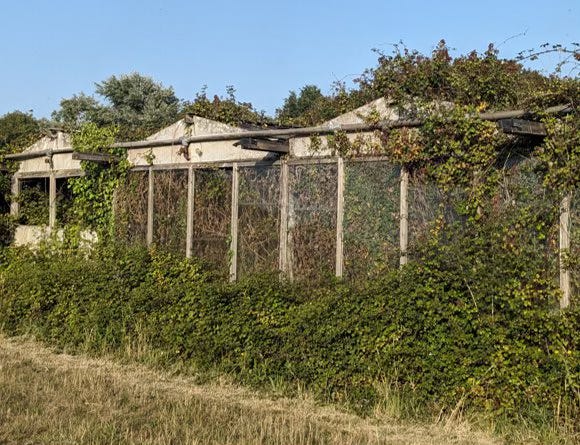
Although the average income of LSA farmers continued to increase until as late as 1979, in the 1980s, various factors (the fuel crisis, competition from farms on the continent that were subsidised by their own governments, and the increasing monopoly power of supermarkets to set cheap prices) meant that it was difficult for the LSA to make money. Had the government chosen to prioritise the production of food for the people of this country, it could have stepped in, as the protestors in Sidlesham handing out free tomatoes were demanding. Instead, the Conservatives announced, just weeks before Christmas in 1982, that the LSA would be shut down the following spring, bringing to an end almost five decades of centralised collective farming. It simply wasn’t deemed profitable enough for this new era of mass privatisation. Nearly 8,000 acres of previously government-owned land was privatised almost overnight, with LSA tenants pushed to buy their land if they wanted to continue to farm. Most of the smallholdings formed local cooperatives, but they struggled without the support of the LSA. My grandparents continued to produce fruit and vegetables as part of Sidlesham Growers, a cooperative of eighty-nine former LSA farmers. I remember helping to pick tomatoes in the early 2000s, using those old boxes emblazoned with the LSA logo. Today, the standard-issue LSA houses still dot the country lanes of Sidlesham, but brambles have long since overgrown most of the glasshouses.
It feels almost inconceivable today that a government in this country would introduce a system to enable fair and equitable production of food based on communal practices and government investment. Yet small-scale farms like my grandparents’ are almost always financially unworkable without the support and organisational principles of a scheme like the LSA. Despite substantial unrest in the agricultural sector, no party or political project today seems to be offering a real solution to this farming crisis. The LSA demonstrates that collectivised and centralised farming methods could offer farmers a better deal, by seeing them as members of their community and investing in them and their industry. Industrial, privatised farming, by contrast, removes farmers’ ability to negotiate on their conditions as a collective – and removes any government responsibility to support them.
In the near future, if we wish to survive, we will have to move huge numbers of workers out of the industries that are destroying our planet, whether that is mass agriculture, fossil capital, or the arms trade. The LSA is evidence that a government could choose to transition workers from one industry to another, and to support those workers in the process. Farming does not have to come at the cost of the environment, or of workers’ rights. In the spirit of the LSA farmers, we must organise towards a form of farming that could provide food for the people, by the people.
[1]Land Settlement Association (1937). Second Annual Report for the Year Ending December 31st 1936. Land Settlement Association.
[2]The Labour Party (1930). The Labour Party 1930 Report of the 30th Annual Conference. The Labour Party.
[3]Land Settlement Association (1939). The Use of the Land in Relation to Unemployment and Agricultural Policy. Land Settlement Association.
[4]Dearlove, Pamela. (2007). ‘Go Home You Miners!’: Fen Drayton and the LSA. Pamela Dearlove.
[5]McCready, KJ, Plunkett Foundation for Co-operative Studies. (1974) Land Settlement Association: Its History and Present Form. Plunkett Foundation for Co-operative Studies.
Stella Swain is a writer and organiser based in London. She spends most of her time campaigning for a free Palestine, but when she’s not doing that she’s cooking, thinking and writing about food and building a better world.
This article was based on research conducted at the British Library and draws from collections including newspapers, manuscripts, government publications, ephemera and trade literature.
The Vittles masthead can be viewed here.
Excellent article by Stella Swain. There is much practical information available regarding the LSA but this is the first article I have read about it that seriously considers the social and political motives involved. I believe the main reason that the Thatcher government closed it down was due to the fact that it was seen by the Tories as a socialist experiment and ran completely against their mantra of profit at any social cost, which, of course, still prevails today and is at the root cause of most of the current problems facing our country.
Brilliant. Inspirational. Very much needed. Congratulations