

Serving Biscuits in God’s Kitchen
On running the refreshment table at London AA meetings, by Anonymous. Illustration by Sing Yun Lee.

Good morning and welcome to Vittles. Today, Anonymous has written an essay about running the tea and biscuit table at Alcoholics Anonymous meetings in London. If you haven’t picked one up already, we still have copies left of our second print issue, on the theme of ‘Bad Food’ – we highly recommend buying a copy. Ruby Tandoh’s guide to the ice cream of London is also still available for pre-order here (note: preorders are currently only available in the UK).

A subscription to Vittles is £7/month or £59/year. Vittles is entirely subscriber funded, and your subscriptions help to pay all our writers, photographers and illustrators at a fair rate.
Anyone coming to the British Library Food Season and booking a ticket for Vittles presents: From Aspic to Instagram may also claim a free ticket for - The Legacy of Edna Lewis. Simply enter the promo code FSFREE when adding one of those events to your basket.
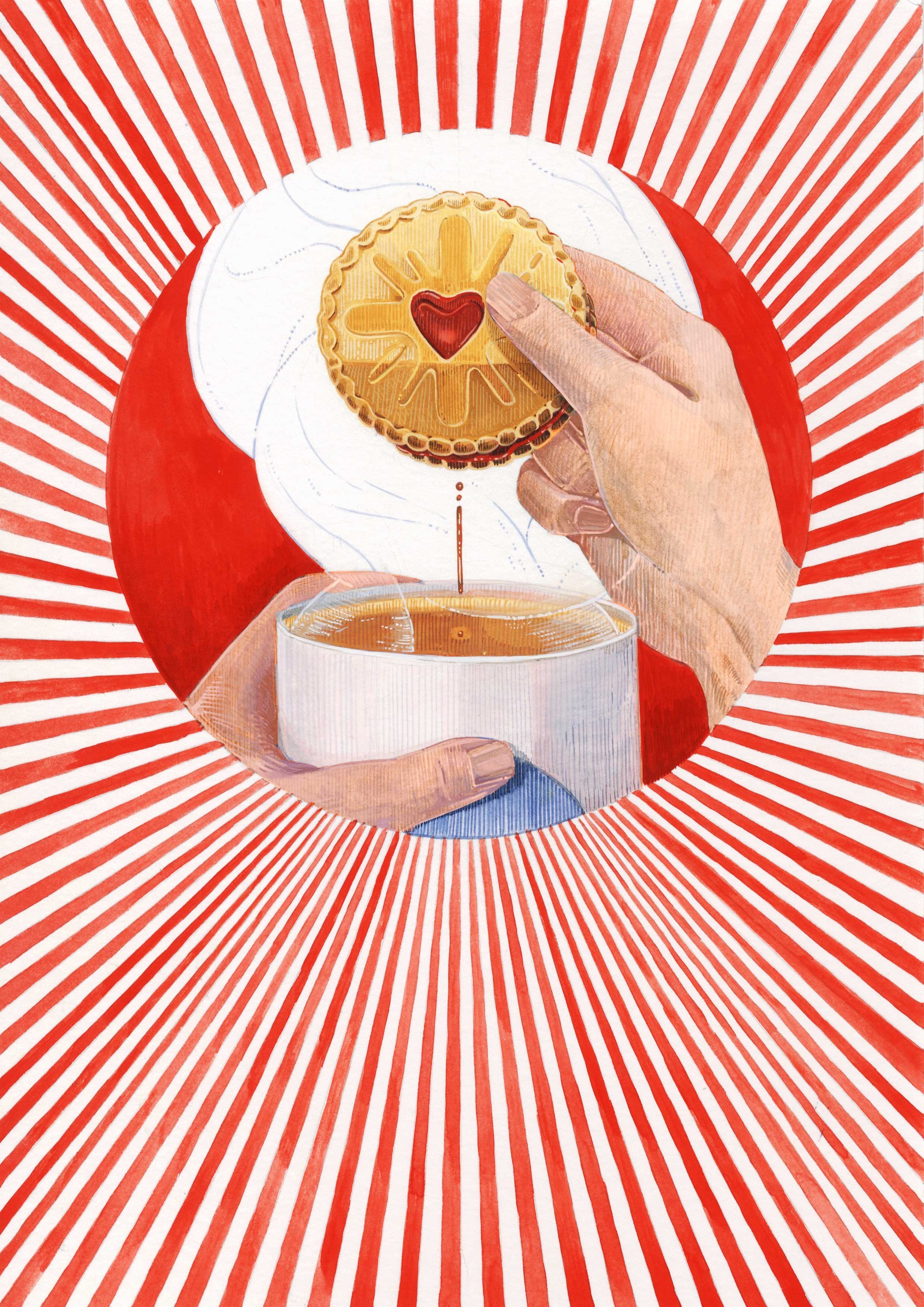
One of the first things I noticed about AA was the biscuits. Meetings most often take place in the supplementary buildings of churches, and the biscuit offering felt identical to that of a charity coffee morning. Large, institutional stainless-steel kettles were in use, and a variety of familiar biscuits – chocolate digestives, Jaffa Cakes and so on – were arranged on 1970s crockery. At my first meeting I was asked whether I wanted tea or coffee, and when I requested the latter I was told that ‘The only instant part of recovery is the coffee.’
I was initially bemused by the relish other attendees exhibited at the biscuit table; they debated the week’s offering and expounded the merits of Jammy Dodgers as opposed to Ginger Nuts. Fig rolls were met – unfairly, I thought – with horror. Prior to the more formal, and generally darker, sharing that happened inside the meetings themselves, the biscuit table was a conversational place. The kindness and care with which I was always offered a cup of tea and a biscuit surprised me too; I did not think I deserved kindness or a biscuit. I did not even think I liked biscuits.
Fig rolls were met – unfairly, I thought – with horror.
Like many recovering addicts, I did not have a sweet tooth prior to sobriety – I was a crisps person – but suddenly, after giving up alcohol and drugs, I found that I needed sugar. I copied the other alcoholics and began to drink it in my tea – ironically, this felt illicit. I began to look forward to meetings, in no small part due to the biscuits; they were a pleasant and delicious thing which I was still allowed. I once watched a recovering addict who was trying to give up smoking light a cigarette – he held it up appreciatively and said, ‘The thing about one of these is it won’t make you wake up in a skip tomorrow morning.’ The same goes for a biscuit – I could just eat a Jaffa Cake and enjoy it and there would not be a vast and terrible consequence. That may sound extremely obvious and simple, but it was not. I began to imitate my fellow alcoholics and take a small stack of biscuits into each meeting; like them, I had poor impulse control and would finish the biscuits within the first five minutes.
One of AA’s many aphorisms is that ‘Service keeps you sober.’ Meetings run because people set out the chairs, organise the hiring of a space from a church or community hall and chair the meeting. These tasks are known as ‘service commitments.’ I was desperate to stay sober and obeyed every bumper-sticker suggestion I was given. At a monthly business meeting after my favourite AA group (imagine a parish council run by former wreckheads and you will get the idea), I learned that the meeting needed a new tea person; I put myself forward and was voted in. This is how I found myself in charge of serving the tea at a small evening meeting in Soho. The church in which the meeting takes place is a stone’s throw away from The French House, where I used to bartend, and the church’s bar – on which I served the tea directly – faced the bar where I used to serve wine to customers (but more often to myself).
I was unable to afford to buy nice biscuits. Every week I presented the alcoholics with knock-off rich teas and digestives from Lidl, and I felt terrible about it. Eventually someone told me that I was presenting the alcoholics with the sort of biscuit which the then Conservative government would deem they deserved. Still tender, I wept at my failure, not least because the criticism had come from two incredibly handsome men and I was worried that I would never find another boyfriend. I protested that I couldn’t afford to buy better biscuits, and they laughed at me and told me to get the money from the treasurer – I hadn’t realised there was one. The following week I had a budget of £15. I felt rich. I had to keep a receipt, which made me feel important and as though the other people in the supermarket would assume I had a job.
Eventually someone told me that I was presenting the alcoholics with the sort of biscuit which the then Conservative government would deem they deserved.
Perhaps my lack of other gainful employment explained the zeal with which I took to my tea commitment. I cleaned the church’s upstairs breakfast bar thoroughly before starting, I laid out the biscuits and sweets neatly on plates and in bowls, I designated a bowl for teabags and I decanted the sugar so that the church’s main supply wouldn’t become stained and contaminated by thrice-returning wet teaspoons – alcoholics frequently need at least two sugars. I became angry when the meeting just before mine invariably made the kitchen messy and encroached on my time when they tried to clean up, inexpertly, afterwards. The ineffective way they loaded the dishwasher enraged me.
Through trial and error, I discovered a formula for the biscuit selection: at least half should be chocolate; there should be one ‘posh’ or novelty chocolate biscuit, and the rest of the chocolate offering should be chocolate digestives or chocolate hobnobs. These should never be the dark chocolate kind – they do not provide enough instant gratification. There should always be a classic, like Jammy Dodgers or Ginger Nuts. Cheap biscuits, like I had learned, were frowned upon; Bourbons and custard creams were not considered worth staying sober for. Once, in an experimental mood, I bought Tangfastics. They were a great success, and the move to include fizzy sweets in the offering caught on across London.
One awful day the church’s kettle broke and, unbeknownst to me, the water was merely hot rather than boiling. An older man I did not know took a sip, looked to see if I was wearing a wedding ring, and told me that tea like that was why I was still single.
The secret to good AA tea is the same as the secret to good bartending: you have the remember the regulars’ orders. There are people who, even now, I will see in Soho and recognise only as ‘Three cubes of ice’ or ‘145ml Côtes du Rhône’. The recovering alcoholics I was serving at AA were every bit as annoyingly specific about their orders as the regulars in the French. Some would insist on two teabags, while others had a fear of any caffeine. I would be told I had not left enough room for milk; I would be told I had left too much. I was asked for a slice of lemon in a cup, not a mug of Earl Grey. I would receive praise for the selection of herbal teas on offer, and I would be chastised for the lack of decaf options. One awful day the church’s kettle broke and, unbeknownst to me, the water was merely hot rather than boiling. An older man I did not know took a sip, looked to see if I was wearing a wedding ring, and told me that tea like that was why I was still single.
AA service commitments last for one year. After a year of making the tea, I had finished the twelve steps of recovery and begun to sponsor another woman. I passed my tea-making commitment on to her and she passed it on to my second sponsee. Both took the role as seriously as I had and it became a despotic ‘family’ tradition. Finally, after three years of unbroken control over the teas, the issue of succession reared its head. When two straight men I did not know took over, I was concerned. They started off strong: one, a former chef, bought Mulino Bianco biscuits, kept the blue roll handy and had a good sense of mise en place. In many cases – though it has not yet happened for me – recovery leads to great professional success. The former chef finished training to be a lawyer and so had to relinquish the tea service. I was happy for him, but worried that the remaining man would be unable to handle the tea alone. I was proved correct. A charming ageing skater, he made the sort of tea I was used to receiving from one of the Americans. He once asked if he really needed to buy milk. I disgraced myself in the next business meeting by speaking out of turn and protesting that we had suffered enough, the tea had gotten too bad and attendance was plummeting. Despite my blatant abuse of AA’s ultimately benevolent anarchist society, I was voted in as the tea person for a second term, three years after my first.
I frequently want to strangle the nice old man who watches closely as I measure a half-teaspoon of instant into his cup.
St Augustine once pleaded with God, famously saying, ‘Oh God, make me good, but not yet.’ I frequently plead to an ill-defined and murky ‘higher power’ (which I was told to believe in and which I do not interrogate too closely lest it collapse), ‘Oh God, make me good now.’ I mostly am good, but when it comes to making the tea at AA, I am cruel and controlling. I bark at the alcoholics who fail to clean the kitchen, I roll my eyes theatrically when I’m asked to list the herbal teas and I frequently want to strangle the nice old man who watches closely as I measure a half-teaspoon of instant into his cup. He is nervous because three years ago I gave him a coffee with my customary two. I once told him, nastily, that as his cocaine habit had failed to kill him, it was unlikely that my coffee would finish the job. The orders of the alcoholics I serve are undeniably specific and exacting, and yet, in my iron-clad grip on the meeting’s tea and biscuits, I am the most controlling of all. During the sharing portion of AA meetings, when those attending talk about their days and weeks and their recovery more generally, a recurring theme is that, while physical or chemical sobriety generally becomes easier with time, ‘emotional’ sobriety remains difficult. I have found this to be true, and yet while I am generally more or less emotionally sober outside of AA – a reliable and loving friend, the sort of person to relinquish a tube seat – inside it I remain a terror.
During my sobriety I have lived in house shares, squats, house-sits, and been a lodger; I have rarely had a kitchen where I can cook with ease and freedom. I treat the people with whom I share the AA kitchen in a manner that would be effective and acceptable in hospitality, but which is rude and hostile in a recovery context. In lieu of being able to host people comfortably at home, I make tea for alcoholics, and I do it horribly because it means too much to me. Similarly, the instability of freelance work and a long-term lack of sustainable employment mean that I have, on occasion, faced food insecurity. The only time I enter the supermarket without dread is when I buy the AA biscuits, when my sole concern is choosing what I think people will enjoy the most rather than considering what cheap thing will keep me full for the greatest length of time (generally porridge). While I have moved more times than I can remember in the last four years, I have found myself in the same kitchen week after week for the length of my sobriety. I forget that it is not really my kitchen at all – it is the church’s kitchen, it is God’s kitchen, and I desecrate it frequently.
*
In keeping with an AA tradition to remain anonymous in press and film, the writer of this piece has chosen to remain anonymous.
Credits
Sing Yun Lee is an illustrator and graphic designer based in Essex. You can find more of her work here.
The full Vittles masthead can be found here.
I read this twice. Once to fully appreciate the etiquette of biscuit and tea serving at the AA, and then again so I could revel in our writer's dedication to the service, and their militancy as a result. I laughed out loud at times, then cried and then rushed to the biscuit tin for support.
I have enjoyed every word, purpose and utter joy that this act of service now provides to our author.
P.S. I am partial to a fig roll myself.
A very good read thanks. “A parish council run by former wreckheads” 😃