

Good morning and welcome to Vittles. Today, we have a deep-dive by Arthur Asseraf about trying to find good couscous in London. ‘Why, in a city where you can now find decent tacos and where tteokbokki is around every corner, is the most essential food of the Maghrib absent?’ Arthur asks. Read on to see what he finds.
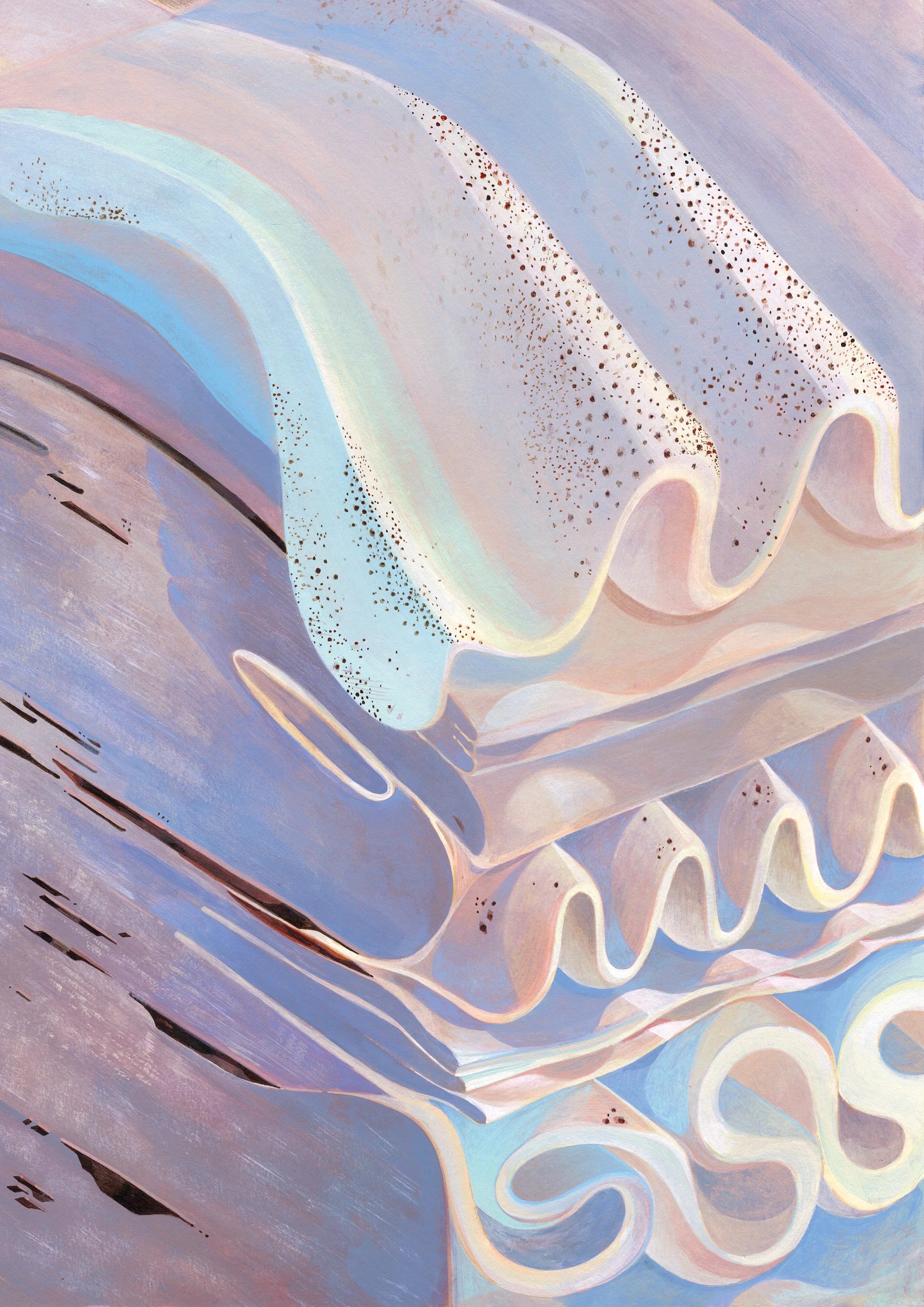
Two weeks ago, we published ‘The Golden Age of British Ice Cream’ with a beautiful illustration by Sing Yun Lee. Many of you asked whether we would release this as a print, so we listened. You can now order it as an A3 print here.
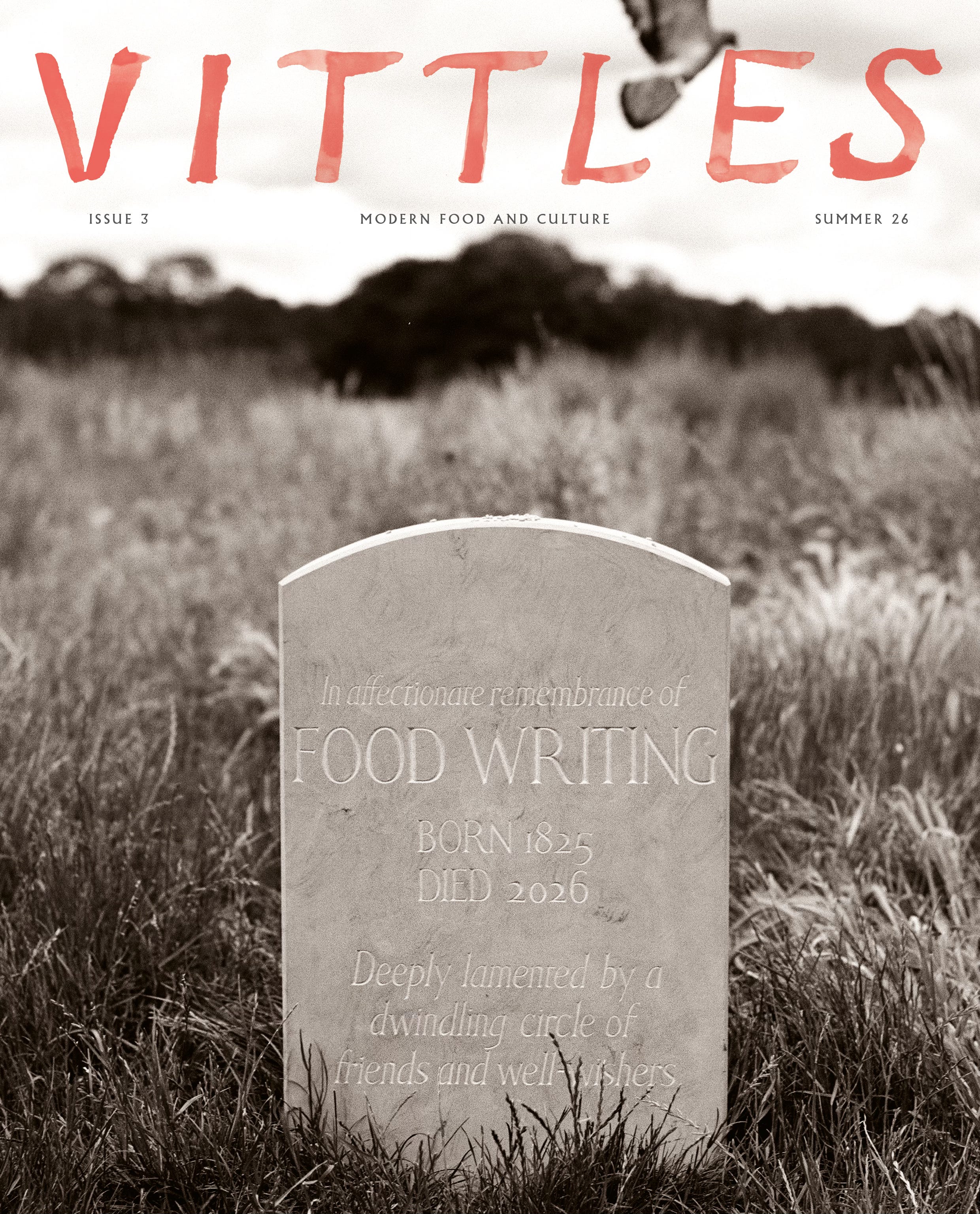
Finally, our third print magazine, ‘The Influencers’ is now in bookstores and available on our website. Order your copy now while stocks last!
The curious case of the missing couscous
Why, in a city that has everything from tacos to tteokbokki, does the most essential food of the Maghrib remain absent? Arthur Asseraf investigates.
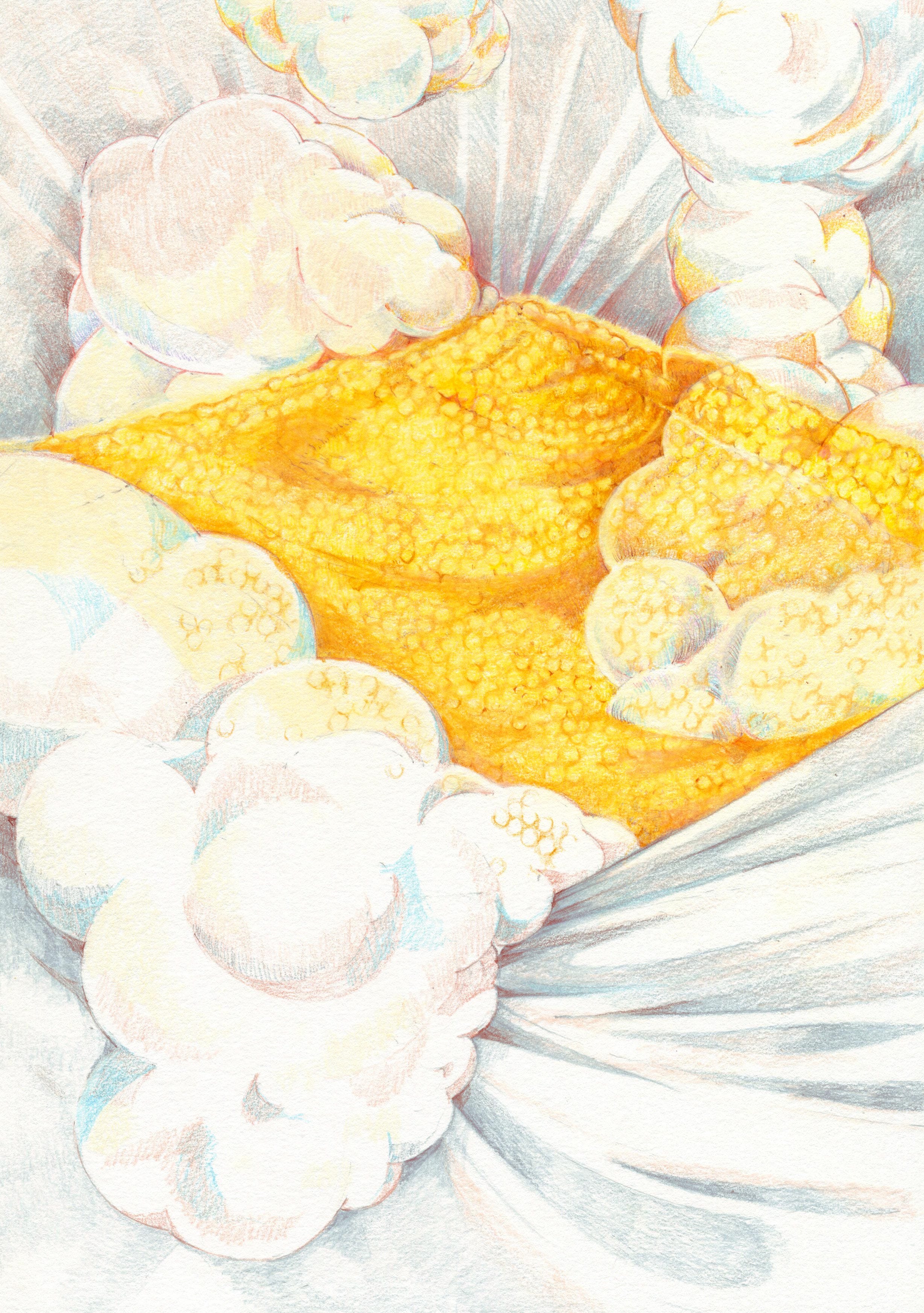
When I moved to London many years ago from Paris, my parents told me to get on the first Eurostar back for certain things: medical care, bread and couscous. Among North Africans, it is folk knowledge that you cannot find couscous in this city.
During the lockdowns, as travelling back to Paris became more complicated, I began to wonder if I was the only one who had been given these instructions. I asked around: Is there couscous in London? Not one but two women from Algeria named Donia confirmed my hunch. Donia Ismail, a journalist who writes on North African culture, said that there are simply ‘no options in London’ compared to Paris. The second Donia, who spells her name Dounia and lived in London as a student, flashed a question back – ‘You mean, real couscous? No.’
This is the unspoken rule of European food culture: London for curry, Amsterdam for rijsttafel, Paris for couscous. It is the equation of soft multiculturalism that governs the continent – first you go over and colonise them, then they migrate here, then you get good food. The cute logic retains an element of colonial possession: each Western European country has ‘its’ immigrants, with ‘its’ totemic dish embraced by the majority population.
Thankfully, this does not bear up when you’re in the business of serious eating. Waves of migration do not just follow the path of colonialism. Step off the Eurostar at Gare du Nord and you will find a profusion of restaurants serving Tamil food, founded by people displaced by genocide by the Sinhala-majority Sri Lankan government. Similarly, France may have colonised Vietnam, but I’ve learned as much about bún bò Huế on Mare Street in Hackney as I have at the Olympiades in Paris.
In the same way, even though North Africans have never occupied as prominent a role in London as they have in Paris, trickles of us have found our home here. Some came to work in finance in the boom years, or to study; others to flee the Algerian Civil War in the 1990s. Many are hidden among London’s massive French community. The more I have called London home, the more I’ve begun to find a certain absence mysterious: why, in a city where you can now find decent tacos and where tteokbokki is around every corner, is the most essential food of the Maghrib absent? I set out to solve this case.
Before we begin, let’s get things straight: if you think that couscous is a sad grain salad, half-heartedly spiced with some dried fruit, that you pick up from the Waitrose chilled shelf, I need you to educate yourself. In fact, if you have ever sincerely used the phrase ‘Moroccan-style’ to refer to something you have cooked, you can leave. I will absolutely not be chill when it comes to couscous. As Magali Morsy, a historian and prominent couscous expert, writes, ‘couscous is not a food like others’. If your family, like mine, comes from anywhere in the northwest quarter of the African continent – which stretches clockwise from Senegal to Mauritania, Morocco, Algeria, Tunisia and Libya – couscous is not just a food: it is the food.
Couscous, in the way we understand it, is a kind of trinity: the lovingly prepared semolina, a sauce, and some meat and vegetables. Making couscous involves a careful ballet of working the grain with your hands, steaming it above a broth, then repeating the process multiple times. If, after reading this, you still buy a pack of semolina from a supermarket, pour hot water on it, eat it as a clump and call it ‘couscous’, let me make a very specific threat: I will come to your house, make a Yorkshire pudding from a packet, chop it up, eat it cold and call it a Sunday roast to your face.
‘This is the unspoken rule of European food culture: London for curry, Amsterdam for rijsttafel, Paris for couscous. It is the equation of soft multiculturalism that governs the continent – first you go over and colonise them, then they migrate here, then you get good food’
Now back to my quest, which I started close to home in North London. On Blackstock Road in Finsbury Park, the string of Algerian and Moroccan shops is probably the most visible concentration of North Africans in the city. Several butchers here sell couscous – usually the well-respected Moroccan brand, Dari. They even conveniently sell the pot, the couscoussier: a set of two stackable containers used to steam the grain. So there it was: I could find all the things to make couscous, but not the dish itself.
When I asked people on the street for recommendations, it felt like I was chasing ghosts of couscouses past. Le Rif, nearby on Seven Sisters Road, turned out to be permanently closed. Several of the people I asked – all men – mentioned a mythical posh place somewhere central called Momo, which may have had couscous. Upon investigation, it turned out that the restaurant - a longtime Mayfair classic opened by French-Algerian restaurateur Mourad Mazouz and anointed by Grace Dent - is also long closed.
Since fieldwork wasn’t producing very good results, I turned to Google and searched ‘couscous London’. It suggested a caterer: Rafik Kadri of Marrakech Kitchen. Chasing this lead, I called Kadri and asked point-blank: Why is it so difficult to find couscous here? Kadri’s answer was that North African food is not very well known in the UK. ‘There’s not much publicity on TV. I wish it was more popular – it would be more busy for me.’ Most of his customers, he tells me, are French people who live in London, or Algerians.
Kadri may be right, but I think the answer is a bit more complicated. North African ingredients have been popping up everywhere for a while now: a few drops of harissa, swimming on top of a martini in a Soho restaurant. Preserved lemons, available online in a section of the shop intriguingly titled ‘emerging cuisines’. The wider Ottolenghification of British pantries over the past two decades has seen Maghribi food rise, but decontextualised as part of a wider ‘Middle Eastern’ jumble. All major British supermarket brands have a ‘Moroccan-style hummus’, despite the fact that we do not eat much hummus in Morocco.
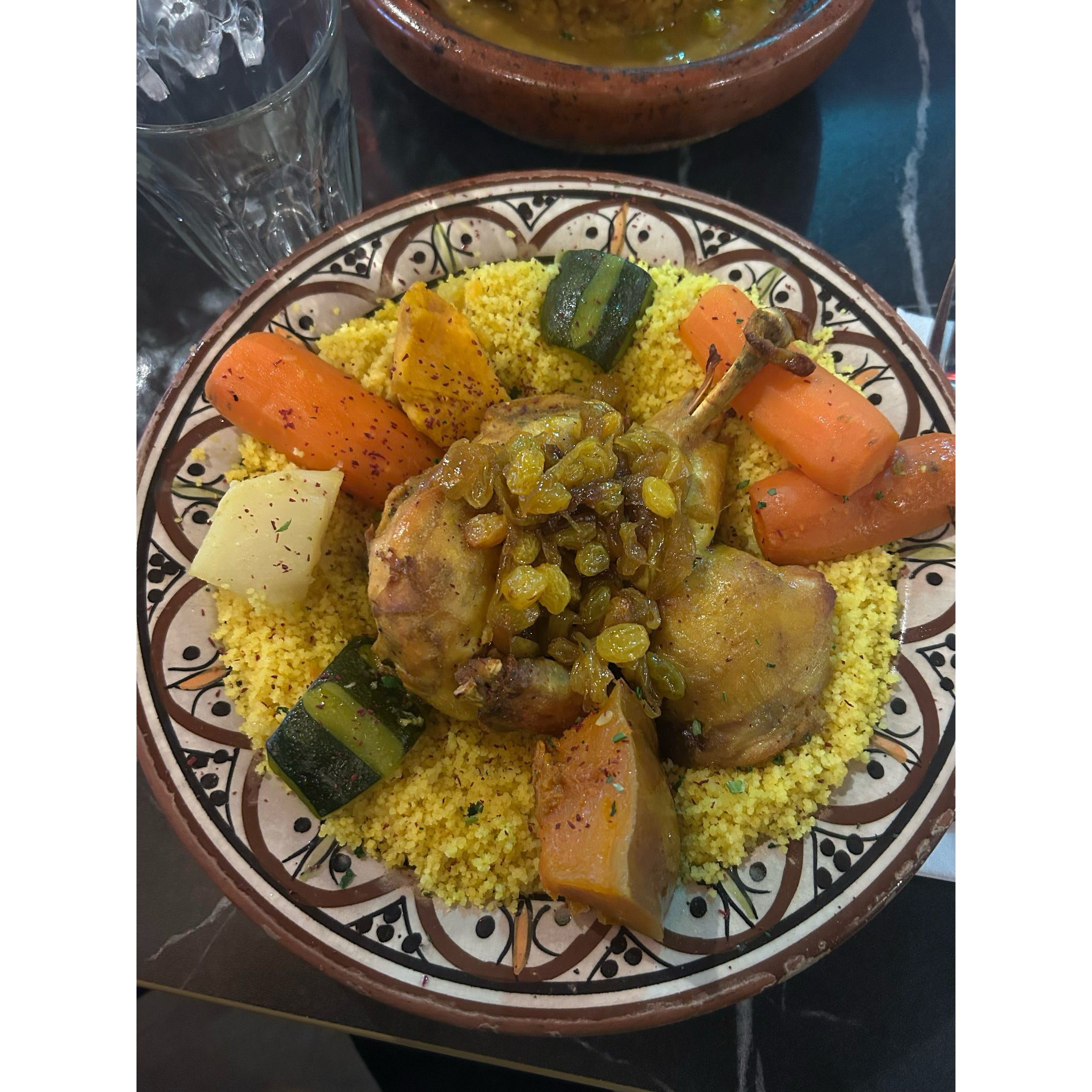
My initial hypothesis for couscous’ absence is that the dish, properly made, is not a flavour that you can use to spice up a midweek meal – which is what brands like Al’fez promise with their packs of ready-made ‘spiced couscous’. It is a dish that requires commitment, technique and labour. But Kadri shut down my diaspora-poetry fantasies of grandmothers with tattoos hand-rolling grain (‘it takes ten minutes,’ he said). Instead, he offered another explanation: couscous is a dish ‘you need to share, for a birthday or for ten of you. By yourself it’s a bit boring.’
Back on Blackstock Road, Mediterranean Café confirmed this. When I paid them a visit in May, they said I could only get couscous on Fridays and told me to return the following week. Though disappointing, this made sense: in most restaurants in North Africa, you can only get couscous once a week. As Kadri said, couscous is not an everyday dish. Lingering together after jumu’a prayers, gossiping with the whole family, sipping a glass of laban, in no rush as you go for seconds – that is when the couscous tastes right. In Jewish families like my own, the same rhythm holds: couscous is for the shabbat dinner on Friday evenings, when routine stops and we enter sacred time.
‘North African ingredients have been popping up everywhere for a while now: a few drops of harissa, swimming on top of a martini in a Soho restaurant. Preserved lemons, available online in a section of the shop intriguingly titled ‘emerging cuisines’’
After being turned away from Mediterranean Café, I was beginning to wonder if the problem was not just British people’s ignorance of North Africans and our food, but us not going out to eat couscous in the first place. Growing up, I only ever ate couscous at my grandmother’s house; going out was for sushi or pizza. Perhaps this is why many North Africans seem to be opening ‘Middle Eastern’ or ‘Mediterranean’ restaurants rather than trying to serve the food we eat at home. Take the owner of the Comptoir Libanais chain, Tony Kitous, who is Algerian. As Riane Tarik, an Algerian who lived in London for eight years, pointed out to me, ‘He wouldn’t have done a Lebanese restaurant if he thought Algerian food was selling.’ Some of the Orientalism in British food culture is an inside job.
Given the amount of Ryanair flights leaving to Marrakesh, I wondered if instead of searching for ‘couscous London’ which had mostly led me to depressing grain salads, shifting the focus by searching to ‘Moroccan restaurant’ would help me find couscous.
This search led me down the Piccadilly line, where I visited Bab Mansour in Covent Garden. The restaurant was straight Marrakesh for returning tourists: babouches on the walls, serial-rapist singer Saad Lamjarred as the soundtrack. For £21, the chicken couscous had juicy meat, but the grain was woefully dry. This confirmed a hunch: if couscous is served alone, without a bowl of sauce on the side so you can adjust to your desired level, it cannot be taken seriously. ‘Morocco’ was not a brand that could be trusted. I would have to broaden the search beyond the land where (some of) my ancestors came from.
The internet is full of boring couscous wars whose ferocity is only surpassed by the jollof wars of the West Africans. A frequent set piece for these arguments is octopus on couscous — a Tunisian speciality whose polarising effect is similar to that of pineapple on pizza; and there is also couscous merguez, which many believe to be a heretical invention of the French.
All these comment skirmishes focus on defining the correct couscous, but if any emoji-flag warriors are reading this, remember: nationalism is the thief of joy. Couscous’s inscription to UNESCO intangible cultural heritage was a rare case of cooperation between Mauritania, Morocco, Algeria and Tunisia, so don’t ruin couscous by claiming that yours is the only real one.
Like most Jews, my family has moved around with every generation, in our case between Morocco, Algeria, and France. My mother isn’t even North African, and my dad’s mother, born on the border between Morocco and Algeria, was famously a terrible cook. I am, therefore – both by upbringing and conviction – a couscous pluralist. I have tasted a truly bewildering range travelling around – one for every season and region. Sweet wedding couscous topped with cinnamon and sugar; delicate barley couscous made for the rough winters of the mountains; fresh vegetable couscous of spring, piled with fresh green fava beans; red fish couscous of the coastline; the millet-based thiéré of Senegal. How many delights are we depriving ourselves of by not being open to discovery?
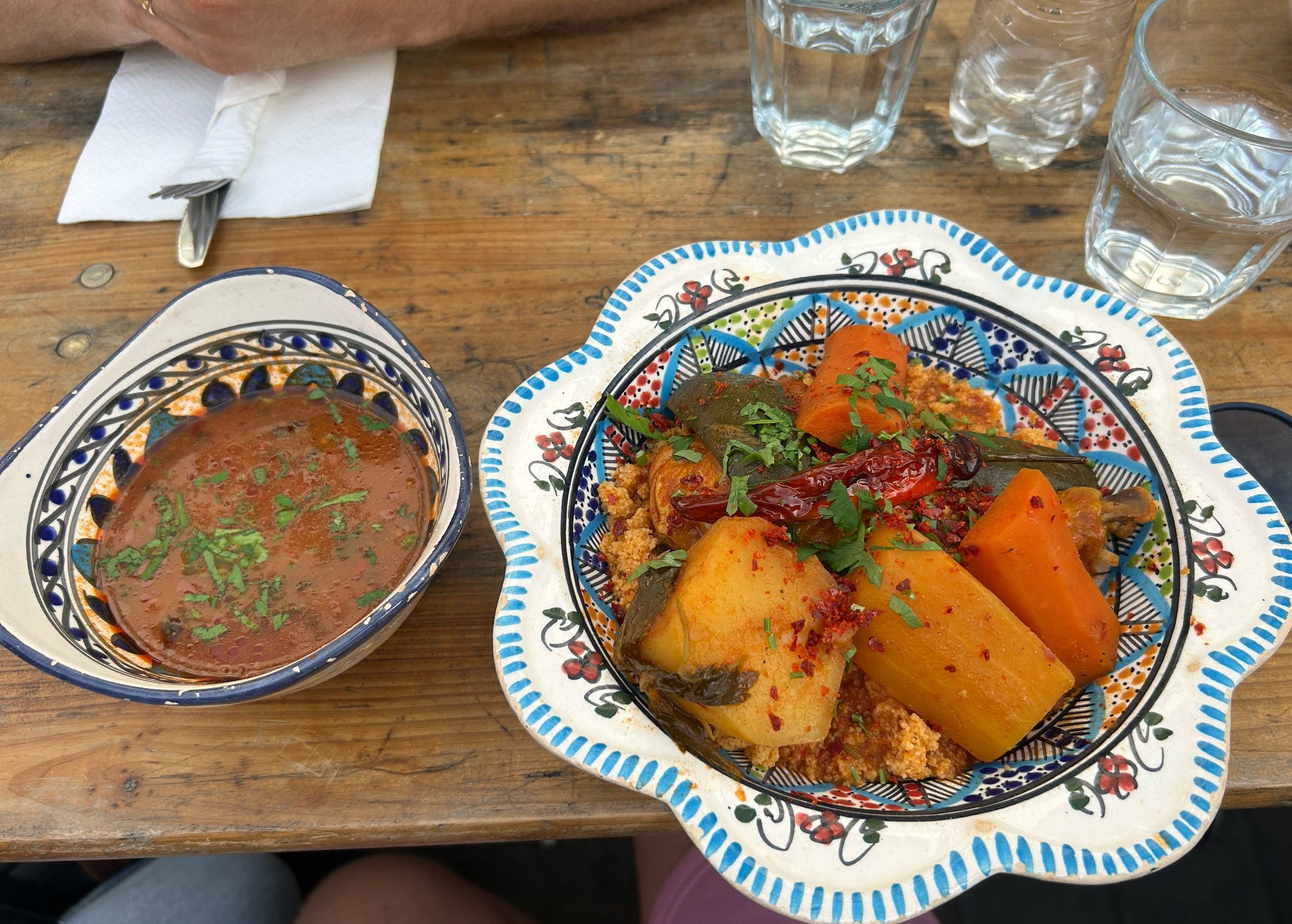
For my second stop, I expanded my horizons and headed for Waterloo Station. Tunisian Street Kitchen, which I had visited before, has since added couscous to its menu. The dish came Tunisian-style: gloriously red, with some of the tomato-based sauce already mixed into the grain. Mercifully, it had a bowl of thick red broth on the side. Though I could have done with more heat, the whole chilli piled on top allowed for personal spice regulation. A reminder to my fellow Moroccans and Algerians, who prefer a more delicate, white fluffy grain, with the sauce solely on the side – let the Tunisians cook.
Part of the reason North Africans deny the existence of couscous in London is that we refuse to accept the ones that do exist. Any couscous that is offered to us must be dismissed as inauthentic in order to preserve the mythical couscous of our childhood memories. ‘We have terribly high expectations’, says Asma Barchiche, an Algerian art curator who used to live in London. I remember Dounia’s initial reaction: ‘real couscous? No.’
My next stop, near Baker Street, confirmed that the a good approach was to seek out the new (in this case Libyan) couscous. While the internet fights over Morocco and Algeria, everyone always forgets about Libya, the unsung load-bearing member of the UK’s Maghribi community.
At Acacus, I could definitely tell that I was closer to the Edgware Road galaxy of the Eastern Arabs. From the outside, it looked like shisha – which people were enjoying on the warm June evening – was the main activity, with food as an afterthought. However, the menu revealed not just one but several kinds of couscous on offer.
Sweet wedding couscous topped with cinnamon and sugar; delicate barley couscous made for the rough winters of the mountains; fresh vegetable couscous of spring, piled with fresh green fava beans; red fish couscous of the coastline; the millet-based thiéré of Senegal. How many delights are we depriving ourselves of by not being open to discovery?
I chose chicken, and it was exquisite, with a rich and meaty sauce. I should not have been so surprised as I was at the quality, since the best couscous I have ever eaten in the UK was a Libyan one, at Zoroona in Manchester. What I perhaps loved most about Acacus’s couscous was that I would not have been able to find it in Paris. The restaurant’s menu was a wonderful antidote to the notion that couscous is France’s version of what chicken tikka masala is to the UK. It featured a helpful list of ‘Things you might like to know about Libya’, which included the following historical summary: ‘there were hundreds of revolutions against every colonist who settled in our land. It suffices to mention the struggle of our ancestors against the Italians.’ It turns out the best couscous is served not just with chickpeas but also with an homage to Omar al-Mukhtar.
So, one could, with the right attitude, eat pretty good couscous in London. Sure, it’s not widespread and it’s not at the centre of a trend, but if you look hard, it is possible to find. The more I asked, the more I was given other suggestions: a Moroccan cafe just opposite Borough Market, another in Whitechapel, a Turkish-Algerian cafe in Penge that may, it turns out, serve couscous, and a cluster of North African restaurants in Hammersmith. The problem, then, was less actual supply, but that something else was missing.
When I returned, late in my quest, to Mediterranean Café for a Friday lunch, I was sent next door to Ourika Café. At Ourika, the vibe is quasi-takeaway, with a few tables lying in front of the glass counter. They microwaved an individual bowl of couscous for me. The bowl of yellow broth was comforting, the beef tender, and the grain stodgy from reheating. For £8, this was perhaps the most honest couscous I have eaten in London. I ate it alone at the table, surrounded by red-and-green Moroccan flags.
What most North Africans in London miss, I think, is not the food, but who we eat it with. Most of those I know came here alone, as adults, for work or study. The absence of couscous is a proxy for the absence of a family to share it with. As Dounia puts it, ‘it’s one of those rare dishes that everyone thinks their mum makes best’. The hands that roll the grain are inseparable from the hands that held you.
I can relate to this. In times of grief, I have regretted that there was no one around here to make couscous for me. But I also don’t completely trust this fantasy of family. For me, the best couscous back home often came with many toxic sauces: a mix of guilt, career expectations, gossip, right-wing politics and, in some cases, Zionism and homophobia. The highest couscous cooks in the extended family’s official ranking – those that were trusted to provide large family meals – were also more conservative in their outlook.
‘Part of the reason North Africans deny the existence of couscous in London is that we refuse to accept the ones that do exist. Any couscous that is offered to us must be dismissed as inauthentic in order to preserve the mythical couscous of our childhood memories’
Even in the deep confusion of his dementia, couscous was my father’s favourite food. When he died in 2023, I travelled back to Paris for the funeral. His cousins enveloped me at the cemetery like a protective swarm, loving and invasive. I fell into their affection for a moment, but I felt the need to return to the distance I have kept from them for most of my adult life. When I returned to London, I felt deeply alone. No one here would know how to grieve with me. Worse: on my own, I would not know how to grieve at all. Because I thought of my community as a burden, I had not learned from them. I had never learned to read Hebrew, and could not read the prayers. I had never dared to make couscous myself. Now, I felt like I was being punished for not knowing what I was supposed to do.
On the shloshim – the thirty days which mark the end of the first period of mourning – I went to Blackstock Road and found a cheap couscoussier. I watched YouTube video after YouTube video of Choumicha, the goddess of Moroccan cooking whose face adorns the Dari couscous packs. I invited my sister and some friends to my house. My hands, I found, did know how to roll to avoid clumps. The couscous itself, if I’m being objective, was a bit of a mess. Because I had no platter big enough, I served it on a giant plastic chopping board. Grains scrambled all over my flat; I was finding them for months. We lit some candles, we spoke about families and everybody got just the vegetable they liked. For most of the people around the table, it was their first couscous. I will not resign myself to the belief that there can be no food that feels like home in the city I call home.
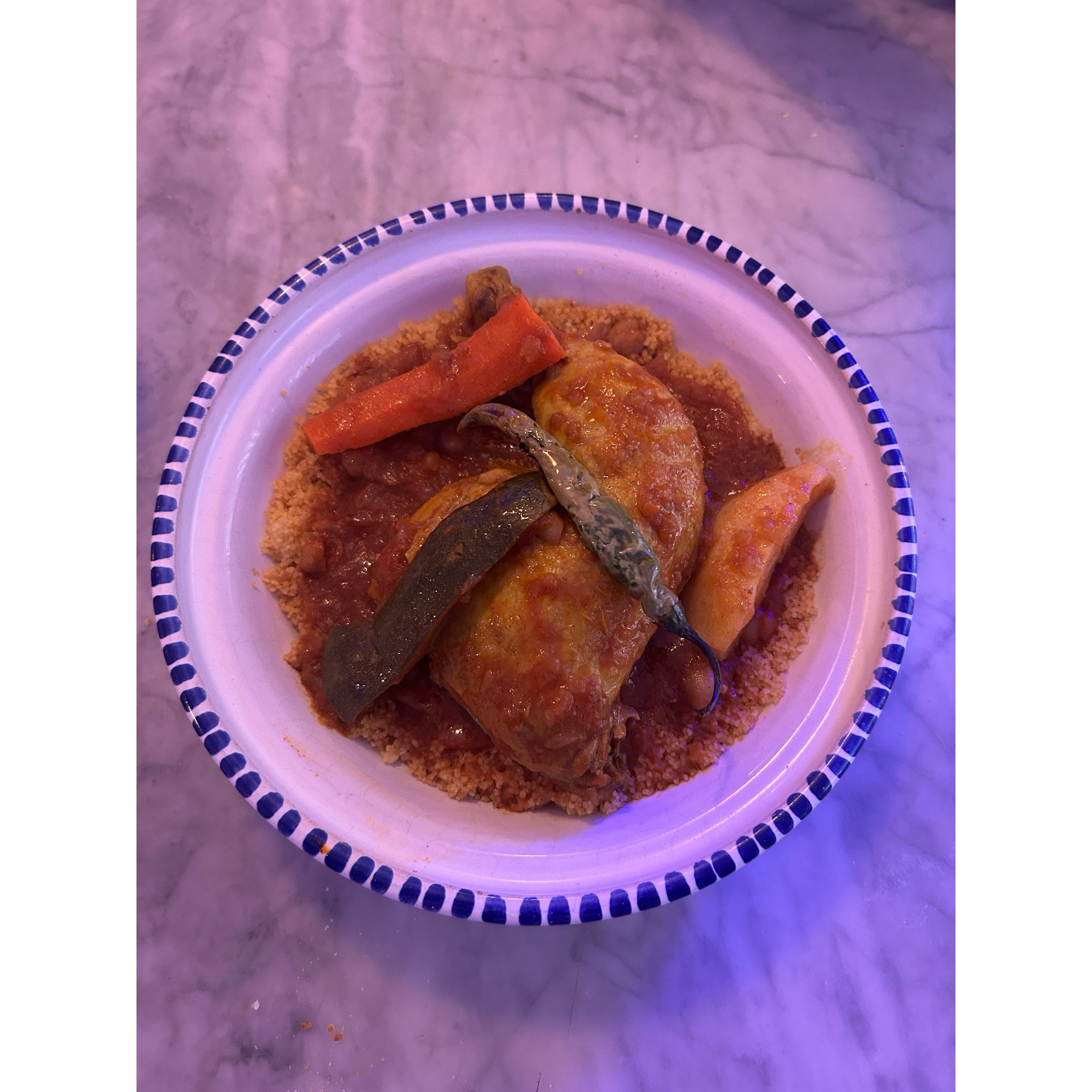
In denying that we can have couscous in London, we underestimate its power as a technology for gathering people. At Barcha Barcha in Hammersmith, head chef and owner Sas tells me that her couscous has had unexpected results: ‘The feedback I get, whatever the origin of the people, is that it reminds them of their grandma. The English people themselves also tell me this, even though taste-wise it has nothing to do with them, but the energy is transmitted.’ The couscous that binds an existing family, which is made from custom, biology and patriarchy, can pale in comparison to the couscous that builds new connections.
Many times, I have been asked to eat couscous specifically because I am a stranger. One spring, high in the mountains of Kabylie, east of Algiers, a man in his early thirties stopped me in the middle of the village. The flowers around us were excessive, as was the trash accumulating by the roadside. He pointed to a giant platter of couscous by him. His son, he explained, had been hit by a truck. As the boy lay in hospital, the father appealed to higher forces. He swore that if his son lived, he would make a couscous for everyone. He pointed to his smiling child next to him, and he handed me a bowl which contained both a meal for me and the force that had sustained his son’s life. I took in his fear and his hope, the illness and the healing. It was delicious.
Something exceeds matter in what we ingest. It is impossible to properly talk about couscous without speaking about the sacred. It might seem strange that baraka, the holy power that flows through the world, can be embodied in such an ordinary thing as food. I don’t want to sound like an anthropologist, so let me try and strip this down to the way I see it: feeding people you do not know can have an effect on the world. One winter in the south of Tunisia, on the edge of the great salt lake where they shot Star Wars, I stumbled, with some friends, upon a crowd who were celebrating a festival at a saint’s tomb. I thought we were intruding as they danced themselves into a trance. But they were insistent: Sit. Eat. The couscous was red and infinite in quantity. This was not ‘generosity’ – which is often too weak a term, suggesting something extra and unnecessary, rather than an imperative, a way of acting upon what surrounds you.
‘Because I thought of my community as a burden, I had not learned from them. I had never learned to read Hebrew, and could not read the prayers. I had never dared to make couscous myself. Now, I felt like I was being punished for not knowing what I was supposed to do’
I am not naive about the power of food to bring people together. If anything, the spread of certain forms of North African food in the UK, often mediated by Israelis and repackaged as ‘Mediterranean’ or ‘Middle Eastern’ to dodge their settler colonialism, suggests the opposite. But I do believe that changing who you eat with can change a lot of other things around you. This is what couscous is at its core – not so much a series of ingredients as a mode of eating, one that requires labour, commitment and, most of all, gathering. ‘Couscous was never really designed around restaurant service’, says Boutheina Ben Salem, founder of Oula Café at Ibraaz near Oxford Street. At Oula, they only ever put one couscous on the menu, served ‘in the middle of the table, with people helping themselves, talking, and going back for more.’
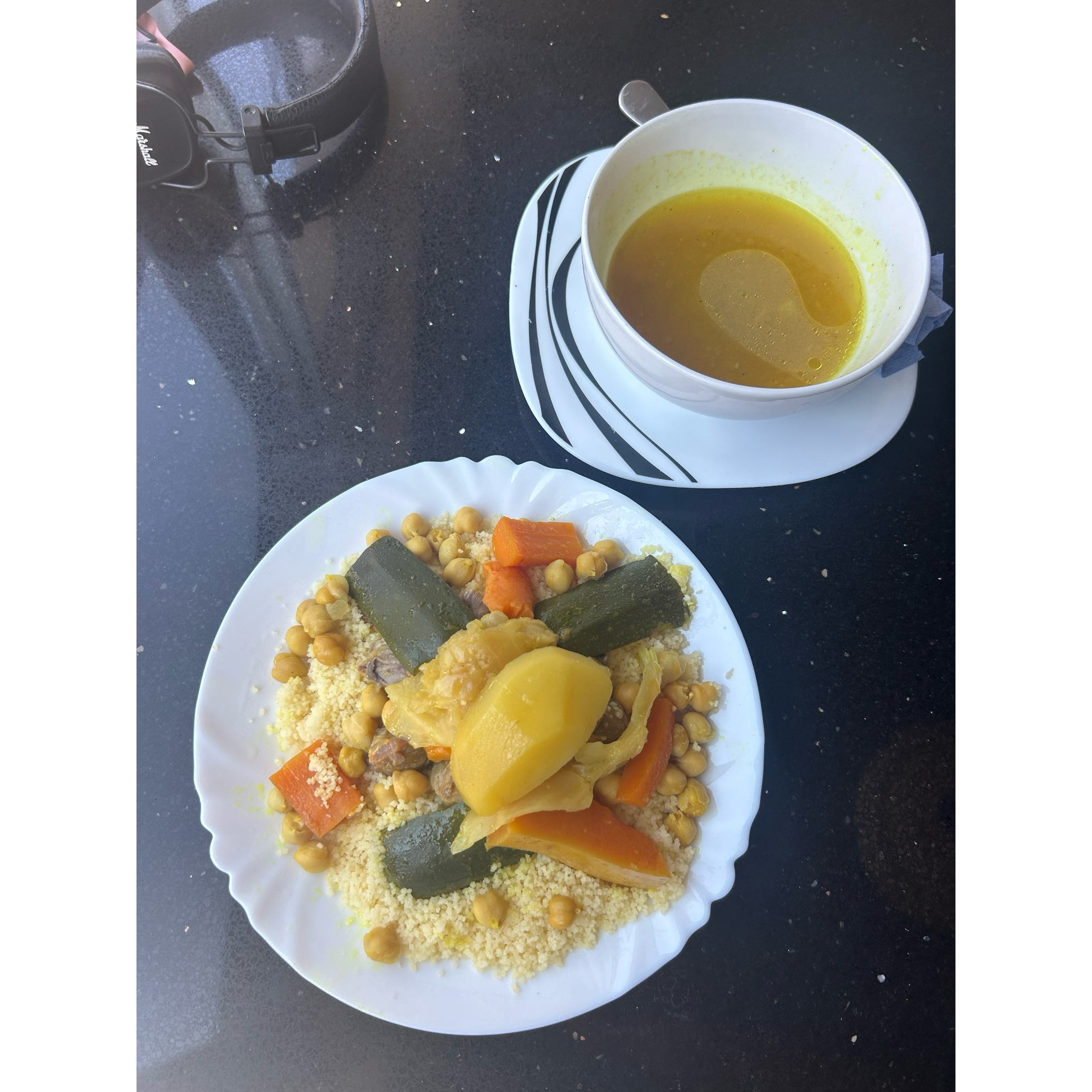
So here is the definitive guide to eating couscous in London: you have to find some people to eat it with first. The rest is details. If you want a warm, comforting, affordable meal, head down to Ourika Café on Blackstock Road on a Friday. For something more luscious, Acacus on Dorset Street is one of the best introductions you will find. Or, just grab a pack of Dari semolina, go onto YouTube and, using your two hands, make your own couscous. Invite as many people as you can fit in your home: the dish is designed so that you can multiply quantities almost to infinity. Don’t have enough people around to make this work? This city can sometimes feel lonely. Here’s a valuable trick: the more couscous you make, the more you can give away to strangers. See? Not so alone anymore.
Credits
Arthur Asseraf is a historian and writer from Paris who lives in London. He teaches at the University of Cambridge and is the author of several books in English and French on North African history and colonialism.
Sing Yun Lee is an illustrator and graphic designer based in Essex. You can find more of her work here.
The full Vittles masthead can be found here.
What’s the address for Ourika Cafe?