

Upsetting the Table
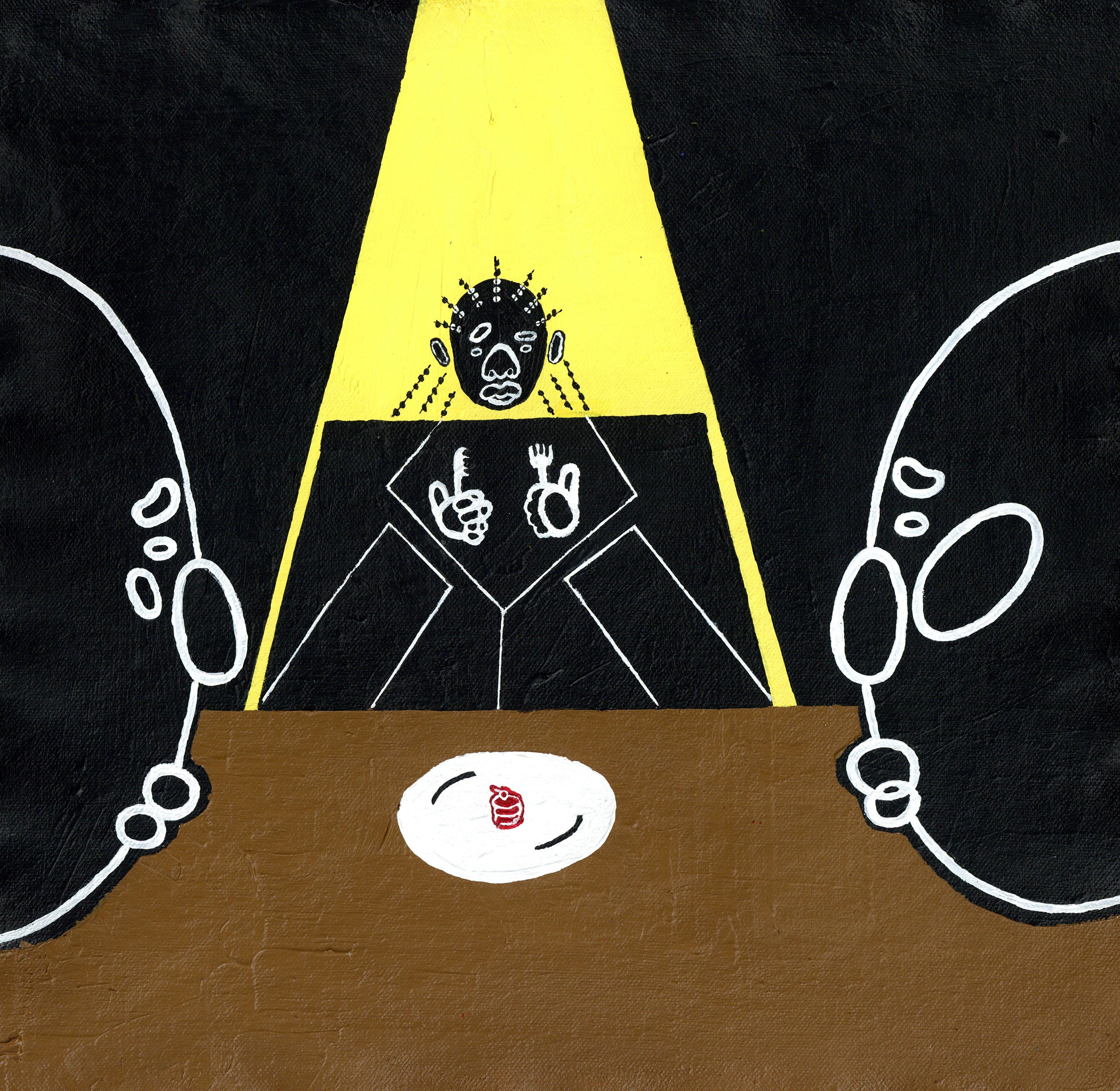
Amel Mukhtar visits three restaurants and lays out the complex rules and contradictions of dining-etiquette in Britain. Illustration by Joy Yamusangie.
Good morning and welcome to Vittles. Today, we are publishing our last essay from Issue 2, in which the writer Amel Mukhtar visits three London restaurants — The River Café, Luca, and Barney’s Pie and Mash — while navigating the classist and colonial connotations attached to dining etiquette and table manners in Britain. To read all the essays from Bad Food, click here. We do still have some copies left of Issue 2 if you want to read the whole magazine.
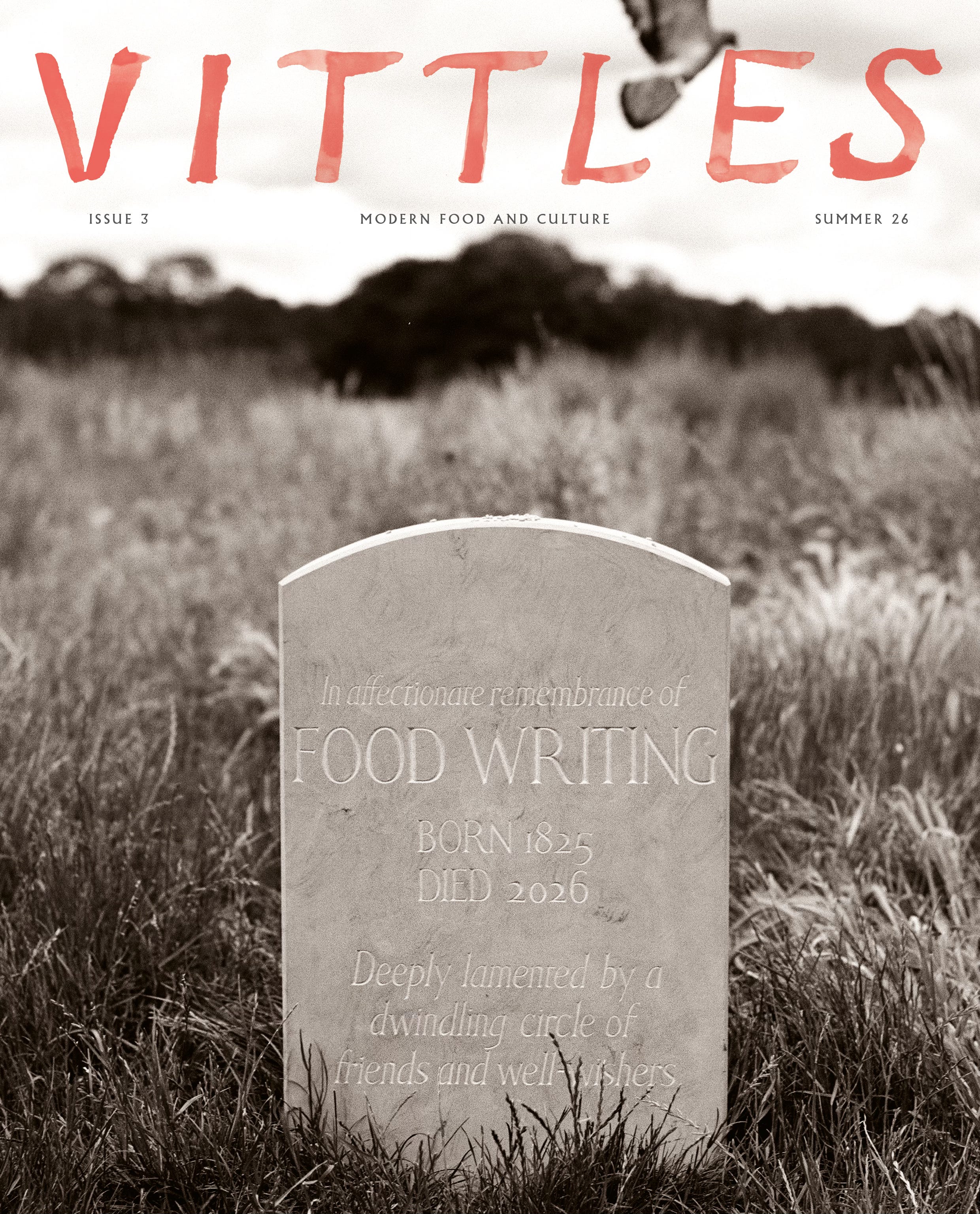
Earlier this week, we announced our third print issue, ‘The Influencers’, a magazine about how the internet and short-form video has reshaped food culture. If you pre-order the issue before 27 July, you will receive it for a discounted price of 10% off, with an 20% discount for paid subscribers (see the original email for details). You can order your copy here!
We have also now sold out of Ruby Tandoh’s Ice Cream City. If you didn’t manage to get a copy then don’t worry - we are going to do another print run and you can register your interest here.
Finally, we are extending the pitching window for reported features, investigations and long reads until this Sunday, 5 July. Further details are available here. A note: we are looking for specific stories rather than broad overviews of subjects, so if you have one then please pitch it to us.
When I was nineteen years old, my first boyfriend’s mother taught me how to eat. Up in Norwich for a week (my first time meeting his family), their stately home had a name, not a number. There was a drawing room – separate to both the living room and the dining room – with a grand piano. They had acres of garden. Each dinner, my boyfriend, his parents and his siblings got dressed, picked out a wine from the rack and sat around the table just chatting – no TV in the room. I felt like I’d stepped into an Enid Blyton novel. After I left, I was pleased to hear over the phone that his parents had liked me. There was just one thing, he said. ‘My mum was distracted by the way you eat.’
Huh? I’d had my fork in my left hand, knife in my right… Were my elbows on the table? ‘Don’t worry. She said she’ll show you the next time you’re here.’
A month or so later, sitting by the breakfast bar, his mum gave me a private lesson. You pierce with your fork – never scoop. Push extra food onto the back of the fork with the knife. If you must scoop, place the knife down and switch the fork to the right hand. Want more food or a cruet? Even if it’s within reach, never grab it; ask someone else if they’d like it and allow them to offer it back to you. And so on, and so on. Dissociating a bit, I watched the scene from outside myself: a young savage educated on the proper ways by the kind mistress of the house. Perfect Oscar bait, for sure, but jarringly retrograde on an otherwise normal 2010s day.
Later, I complained to her son about how colonial and classist it felt – the idea that there was one right way to eat and that it was whatever convoluted bullshit rich white people had made up between themselves one day – and he explained that she’d gone to a finishing school and just wanted to help. And I mean, fair enough. They had a family crest. They knew how to turn the most normal things possible, like being born or eating lunch, into something that seemed more official than everyone else’s. That was an alchemy I didn’t know the first thing about. How did you even get a crest? Was there a waiting list? Maybe these secret societies would open to me, too, once I learned their codes and stopped turning their stomachs with my scooping.
Pierre Bourdieu’s Distinction, which was on my university syllabus the next year, helped me to understand the fundamental difference in our perspectives. ‘In opposition to the free-and-easy working-class meal, the bourgeoisie is concerned to eat with all due form … this whole commitment to stylization tends to shift the emphasis from substance and function to form and manner, and so to deny the crudely material reality of the act of eating and of the things consumed, or … the basely material vulgarity of those who indulge in the immediate satisfactions of food and drink,’ he writes.
A French sociologist, Bourdieu was from the birthplace of etiquette. The notion of etiquette was born of the scores of strict – and superfluous – rules that King Louis XIV set for his court, many of which continue today (he popularised the whole no-elbows thing). The point for the king was to keep his courtiers busy and perpetually distracted by each complicated mandate they had to learn and follow, thereby quelling the possibility of class rebellions like the ones he witnessed as a child.
In Sudan, my parents ate with their right hands, sans utensils – a cultural rite that connects humility with godliness (in numerous hadiths, this is how the Prophet Muhammad eats). The only rule I recall from home is that you don’t eat with your left hand. Otherwise, one of my earliest memories is being scolded in a Manchester preschool for holding the knife and fork the wrong way round. But I had no real concept of just how complex it could get.
When I read it, Bourdieu’s 1979 class theory stunned me with its ready application, but how far does it really apply? And in any case, the current post-Brexit, post-woke, proto-fascist landscape feels like a different world. Are there new rules of the table, too?
‘This is where the money is, darlin’.’ My Uber driver and I are debating the merits of East London versus West London until he wins it with this line. I can’t argue with that. It is what has brought me to W6, Hammersmith – an hour and a half from my home – to scope out The River Cafe. I’d first heard of this lauded British-Italian institution through a zany billionaire scion of a media conglomerate. We were the same age – in our mid-twenties – starting the same role at the same job. After work, on the evenings I felt too lazy to cook, I’d often pick out a ready meal at Sainsbury’s, comparing the discounts. The days that he felt too lazy to cook, which were most of them, he ate at The River Cafe.