

The Vittles Guide to the London Chinatowns
Six (and counting) Chinatowns, across more than eighty restaurants and fifteen distinct cuisines,

Welcome back to the Vittles Chinatowns Project. Today’s newsletter is the largest guide ever written for the London Chinatowns. It covers six ‘Chinatowns’ serving six different communities: the historical London Chinatowns of Soho and Queensway, as well as the new styles of Chinatown emerging in Bloomsbury, Spitalfields, Colindale–Hendon and the Docklands. As this is a long post, we recommend reading it in full via our website here.
You can read the rest of the project here:
Who is Chinatown for?, by Xiao Ma
The New Chinatowns, by Barclay Bram
Crying in Wing Yip, by various
The Vittles Guide to the UK’s Chinatowns (including individual guides to Birmingham, Manchester, Liverpool, Cambridge and Glasgow), by various
The concept of Chinatown as we commonly understand it emerged from a very specific set of circumstances at the turn of the twentieth century, when Cantonese sailors with meagre resources were forced to make creative use of limited space in their new cities. In London, this began at the docks in Limehouse and moved to Soho in the 1960s, when migrants from Hong Kong and the New Territories took on cheap leases in what was then considered an undesirable part of the city. Many had been displaced by wartime bombing and rebuilt their businesses around a tight cluster of streets between Leicester Square and Soho. Alongside restaurants sat Chinese supermarkets, traditional Chinese medicine clinics, massage parlours, video stores, cinemas and a handful of betting shops tucked into side corners, all part of the same compact ecosystem.
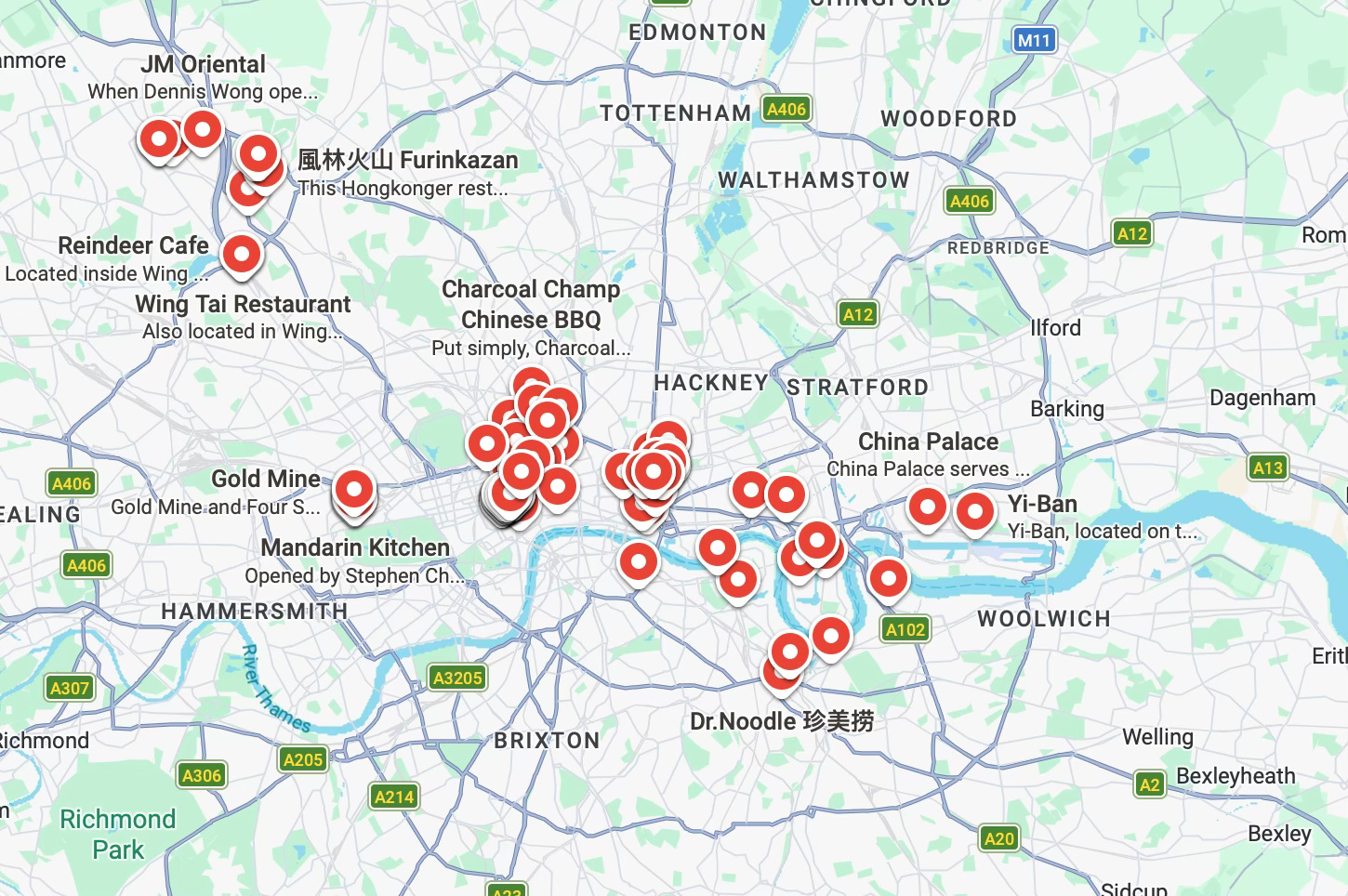
That era of Chinatown is over. The Soho Chinatown – the place that most Londoners would think of when they hear the word ‘Chinatown’ – is no longer the only centre of Chinese culture in the city. New types of Chinatowns are flourishing across the city, in places where Chinese people actually live. To the historical Chinatowns of Soho and Queensway, you can add the conurbations from Bloomsbury to King’s Cross, and from Spitalfields to Aldgate, that have been utterly transformed by the university and housing markets, and which cater to a new demographic of students. In Colindale and Hendon you will find a satellite Chinatown catering to second-generation Cantonese families and new arrivals from Hong Kong on BNO passports. And in the Docklands, on the site of the first Chinatown, you will find a sprawling, unplanned ecosystem of gigantic dim sum parlours and regional Chinese restaurants, making use of the area’s unique topography.
What this means is that there has never been another time in London’s history when you can eat better and more widely across China’s rich diversity of regional cuisines. For the first time ever, across more than eighty restaurants and fifteen distinct cuisines, we have compiled a guide on where to eat them, in London’s six (and counting) Chinatowns.
Contributors
JN – Jonathan Nunn. AH – Angela Hui. EZ – Elaine Zhao. SC – Siqi Chong. GC – Guan Chua. ZS – Zoe Suen. FD – Fuchsia Dunlop. BB – Barclay Bram. DB – Dan Biddulph. IR – Isaac Rangaswami. MAC – Montague Ashley-Craig. AW – Anto Wu. FL – @foodinlondon. LT – Liz Tray.
Soho Chinatown
While Chinatown was once primarily a place for the Chinese community, today it is a mirror of central London itself – a mix of cultures, cuisines and generations, constantly shifting, full of energy and impermanence. The neighbourhood is almost unrecognisable from what it was even ten years ago; restaurants change hands fast and often without much fanfare, pushed out by rising rents. In recent years, Brexit and Covid-related staff shortages, have led to a shrinking pool of skilled wok and dim sum chefs, while changing tastes and demographics have altered the type of restaurant that opens here. What was once a stronghold of Cantonese roast meats and dim sum banquet halls has evolved into a pan-Asian bubble tea slurping, jiggly soufflé pancake queuing and custard taiyaki snacking TikTok town.
Still, Soho’s Chinatown remains one of the great central London neighbourhoods for eating out. Everyone – theatregoers, tourists, late night revellers – passes through it, which means each restaurant fulfils a function. It contains everything from tiny street food stalls selling oyster cakes and jianbing, to Haidilao, the gigantic Chinese hot pot chain that approximates a Harvester if it was directed by Zhang Yimou. And in its longstanding institutions – Wong Kei, New Loon Fung, Lido, anywhere that owns its freehold – Chinatown has its unwavering anchors, there through it all, even as everything changes around them.
Old Town 97 Cantonese
Chinatown used to be a village of nighthawks but it’s only Old Town left that still caters for the outcasts, late-night revellers and post-shift chefs. The best food here has the tenor of a great midnight snack: ho fun in slippery egg sauce, equal parts charred and gloopy; salted egg yolk chicken wings; seafood fried ‘fragrant and spicy 香辣’ (translated on the menu as ‘spicy golden leaf’) that leaves your lips buzzing with lemongrass and sambal. Old Town is infamous for its absurd off-menu dishes for students with iron stomachs. ‘LSE rice’ is egg to the power of three: pork belly in honey and pepper egg sauce, egg fried rice and a fried egg on top, although I prefer the Ah Ming fried rice, with crispy pork and fried balls of tofu. JN
19 Wardour St, W1D 6PL
Cafe TPT Cantonese
Cafe TPT is a template for how all Cantonese restaurants in London can and should be – competent at everything and exceptional at a select few standouts. There’s the creamy beef flank curry that reduces down in its stone pot, the blistered, caramelised green beans and the soft shell crab stir-fried typhoon shelter-style with chilli and curry leaves, but also, ingeniously, with cornflakes. Or the pork chop Macau-style with onions and cheesy béchamel – a chaise longue of a comfort dish, best eaten in the late hours to soak up a Soho night. I cannot be objective about this place. The most meaningful relationship of my adult life is the one I have with the laoban, who, in fifteen years, has acknowledged that I’m a regular on exactly two occasions. JN
21 Wardour St, W1D 6PN
C&R Cafe Malaysian/Cantonese
Located down a blink-and-you’ll-miss-it alley off Rupert Street, C&R Café is one of Chinatown’s worst-kept secrets and rightly so. This Malaysian joint has been dishing out comfort food since the late nineties, with its laksa the star of the show: a fiery, coconut-rich broth packed with prawns, tofu puffs, fish balls and slippery vermicelli noodles. Stir-frying here is a strength: the C&R wat tan hor is among the best in London, but even better is the chai tow kwai (radish and rice cakes) with each of their six cube faces blackened from the wok, plus a heap of beansprouts and tiny umami-jolts of preserved radish. Pro tip: if you sit close to the back you can steal Speedboat Bar’s wi-fi. AH + JN
4–5 Rupert Court, W1D 6DY
Lotus Garden Cantonese/dim sum
I often used to come to Lotus Garden specifically for siu yuk on rice, which I marginally prefer to its rivals in Chinatown on taste and price. That is, until last year, when I bumped into Super 8’s Songsoo Kim, who recommended I get the prawn and chive dumplings, plus a deep cut from the cheung fun menu: a crispy bean curd roll stuffed with sesame and prawn cake. Since then, I’ve never deviated from this order. I’ve never seen the cheung fun anywhere else exactly as it is here: a textural riot from the addition of toasted sesame. It’s one of the best single items in the whole of Chinatown. JN
15a Gerrard St, W1D 6JD
Wong Kei Cantonese
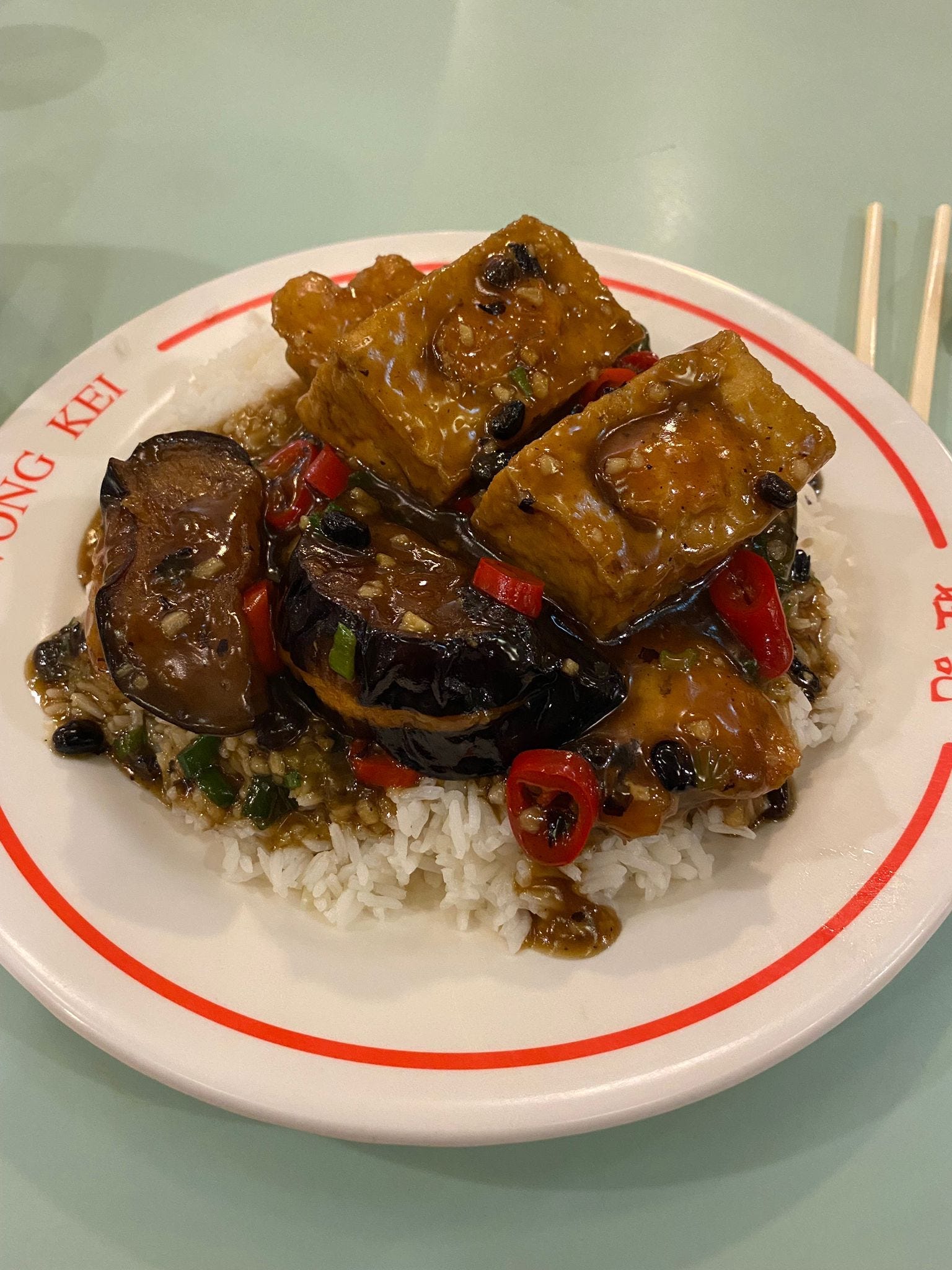
Opened in 1972, this cash-only Cantonese canteen is the stuff of legend. Sprawled over four floors, the menu is a beast – so long and varied that no mortal could realistically conquer it (except maybe Joshua Armstrong, the obsessive behind the Library of Alexandria Wong Kei Tumblr, who ate and documented his way through every combination on offer). If you’re dining solo, go for the wonton noodle soup, assorted meat ho fun and the barbecue cold meat on hot rice. If in a group, order the black-bean-stuffed green peppers, bean curd and aubergine and plenty of stir-fried morning glory. Or just point to whatever the table next to you is having. The chances are it’ll be great. And whatever lands on your table, wash it down with the pot of free tea and a generous spoonful of the communal table chilli oil. AH
41–43 Wardour St, W1D 6PX
Haidilao Sichuan/hot pot
China’s premier hot pot chain might not look like much from the street in Piccadilly. But its ground-floor room is merely the waiting area (where you can get your nails done, for free). The restaurant itself is in a cavernous basement at least a football pitch in length. It’s raucous with birthdays and the signature noodle dance, which on my last two visits have been deftly performed by waiters from Ghana. There are other hot pot restaurants in London with more upscale ingredients, but Haidilao has always been about the experience while delivering a consistent meal. It’s also low-key one of the best vegan restaurants in the city, with two distinct vegan hot pot bases and enough varieties of tofu to marvel at the delicate flexibility of the humble soybean. BB
Unit 4, 5 Coventry St, W1D 7DH; Unit 7.0.9, The O2, SE10 0DX
Real Beijing Food House Beijing/Xi’an/Sichuan
If any one restaurant represents the new Chinatown it’s Food House, which has cult status among young Chinese students taking respite from Dover Street Market in red oil noodles. The menu is shared between Sichuan – dry hot pots and whole fish cooked in chilli oil – and heartier northern and central Chinese fare of belt noodles, rou jia mo (flatbreads with meat) and skewers. Everything is great, but I love the red oil noodles with wide-belt la mian, the width of a classroom ruler, mixed at the table with pak choi and dry lamb or beef, so that each belt is coated in a scarlet slick of chilli oil. Simple but brilliant. Make sure to bring heads, as this is one of the few places where dumplings can be ordered by the thirty. JN
46 Gerrard St, W1D 5QH
After the paywall: more than 70 Chinese restaurants across London serving food from Hong Kong, Sichuan, Dongbei, Lanzhou, Yunnan, Xi’an, Shanghai, Ningbo, Hunan, Henan and more.